Quick Answer
The best water flosser for beginners is a cordless handheld model with a soft or gentle mode around 30 to 40 PSI, at least three pressure settings total, a 360-degree rotating jet tip, and a reservoir large enough for a full mouth clean without refilling. Waterpik Cordless Advanced, Bitvae C2, and Nicefeel Rechargeable are the three most-rebought entry-level options.
Water flossers reduce gingival bleeding, plaque, and pocket depth in short-term clinical trials compared to string floss, and they are dramatically easier to use consistently, which is why real-world results often exceed the study numbers.
Why beginners struggle with string floss
String floss requires two-handed dexterity, correct C-shape wrap around each tooth, and precise saw-and-lift motion below the gumline. Most people slack on at least one of those steps within a month and eventually stop flossing entirely. A water flosser reduces the technique load to point-and-hold, which is what makes it stick as a daily habit.
The four specs that actually matter for beginners
1. Adjustable pressure with a real soft mode
Beginner gums are sensitive because plaque along the gumline has been quietly inflaming them. A first-week pressure of 30 to 40 PSI lets tissue adapt without triggering bleeding. Only after a week should you step up to 60 to 90 PSI for deeper cleaning. Skip any device that starts at "medium" only.
2. Cordless design with a built-in reservoir
Cordless handhelds keep the water tank in the handle. The whole tool is one piece, fits in one hand, and has no cord to fight in the bathroom. Countertop units with a separate reservoir are more powerful but harder to travel with and take up permanent counter space.
3. 360-degree rotating tip
The nozzle should twist a full circle so you can point it at back molars, top and bottom, without contorting your wrist. Every major manufacturer offers this now; verify it before buying.
4. Reservoir capacity of at least 200 mL
A full mouth (28 to 32 teeth) needs about 45 to 60 seconds of continuous jet. Smaller 150 mL travel reservoirs force a mid-flossing refill.
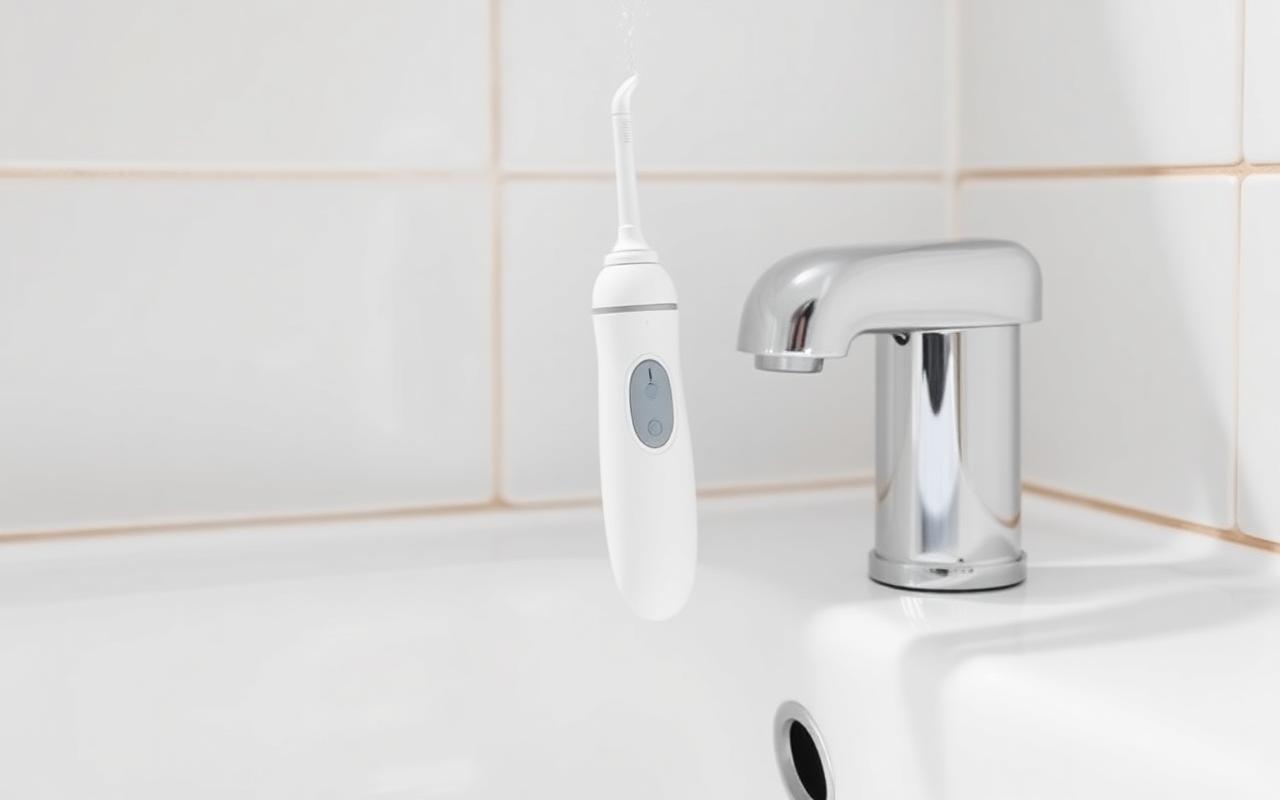
Splash-free beginner technique
- Fill with lukewarm water. Cold water triggers sudden tooth sensitivity. Warm is more comfortable.
- Lean over the sink with your mouth closed around the tip before turning it on. This is the single change that eliminates bathroom splashes.
- Aim the nozzle at a 90-degree angle to the gumline.
- Turn on the softest setting first, and only step up after a week of comfort.
- Move systematically: start at the back top molar, glide along the gumline pausing briefly on each tooth, then move to the front and around to the other side. Repeat on the bottom.
- Let water drain out naturally through slightly parted lips into the sink.
- Turn off before removing. Removing while running is what sprays the mirror.
Additions that make a real difference
- Add mouthwash to the reservoir once a week (alcohol-free formulas only; alcohol-based rinses degrade the pump seals).
- Warm salt water in the tank helps calm inflamed gums during the first two weeks.
- Replace the tip every 3 to 6 months. Nozzles wear like toothbrush heads.
- Empty and air-dry the reservoir weekly to prevent biofilm growth inside the tank.
What a water flosser does and does not replace
- Does: replace string flossing for most people with healthy gums, orthodontic patients (braces, aligners), implant users, and anyone with dexterity issues.
- Does not: replace brushing. Bristle abrasion is still what physically removes plaque from tooth surfaces.
- Does not: replace professional cleanings. Tartar (hardened plaque) can only be removed with dental scaling.
Common mistakes
- Starting on maximum pressure. Guaranteed to bleed and put you off the habit.
- Turning it on before closing your lips around the tip. Sprays the mirror.
- Using it as your only oral hygiene. Brush first, then floss.
- Refilling with mouthwash containing alcohol. Damages internal seals over months.
Bottom line
A cordless handheld water flosser with a real soft mode, three pressure settings, a 360-degree tip, and a 200-plus mL reservoir is the easiest daily flossing habit you will ever build. Lean over the sink, close your lips around the tip, and glide along the gumline. Expect noticeably less bleeding within one week.