Quick Answer
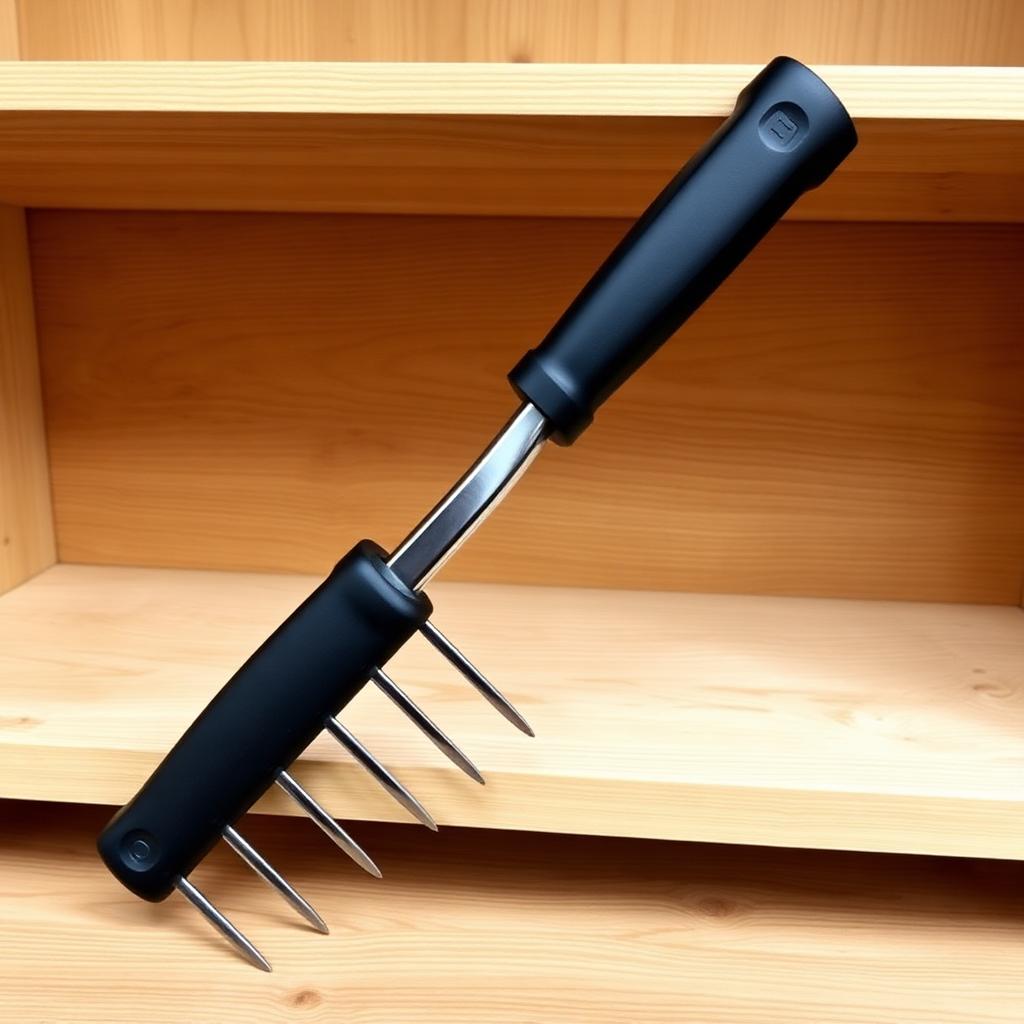
The best dematting rake for dense undercoats has curved safety-hook teeth with laser-sharpened internal serrations and an ergonomic thumb rest. The outer curve slides smoothly along the skin, so the hidden inner blades slice through the mat's weave instead of yanking hair out by the roots.
The rake is not a substitute for regular brushing. It is a rescue tool for a coat that got behind schedule, and it lets you save a mat without shaving to the skin.
Why a slicker brush cannot handle a dense mat
A mat is not a tangle. It is felted keratin: dead undercoat shed hair that has interwoven with living guard hairs, tightened by moisture, and compressed by movement into a dense, mesh-like clump. A slicker's fine pins ride over the surface and pull the whole mat sideways; the skin lifts with it, the dog yelps, and you stop.
A dematting rake works because it cuts. The curved teeth glide along the skin, and the serrated inner blades slice the felted mesh into thin sections that a comb can then finish off. You are dismantling the mat's structure, not fighting its grip on the skin.
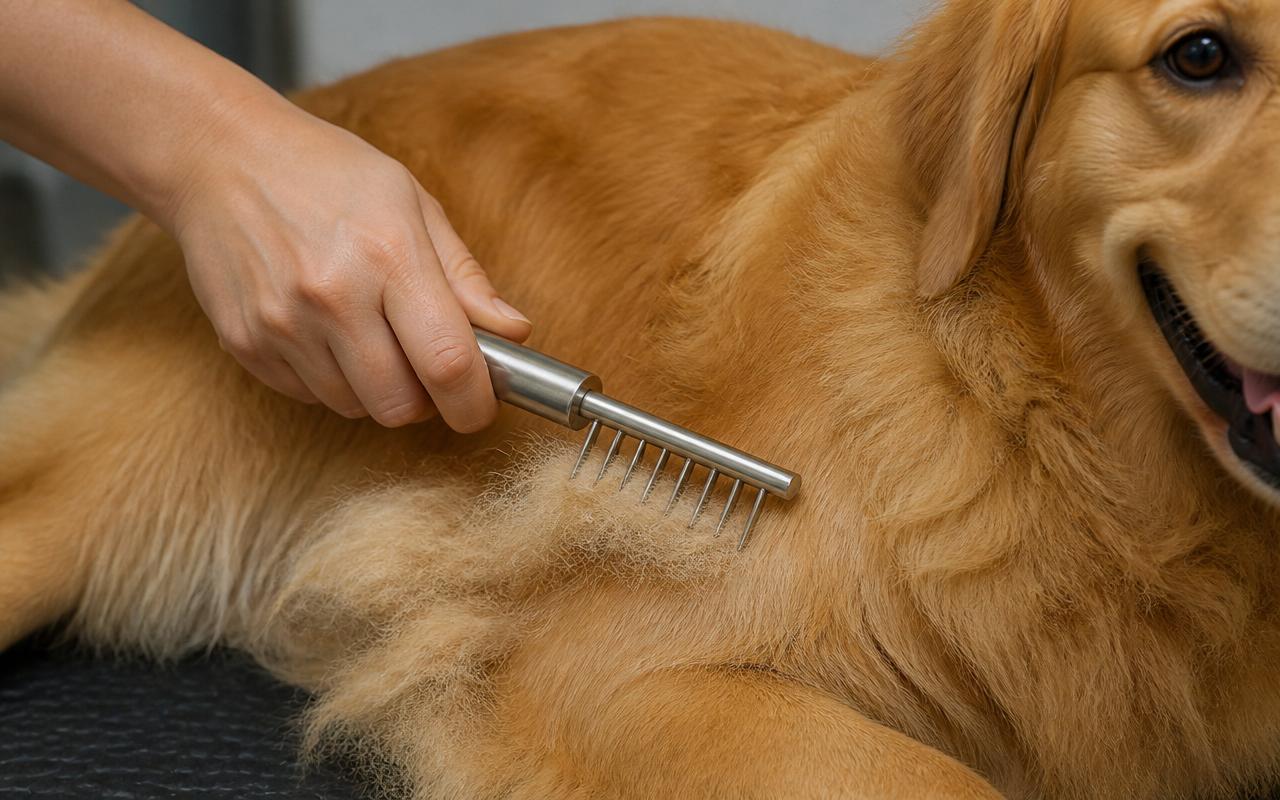
What a good dematting rake looks like
- Curved safety-hook teeth. Smooth outer curve along the skin; blades hidden on the inside.
- Laser-sharpened internal serrations. Slice on the pull stroke; do not tug.
- Six to ten teeth for most coats. Fewer teeth cut faster; more teeth thin more gently.
- Heavy ergonomic thumb rest. Leverage without slipping.
- Solid stainless steel head. Cheap chromed teeth bend on the second use.
- Left/right symmetrical if you switch hands. Groomers use both sides on flanks.
Step by step: safe dematting protocol
- Never demat a wet coat. Moisture tightens mats; dry the coat first.
- Spray a light detangling conditioner on the mat. Soften, do not soak.
- Isolate the mat between your fingers, close to the skin. This is the anchor; the dog does not feel the pull if you hold the base.
- Slide the rake from the outside of the mat toward the tip. One tooth-length at a time.
- Never pull toward the skin. Every stroke moves away from the body.
- Follow with a wide-tooth comb. Then a fine comb.
- Take breaks every five minutes. Both for the dog and for the mat's memory in your hand.
How to fit the rake to your dog
- Dense double coat (Golden, Newfie): a wider 10-blade rake covers the flanks faster.
- Curly coat (Doodle, Poodle): a 6-blade rake with slightly finer spacing splits tight mats without ripping curls.
- Cat or small dog: a pocket-sized rake with softer serrations; the skin is thinner and the mats are tighter.
- Neglected coat (deep, close-to-skin felt): stop and see a groomer. A shave is kinder than dematting a solid mat.
Common mistakes
- Pulling with the wrist through the mat like a hairbrush. The tool cuts on slide, not on force.
- Working through the mat without isolating it. The pull travels to the skin, and the dog remembers.
- Skipping the follow-up comb. Half-dematted knots re-form inside a week.
- Dematting a wet dog after a bath. Reset the felt tighter than before.
- Using a dematting rake as a daily brush. It thins the coat over time; use a slicker for daily upkeep.
Care and blade life
Wipe the rake with alcohol after every session; hair oil and skin lipids dull the internal blades. A tiny drop of light machine oil once a month on the pivot points keeps the teeth aligned. Store the rake with a blade guard; a bare stainless edge in a drawer bends its first tooth on impact with a comb.
Bottom line
A dematting rake with curved safety-hook teeth and laser-sharpened internal serrations is the right tool for a mat the slicker cannot fix. Isolate the mat, work away from skin, take breaks, and finish with a comb. Save it for rescue work; the real fix is a five-minute daily brush that keeps the mat from forming at all.