Quick Answer
Yes. During a Stellantis investor and turnaround presentation, head of American brands Tim Kuniskis officially confirmed that Jeep is reviving the Scrambler nameplate, and that it is being engineered as a dedicated SRT performance pickup rather than a trim package. The truck is built on a shortened Gladiator frame, sits as a two-door with a removable rear hardtop and front Freedom Panels, and includes rotating second-row jump seats that can face backward. The standard powerplant is locked in at the 6.4-liter 392 Hemi V8 with 470 horsepower, with the 550 horsepower Hurricane twin-turbo inline-six and a possible Hellcat-class supercharged V8 still under evaluation. Target market window is 2030.
The Quick History on the Scrambler Name
The original Jeep Scrambler (the CJ-8) ran from 1981 to 1985. It was a short-wheelbase, two-door, body-on-frame pickup based on the CJ-7, and it became a cult classic almost the moment Jeep killed it. Every concept revival since (the Gladiator-based JT show truck, the various Easter Jeep Safari one-offs) has been a wink at that nameplate without an actual production commitment.
This time the commitment is real. Kuniskis named the truck on stage to investors, and the program was framed as a deliberate part of the SRT turnaround story rather than as a marketing tease.
The Platform: Shortened Gladiator With SRT DNA
The Scrambler uses the Gladiator's body-on-frame architecture with a shortened wheelbase to recover the compact stance the original CJ-8 was known for. The chassis is being tuned by the SRT engineering group, which means the goal is a truck that can be driven aggressively on pavement, not just a lifted off-roader with badges.
| Feature | Detail |
|---|---|
| Body style | Two-door pickup, four seats |
| Base platform | Shortened Gladiator frame |
| Roof | Removable Freedom Panels front, removable hardtop rear |
| Rear seats | Rotating jump seats, optional rear-facing position |
| Suspension | Likely solid axle, IRS under evaluation |
| Target market window | 2030 |
Initial reporting from inside the preview event indicated that Jeep was targeting an independent front and rear suspension for the SRT trim. Kuniskis later walked that back, saying engineering is still working on packaging IRS without sacrificing the off-road clearance and articulation that Jeep buyers expect. Expect the production answer to land closer to the proven solid-axle setup with SRT-spec damping rather than a full IRS conversion.
The Design Cues
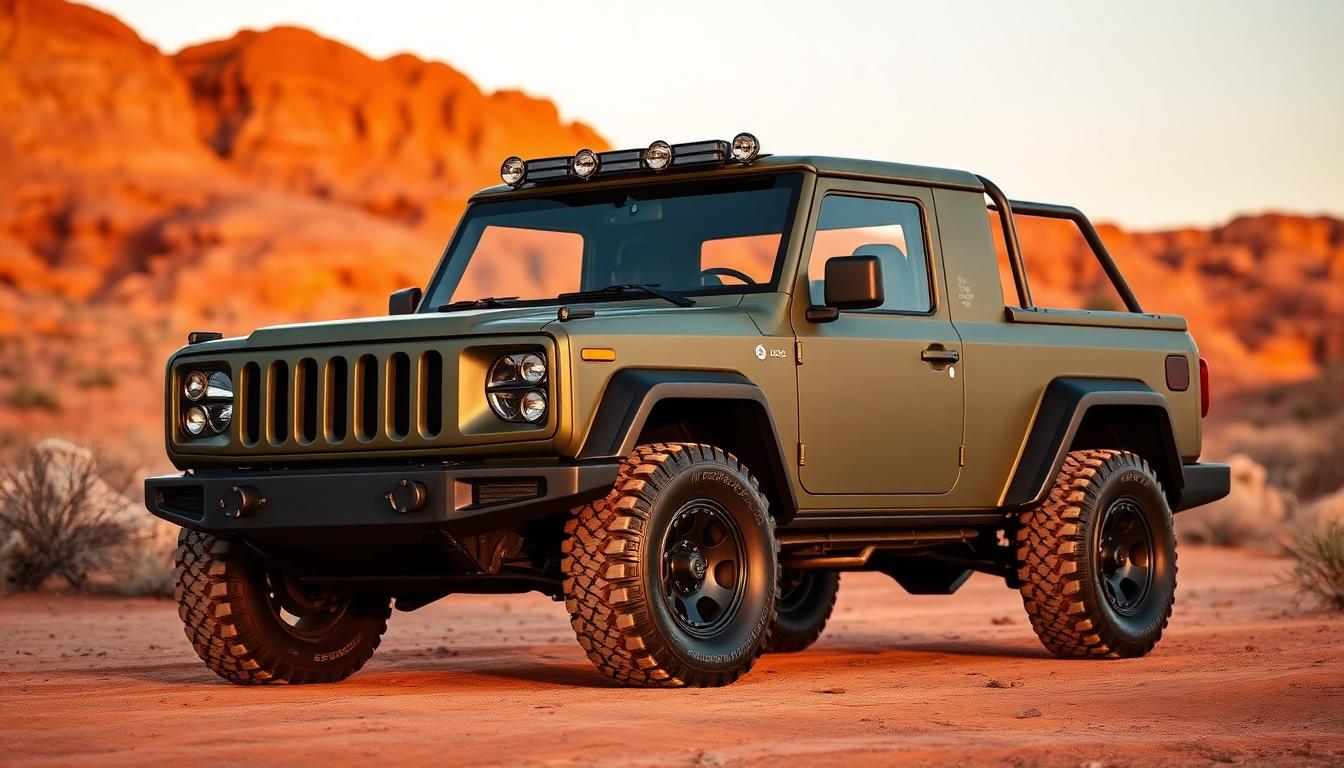
The visual brief borrows from two Easter Jeep Safari concepts: the shark-nosed Convoy and the boxy, military-inspired Anvil 715. The result is an aggressive, retro-tactical front end with squarish headlights, a forward-canted hood line, a functional hood scoop that feeds the engine bay, and short overhangs front and rear.
The roof is the headline. Front Freedom Panels pop off the way they do on a Wrangler. The rear hardtop shell over the cab and bed can be removed entirely, turning the truck into a true open-air vehicle. The rear jump seats then become genuinely usable, and Jeep is engineering them to rotate so passengers can ride facing backward with the roof off (a direct callback to the Subaru BRAT and K5 Blazer era of utility-truck weirdness).
The Powertrain Question
The engine bay is the most interesting open question. Kuniskis confirmed that the standard Gladiator line is officially getting the 6.4-liter 392 Hemi V8, which makes that engine the obvious base for the Scrambler SRT.
| Engine | Output | Likelihood |
|---|---|---|
| 6.4L 392 Apache Hemi V8 | 470 hp, 470 lb-ft | Confirmed for the Gladiator line, base for the Scrambler SRT |
| 3.0L Hurricane twin-turbo I6 (high output) | About 550 hp | Likely as a more efficient performance option |
| 6.2L supercharged Hellcat V8 | 700+ hp | Possible halo trim, not yet confirmed |
The supercharged option is the dream scenario for enthusiasts and the operational nightmare for product planners (emissions, packaging, transmission durability, brake sizing). It would also be the loudest possible signal that SRT is back to building halo products rather than chasing CAFE math.
What This Means for the SRT Lineup
The Scrambler is the sharpest spike, but it is part of a broader SRT relaunch. Kuniskis also confirmed that the Grand Cherokee and Grand Wagoneer are getting dedicated SRT variants, which effectively revives the Trackhawk concept of stuffing serious performance into a family-sized Jeep. Combined with the Charger SRT refresh on the Dodge side, the message is consistent: Stellantis is electrifying where it has to and going harder on combustion where the margins still are.
For Jeep specifically, this matters because SRT had quietly disappeared from the brand over the last few years. Bringing it back with three distinct vehicles (Scrambler, Grand Cherokee, Grand Wagoneer) gives dealers a real high-margin halo lineup again.
The Production Realities
The Scrambler will share manufacturing space at the Toledo Assembly plant, which is where every modern Wrangler and Gladiator has been built. A 2030 target window gives Jeep four model years to finalize suspension architecture, certify the powertrain options, and protect the off-road credentials that the Wrangler base loyalists will demand from a Jeep-badged truck. Expect a concept reveal at the Easter Jeep Safari one or two springs before launch, with a near-production show car the year after.
The Bottom Line
The Jeep Scrambler SRT is officially coming back. Two doors, four seats, removable roof, rotating rear-facing jump seats, a 470 horsepower 392 Hemi as the confirmed base engine, and a real shot at adding the 550 horsepower Hurricane inline-six or a Hellcat-class supercharged V8 as the lineup grows. Target window is 2030, production lives at Toledo, and it is the headline product in a broader SRT revival that also brings back hot Grand Cherokee and Grand Wagoneer variants. The era of Jeep performance trucks is not over. It is restarting.