
Quick Answer
To winterize an outdoor faucet, disconnect and drain the garden hose, then close the indoor shutoff valve that feeds the faucet.
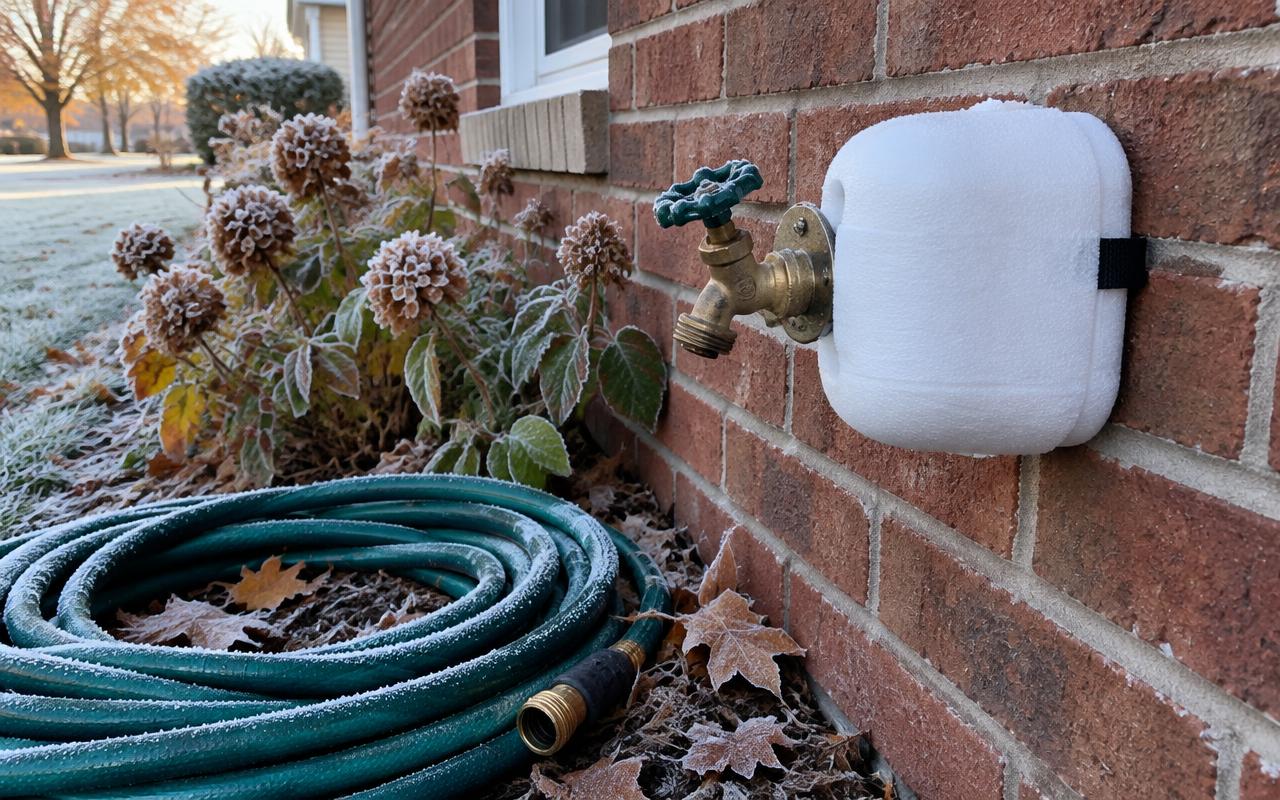
Open the outdoor faucet to let the water in the line drain out, and leave it open for the winter. Add an insulated foam faucet cover for extra protection.
Do this before the first hard freeze, when temperatures drop into the 20s F. A frozen line can burst and leak inside your walls.
Why Do Outdoor Faucets Burst?
Water expands as it freezes. When water trapped in an outdoor faucet or pipe freezes, it builds pressure that can split the pipe.
The crack often happens inside the wall, where you cannot see it. You may not notice until spring, when you turn the water on and it floods a basement or crawl space.
What Supplies Do You Need?
- Insulated foam faucet covers
- A bucket and towel
- Pipe insulation sleeves for exposed indoor pipes
- A flashlight to find the shutoff valve
- An adjustable wrench, if valves are stiff
How Do You Winterize an Outdoor Faucet, Step by Step?
1. Disconnect the hose. Remove the garden hose, splitters and timers. A hose left attached traps water in the faucet, even on frost free models.
2. Drain and store the hose. Stretch it out on a slope to drain, coil it and store it in a garage or shed.
3. Find the indoor shutoff valve. Look in the basement, crawl space or utility room on the wall behind the outdoor faucet.
4. Close the valve. Turn the handle clockwise until it stops, or turn a lever a quarter turn so it is crosswise to the pipe.
5. Open the outdoor faucet. Let the trapped water drain outside. Leave it open all winter so any remaining water can expand.
6. Open the drain cap. Some shutoff valves have a small bleeder cap. Place a bucket underneath and open it to drain the last water, then close it.
7. Cover the faucet. Fit an insulated foam cover over the faucet and tighten its strap or loop.

What Is a Frost Free Faucet?
A frost free faucet, also called a frost free sillcock, has a long stem that places the actual valve inside the warm house. When you shut it off, water drains out of the part that sits in the cold wall.
They are very effective, but only if the hose is removed. An attached hose keeps water in the stem, which can freeze and crack it.
You can spot one by its long body that extends into the wall and a faucet that tilts slightly downward to drain.
What If You Cannot Find a Shutoff Valve?
Some older homes have no separate valve for outdoor faucets. In that case:
- Disconnect hoses and use an insulated cover.
- On very cold nights, let the faucet drip slightly if it is not frost free.
- Consider having a plumber install a shutoff valve or a frost free faucet.
How Do You Protect Other Pipes From Freezing?
The Red Cross recommends several steps for preventing frozen pipes:
- Drain water from swimming pool and sprinkler supply lines as directed by the manufacturer or installer.
- Insulate pipes in unheated areas like garages, attics and crawl spaces.
- Keep garage doors closed if water lines run through the garage.
- Open kitchen and bathroom cabinet doors on cold nights so warm air reaches the pipes.
- Let cold water drip from a faucet served by exposed pipes during extreme cold.
- Keep the thermostat at the same temperature day and night.
What Should You Do If an Outdoor Faucet Freezes?
If no water comes out, the line may be frozen. Open the faucet, then warm the pipe gently with a hair dryer, a heating pad or towels soaked in hot water.
Never use an open flame, propane torch or charcoal heater. If you cannot reach the frozen section, or water leaks when it thaws, shut off the water and call a plumber.
How Do You Know a Faucet Pipe Burst?
- Water leaking inside near the outdoor wall when you turn the faucet on
- Low or no water flow from the outdoor faucet in spring
- Damp drywall, stains or puddles near the faucet
- A sudden jump in your water bill
Test the faucet in spring with the hose off and watch inside for leaks before reconnecting.
How Do You Winterize a Sprinkler System?
Irrigation systems need their own shutdown, usually by closing the main valve and draining or blowing out the lines with compressed air. Follow the manufacturer's directions, or hire a pro for a blowout, since too much air pressure can damage parts.
When Should You Winterize?
Do it after your last outdoor watering and before nights drop into the 20s F. In northern states, that is often October. In milder areas, it may be November or December.
How Do You Turn Faucets Back On in Spring?
Once the risk of hard freezes has passed, close the outdoor faucet, open the indoor valve slowly and check for leaks inside. Then open the outdoor faucet and let it run briefly.
How Much Does a Burst Outdoor Pipe Cost?
Repairs vary widely. Replacing a single faucet can be fairly modest, but leaks inside walls can lead to drywall, flooring and mold repairs that cost far more. A few dollars of foam covers and a few minutes of work are cheap insurance.
Frequently Asked Questions
Do I need a faucet cover on a frost free faucet?
It is not required, but it adds protection in very cold climates.
Should I leave the outdoor faucet open in winter?
Yes, after closing the indoor valve, so water can drain.
At what temperature do outdoor pipes freeze?
Risk rises when temperatures drop into the 20s F or below.
Can I leave my hose connected if it is short?
No. Any attached hose can trap water.
The Bottom Line
Disconnect hoses, close the indoor shutoff valve, drain the line and leave the outdoor faucet open, then add a foam cover.
Ten minutes of prep before the first hard freeze can prevent a burst pipe and costly water damage.