Quick Answer
A Club Car serial number is a 12 character code like AQ0624-543211. The first two letters identify the model (AQ is a Precedent electric, A is a DS electric). The next two digits are the model year (06 means 2006). The next two are the week of production (24 means week 24). The final six digits are the unit sequence number for that week.
Find the code, split it into three chunks, and the cart tells me exactly what it is.
Where Club Car puts the serial sticker
The location moved a few times over the years. I check these spots in order:
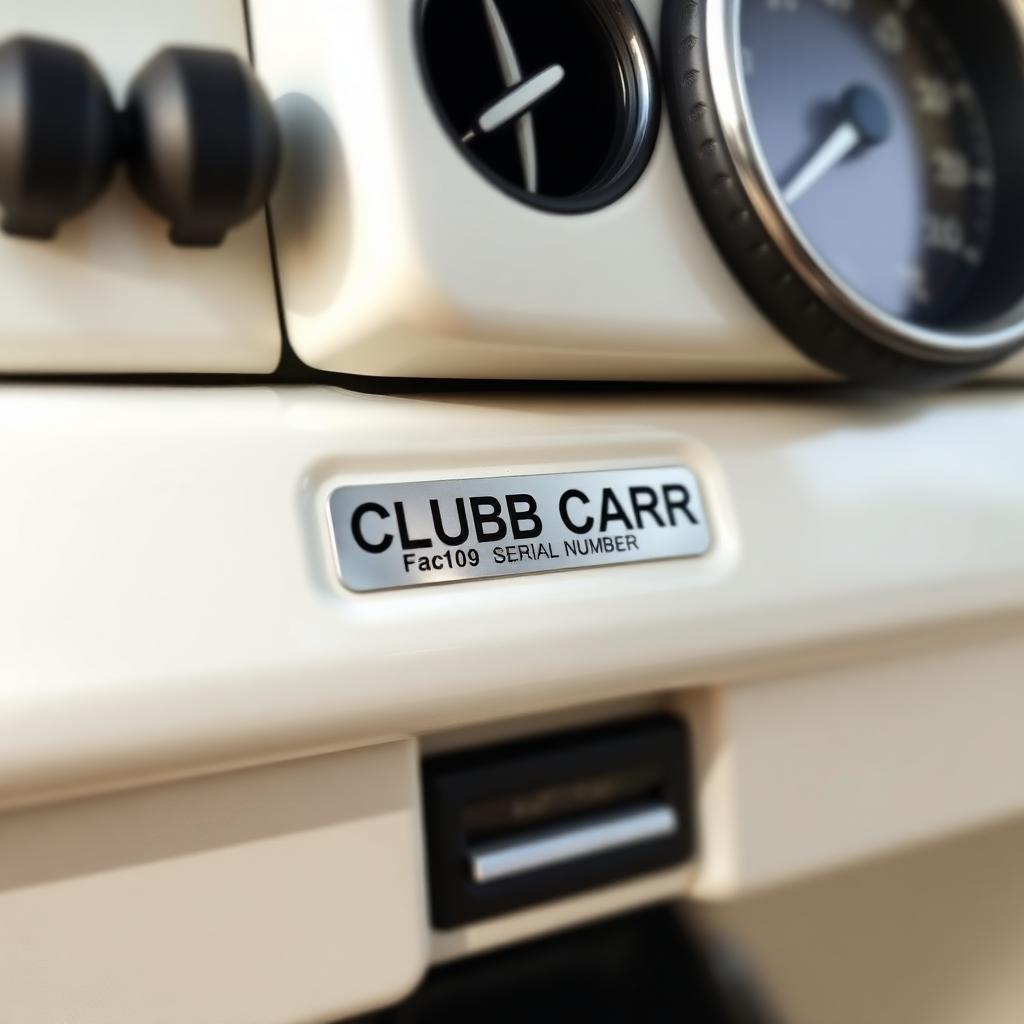
- Club Car DS (1981 to early 2002): Under the passenger side glove box, on the lower edge of the dash. Look for a small silver foil sticker or a riveted aluminum plate.
- Club Car DS (late 2002 to present): Stamped on the frame just above the accelerator and brake pedal, beneath the floorboard trim.
- Club Car Precedent, Onward, Tempo (2004 to present): Inside the passenger side dash bin, or on the lower body panel directly behind the driver seat opening.
- Carryall utility models: Inside the cargo bed near the front lip, or on the frame rail behind the seat.
If the original sticker is gone, the bare frame stamp is the fallback. It is usually on the front cross member next to the battery tray.
Breaking the code apart
The 12 character code AQ0624-543211 splits like this:
- AQ - model family. AQ is the Precedent electric.
- 06 - model year (2006).
- 24 - production week (week 24, mid June).
- 543211 - the sequence number for that week.
So this cart is a 2006 Precedent electric built in week 24 of 2006.
Model prefix reference
- A or AA: Club Car DS, 36V or 48V electric.
- AG or PG: Club Car DS with a Kawasaki gas engine.
- AQ or PQ: Club Car Precedent with the IQ 48V electric system.
- PR: Club Car Precedent with an EFI Subaru gas engine.
- BO: Club Car Onward electric.
- JE or JG: Club Car Tempo electric or gas.
- AU or PU: Carryall utility models.
Why the year matters for parts
Club Car made running changes mid year on almost every model. The DS controller switched from a resistor coil setup to a solid state PDS controller in 1995. The Precedent moved from an OBC charger to a Delta Q in 2008. Ordering a charger, controller, or motor without the exact build year is how I end up with the wrong part on my workbench.
Cross checking with the battery
If the body sticker is faded, the original battery tray often has a second smaller production tag. The tag may include the same serial number, the original battery type (Trojan T-105, US Battery 2200, etc.), and the controller serial.
Common decoding mistakes
- Confusing the dash (the hyphen in AQ0624-543211) with a digit. It is just a separator.
- Reading the year backward. Year codes are always the third and fourth characters, never the last two.
- Assuming an A prefix means a brand new DS. Earlier 1980s carts also start with A. The two digit year fixes the ambiguity.
- Mistaking the unit sequence number for a build date. The final six digits track production volume, not time.
What the serial unlocks
Once I have the year and model, I can:
- Order the correct lift kit (front bracket shapes changed in 2009 on the Precedent).
- Match the right controller model from Curtis or Delta Q.
- Pick the right charger plug (round 3 pin Powerwise for older DS, square Delta Q for newer Precedent).
- Identify whether the cart is regen capable, which dictates which speed and torque mods are worthwhile.
Verifying with the Club Car dealer system
Any authorized Club Car dealer can punch the full 12 character serial into their internal parts system and pull up the original equipment list (motor, controller, suspension, body color, even the original owner if it was a fleet cart). That is useful when a used cart has been retrofitted and I want to know what came stock.
Pro tips
- Photograph the serial sticker before doing any restoration. Stickers get destroyed during paint and body work.
- If buying a used cart, write the serial on the bill of sale. It is the title equivalent for many states.
- For a frame stamp that is hard to read, lightly rub chalk across it. The contrast makes the digits jump out.
The takeaway
Every Club Car carries a 12 character serial that tells me the model, the exact year, and the production week. Find it on the dash, the kick panel, or the body, split it into chunks of two plus two plus six, and the cart's identity is no longer a mystery. That ten seconds of decoding saves me from buying the wrong parts.