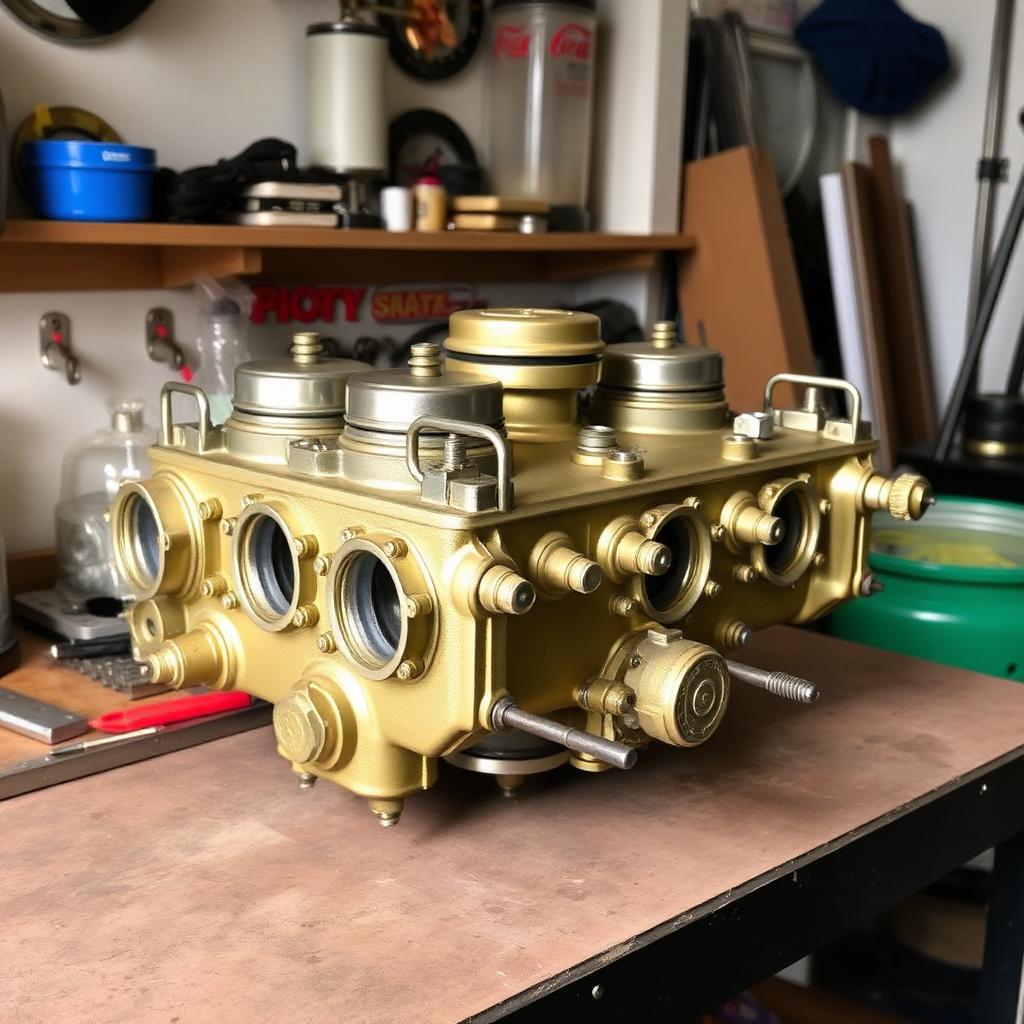
Quick Answer
To tune a Rochester Quadrajet, I confirm the engine is mechanically healthy, set fuel pressure between 4 and 6 PSI, seat the two front idle mixture screws then back them out 2.5 turns each as a baseline, tune for peak manifold vacuum at warm idle, and finish by setting the secondary air valve spring tension to roughly 3/4 to 7/8 of a turn from closed.
The Quadrajet is a spread bore four barrel with tiny primaries for fuel economy and very large vacuum delayed mechanical secondaries for full throttle airflow. Tuning is mostly about discipline: do not try to fix a vacuum leak, weak ignition, or bad fuel pump with a mixture screw.
If I work the steps in order, a healthy Q jet idles smooth, transitions cleanly, and opens its secondaries without a bog.
Step 1: Pre tune the engine, not the carburetor
Before I touch a single screw, I verify the underlying engine is sound. Most Q jet complaints trace back to vacuum leaks, weak ignition, or fuel pressure problems rather than the carburetor itself.
- Check fuel pressure at the inlet. The Quadrajet needle and seat are designed for 4 to 6 PSI. Anything above 6.5 PSI will lift the needle and flood the bowl.
- Spray carb cleaner around the throttle shaft bushings and base gasket. A rising idle confirms a vacuum leak that must be fixed before tuning.
- Set base ignition timing per the factory specification (typically 6 to 12 degrees BTDC at idle with the vacuum advance disconnected and plugged).
- Confirm the choke is fully open at operating temperature. A partially closed choke skews every mixture reading.
Step 2: Baseline the idle mixture screws
The two brass needles at the front of the throttle body meter fuel into the idle circuit. I always start from a known baseline.
- With the engine off, turn each screw clockwise until it lightly seats. Do not force it. Forcing the needle will score the seat and ruin the casting.
- Back each screw out exactly 2.5 turns counterclockwise. This is the factory safe starting point for almost every Q jet application.
Step 3: Tune for peak manifold vacuum
Now I bring the engine to full operating temperature so the choke is open and the fast idle cam is off the screw. I connect a mechanical vacuum gauge to a manifold (not ported) vacuum source.
- Turn one mixture screw 1/4 turn at a time and watch the gauge. Stop when vacuum stops climbing.
- Repeat on the second screw. Adjust both in small steps until I find the highest steady reading.
- Once peak vacuum is set, turn each screw out an additional 1/8 turn. This gives a slightly richer cushion that prevents a lean roll on cold mornings.
- Reset curb idle speed with the dedicated idle speed screw on the throttle linkage, not by chasing it with the mixture screws.
Step 4: Verify the accelerator pump shot
A correct pump shot eliminates the off idle stumble that gets blamed on the secondaries. With the engine off and the air cleaner removed, I look down the primaries and snap the throttle open by hand. I should see a clean, immediate stream of fuel from both pump nozzles.
- If the shot is weak or delayed, the accelerator pump plunger cup is hardened or the pump arm is on the wrong adjustment hole.
- The pump arm has multiple holes for cold and warm climates. The inner hole gives a longer stroke for cold weather, the outer hole shortens stroke for hot climates.
Step 5: Set the secondary air valve spring tension
This is the adjustment that separates a Q jet that pulls hard from one that bogs. The big air valve flap at the top of the air horn is held closed by a small clock spring. Too tight and the secondaries feel sluggish, too loose and the engine falls on its face under wide open throttle.
- Find the small hex locking set screw on the passenger side of the air horn casting. Loosen it with a 3/32 inch Allen wrench.
- Insert a small flathead screwdriver into the adjacent slotted adjustment screw. Turn it counterclockwise until the air valve flap flops completely open with no spring tension.
- Now turn the slotted screw clockwise until the flap just closes against its stop.
- From that closed point, turn the screw an additional 3/4 to 7/8 turn clockwise. This is the factory baseline wind up for most stock applications.
- Hold the slotted screw steady and re tighten the hex locking set screw to lock the spring tension in place.
If a road test still shows a bog when the secondaries open, I add 1/8 turn of tension at a time until the bog disappears. If the engine feels lazy under full throttle, I back off 1/8 turn at a time.
Step 6: Set the secondary metering rod hangers
The hanger letter (B, M, N, P, Q, R, S, T) controls how soon the secondary metering rods lift out of the jets. A lower letter (B) holds the rods down longer for a leaner pull, a higher letter (T) lifts them sooner for a richer pull. For most stock engines the factory hanger is correct. If I change the cam or intake, I usually move one letter at a time and read the spark plugs after a sustained wide open throttle pass.
Step 7: Confirm the float level
The float level controls the fuel height in the bowl, which in turn affects every circuit. With the air horn off, the typical Q jet float spec is 7/16 inch from the air horn gasket surface to the toe of the float, but the exact number varies by part number. I always look up the spec for my specific casting before bending the float tang.
Common tuning mistakes to avoid
- Cranking the mixture screws all the way out hoping for more power. The idle circuit only feeds the engine below about 1,200 RPM. Beyond that, the main and secondary circuits take over and the mixture screws do nothing.
- Tuning at cold idle on the fast idle cam. Every reading is wrong until the choke is fully open.
- Spraying brake cleaner near the throttle shaft to chase a leak. Use carb cleaner only. Brake cleaner attacks the o rings on the secondary metering rods.
- Replacing the carburetor when the real problem is a cracked vacuum hose, a leaking power brake booster, or a failing ignition module.
The takeaway
A Rochester Quadrajet is not a Quadrajunk. It is a precision instrument that rewards a patient, methodical tune. I fix the engine first, baseline the screws, tune for peak vacuum, then dial in the secondary air valve spring. Done in that order, a Q jet delivers crisp throttle response, real fuel economy on the primaries, and a satisfying induction roar when the secondaries finally fly open.