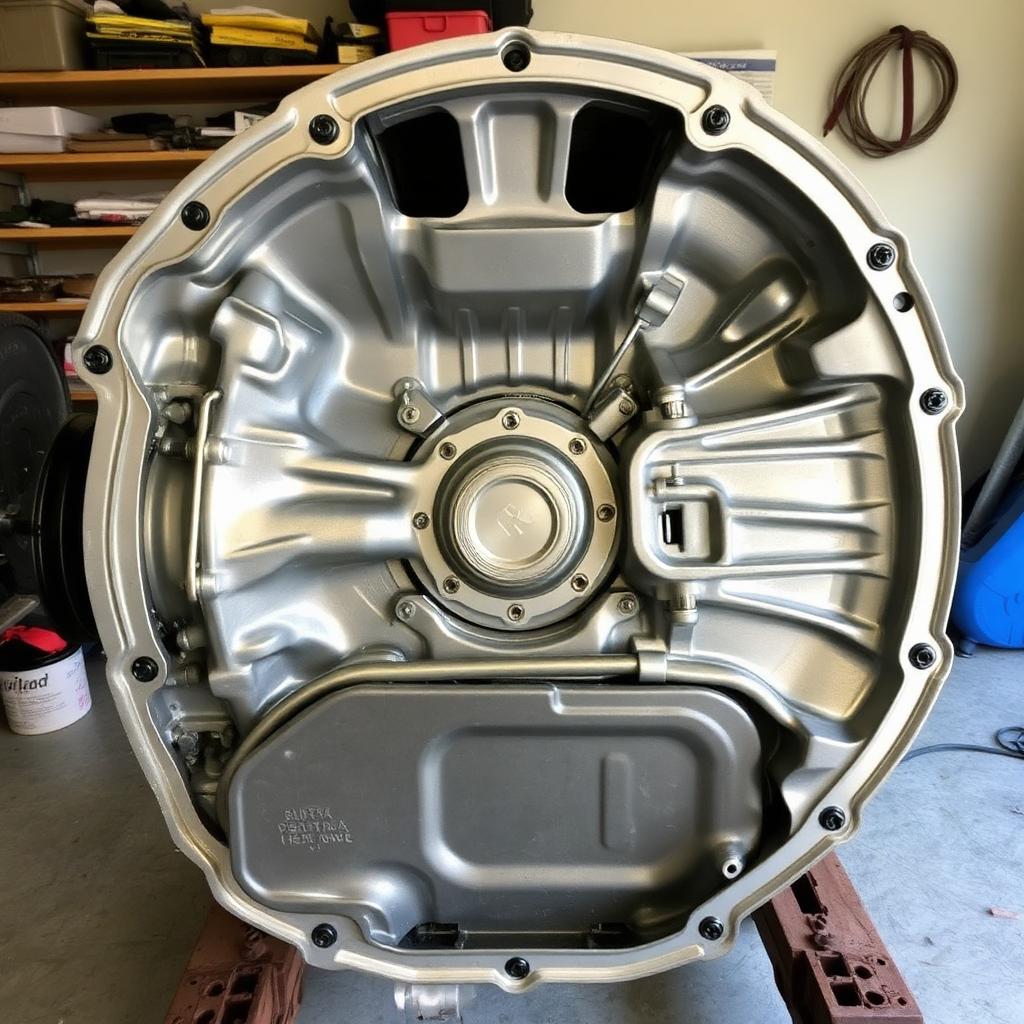
Quick Answer
The fastest way to identify a Chevy automatic transmission is to look at the bottom oil pan. Powerglide has a 14 bolt rectangular pan. TH350 has a 13 bolt square pan with one corner cut off. TH400 has a 13 bolt irregular pan shaped like the state of Nevada. 700R4 and 4L60E share a 16 bolt rectangular pan. 4L80E has a 17 bolt elongated oval pan.
To separate the 700R4 from the 4L60E (same pan), look for a TV (throttle valve) cable at the driver side of the case. The 700R4 has a mechanical TV cable. The 4L60E has a 20 pin electrical connector instead because shifts are controlled by the engine computer.
Step 1: Count the pan bolts and read the shape
The bottom oil pan is the easiest identifier because I can read it without removing anything. I count the bolts and compare the outline to the chart below.
- Powerglide (1962 to 1973): 14 bolts, narrow rectangular pan, two speed automatic.
- TH350 (1969 to 1984): 13 bolts, square pan with the rear passenger corner cut at an angle.
- TH400 (1964 to 1990): 13 bolts, irregular pan with a long passenger side and a notched driver side. Looks like the outline of Nevada.
- 700R4 (1982 to 1992): 16 bolts, clean rectangular pan, four speed with overdrive.
- 4L60E (1993 to 2005, light duty through 2014): 16 bolts, identical rectangular pan to the 700R4.
- 4L80E (1991 to 2013): 17 bolts, long oval rectangular pan with a center indentation.
- 6L80 / 6L90 (2006 plus): No removable service pan. The filter is internal. If the case has no pan bolts at all and runs the length of the trans, I am probably looking at a 6L80 or 6L90.
Step 2: Separate the 700R4 from the 4L60E
This is the most common identification mistake because the pans are identical. The case features tell the real story.
- 700R4: Has a small mechanical TV (throttle valve) cable that exits the driver side of the case and routes up to the carburetor. No large electrical connector on the case.
- 4L60E (1993 to 1997): Has a 13 pin square electrical connector on the passenger side of the case. No TV cable.
- 4L60E (1998 to 2014): Has a 20 pin oval electrical connector on the passenger side. Many versions also have a removable bellhousing (PWM 4L60E) that bolts on with six bolts.
If the case has both a TV cable and an electrical connector, I am looking at a 4L60 (non electronic version, 1990 to 1992) which is a transitional design between the 700R4 and the 4L60E.
Step 3: Read the case ID tag or stamping
Every GM transmission has a model ID stamped or tagged on the case. The location varies:
- TH350 and TH400: Vertical metal tag riveted to the passenger side servo cover. Reads model code, build date, and source plant.
- 700R4: Stamped pad on the driver side of the case above the pan rail. Code starts with letters that decode the model year and application.
- 4L60E and 4L80E: Stamped pad on the passenger side of the case. The first letter is the assembly plant, followed by the build date and serial.
I cross reference the stamping against GM transmission decode tables (the most authoritative is the Hydra Matic / Powertrain Identification Guide). The tag tells me model year, original vehicle application, and gear ratio set.
Step 4: Count the gears and check the tail housing
If the pan is hidden by a skid plate or the tag is missing, I can still narrow things down by counting forward gears and reading the tail housing length.
- Two forward gears: Powerglide.
- Three forward gears with a short tail: TH350.
- Three forward gears with a long tail and a heavier case: TH400.
- Four forward gears with overdrive and a TV cable: 700R4.
- Four forward gears with overdrive and electronic control: 4L60E or 4L80E.
- 4L60E vs 4L80E case: The 4L80E is noticeably larger and heavier (about 236 pounds vs 150 pounds for the 4L60E). The 4L80E also has the 17 bolt oval pan.
Application use cases
- Stock small block restorations: TH350 (1969 to 1984) or 700R4 (1982 to 1992).
- Big block muscle cars and heavy duty trucks: TH400 (1965 to 1990).
- 1990s and early 2000s LS trucks and SUVs: 4L60E (light duty) or 4L80E (heavy duty 2500 and 3500 series).
- Modern LS swap with electronic control: 4L60E or 4L80E paired to a standalone TCU like the US Shift Quick 4 or Compushift.
Common identification traps
- A 4L60E and a 700R4 share the same bellhousing pattern and pan, so a swap meet seller can easily mislabel one as the other. Always look for the TV cable vs the electrical connector.
- A 4L80E uses the same case family as the older TH400, which leads people to call it a TH400E. That is wrong. The 4L80E has overdrive, a lock up converter, and electronic control. The TH400 has none of those.
- The 6L80 and 6L90 do not have a service pan. If I cannot find pan bolts, I am probably looking at one of those modern six speeds or a 4L70E with a different pan style.
The takeaway
Pan shape and bolt count narrow a Chevy transmission to a family in under a minute. The case features (TV cable vs electrical connector, tail length, bellhousing bolt pattern) separate the models within the family. The stamped ID tag confirms the exact application. Use the visual chart first, validate with the tag second, and I will never load the wrong torque converter or wiring harness into a project car again.