Quick Answer
The best air purifiers for a bedroom in 2026 are the Coway AP-1512HH Mighty (about $180 to $210) for a proven True HEPA workhorse with a real 233 CFM smoke CADR and quiet sleep mode, the Blueair Blue Pure 311i Max (about $250 to $300) for a smart auto mode with a laser particle sensor and a whisper-quiet HEPASilent design, and the Levoit Core 300S (about $130 to $160) for the best small-bedroom smart pick under $160.
A bedroom purifier is not a gadget. It is what makes an eight-hour breath cycle allergen-free while you sleep.
Match the CADR to your square footage. Undersized units run at max fan speed all night and still miss the 5 air changes per hour target.
Why bedroom air is worse than you think
Modern homes are sealed for HVAC efficiency, which means the pollen, pet dander, dust mite waste, mold spores, and off-gassing chemicals from furniture and paint all recirculate in the same air you breathe while you sleep. That triggers low-grade nasal inflammation, morning congestion, and disrupted deep sleep. A HEPA filter running quietly at your bedside is one of the cheapest health upgrades I have made in a decade.
The three specs that actually matter
- True HEPA (H13) filter. Captures 99.97 percent of particles at 0.3 microns. Avoid anything labeled "HEPA-type" or "HEPA-like," which are unrated and let fine dust through.
- CADR sized to your room. Multiply your room square footage by 0.66 to get the minimum smoke CADR (in CFM) you need to hit 5 air changes per hour. A 200 sq ft bedroom needs about 132 CFM minimum.
- Sleep-mode decibels. Anything over 30 dB on the lowest fan setting will keep light sleepers awake. The Blueair, Levoit, and Coway picks all sit in the 22 to 25 dB range.
Best overall: Coway AP-1512HH Mighty
The Coway Mighty is the purifier I recommend to most people because it has been on the market long enough that its reliability is not a guess. It uses a 4-stage system (mesh pre-filter, activated carbon, True HEPA, and an optional ionizer that you can leave off) and delivers a smoke CADR of 233 CFM, enough for rooms up to about 361 sq ft. On the lowest fan speed it registers around 24 dB, quieter than a whispered conversation.
An air-quality LED ring on top shifts from blue to purple to red as particle counts rise, and Auto Mode ramps the fan up or down automatically. It has no smart app, which some people count as a downside and others count as a feature. Filter costs run about $45 to $55 a year with the HEPA plus carbon replacement schedule.
Best smart bedroom pick: Blueair Blue Pure 311i Max
Blueair uses a patented HEPASilent design that combines mechanical filtration with a gentle electrostatic charge on incoming particles. Because charged dust clings to the filter more easily, Blueair can use an open-structure filter mat with less airflow resistance, which lets a lower-wattage fan push a strong 250 CFM CADR while running at just 23 dB in night mode.
The 311i Max has real-world useful smart features. A built-in laser particle counter feeds an Auto Mode that reacts to actual dust and dander events (opening a window, a pet jumping on the bed), and the Blueair app pairs cleanly with Alexa and Google Home for voice control. Filter costs are among the lowest in the category at about $39 to $49 per year.
Best small-bedroom smart pick: Levoit Core 300S
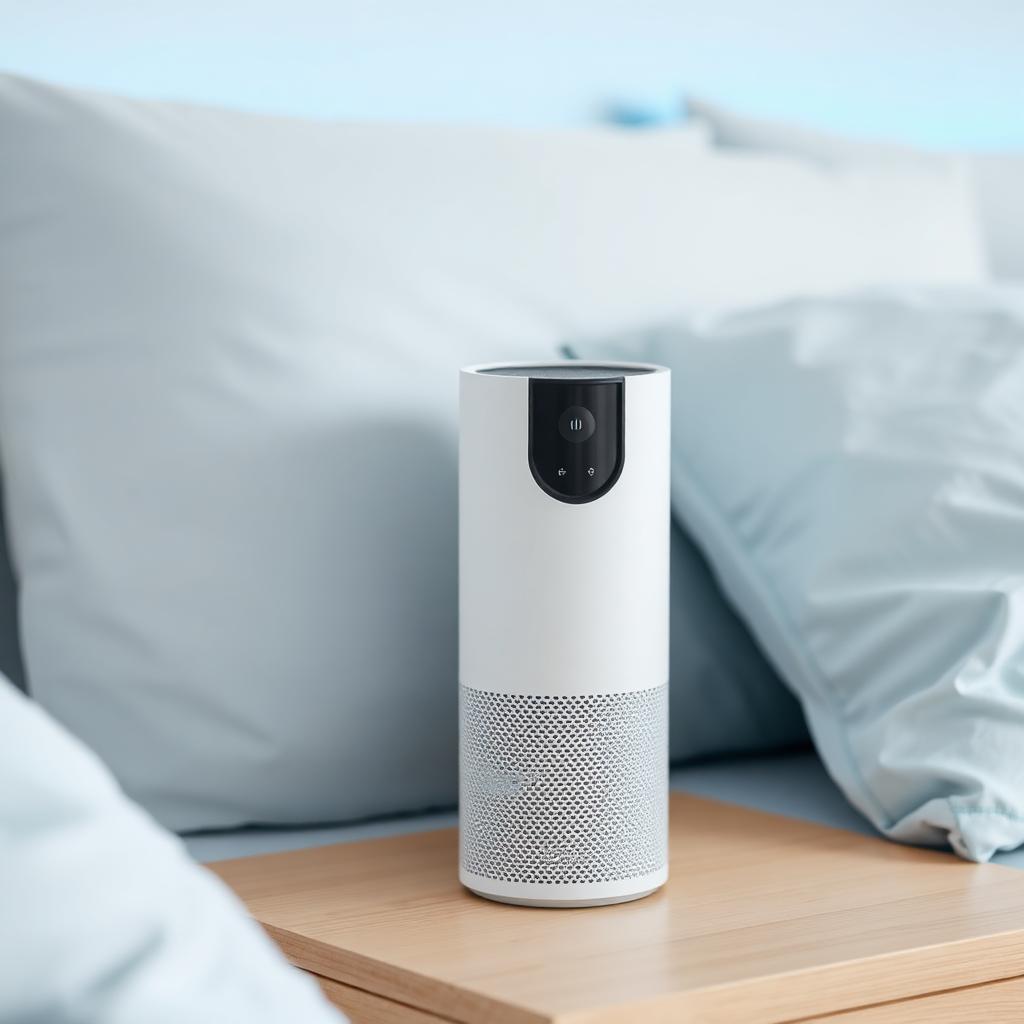
For a nursery, guest room, or a small bedroom under 220 sq ft, the Levoit Core 300S is my pick. It is a compact cylinder about the size of a large water bottle, delivers a 141 CFM CADR, and drops to 22 dB in sleep mode with all display lights off. The VeSync app lets you build a schedule that turns the display off and locks it into sleep mode at bedtime, and it integrates with Alexa and Google routines.
Replacement filters are cheap at about $25 to $32 a year, and the machine itself often sits in the $130 to $160 range. It is the smallest of these picks and works best in rooms under 250 sq ft.
Skip the Dyson for a bedroom
The Dyson Purifier Cool TP07 is a beautiful machine, but at $450 to $499 with a CADR near 100 CFM and a $75 to $85 annual filter cost, it is not the right buy for a purely bedroom-focused air cleaner. Dyson's strengths are its dual heater/fan role and its detailed app data. If you specifically want a heater/cooler/purifier hybrid, it is a fine luxury pick. If you only care about clean sleep, the Coway or Blueair are far better value.
Filter maintenance you cannot skip
A HEPA filter is a physical sieve. Once it is loaded with dust, airflow drops and the machine effectively stops cleaning even if the fan is still humming. Every purifier here has a filter-change indicator, but a good rule of thumb is HEPA every 6 to 12 months and the carbon layer every 3 to 6 months depending on how many pets, candles, or off-gassing new pieces of furniture the room sees. Set a phone reminder when you buy the unit.
How to size your room properly
Multiply your bedroom's square footage by 0.66 to get the minimum smoke CADR (in CFM) needed for 5 air changes per hour, which is the medical standard for allergy management. A 15 by 15 ft bedroom is 225 sq ft, which needs about 150 CFM CADR. The Levoit Core 300S clears this by a modest margin, the Blueair 311i Max and Coway Mighty clear it with headroom, which means both can run on their quieter mid-speed setting most of the time.
Bottom line
For most bedrooms, the Coway AP-1512HH Mighty is the buy: proven reliability, real CADR, quiet operation, and no app dependency. If you want automated air-quality tracking and voice-assistant integration, spend a little more on the Blueair Blue Pure 311i Max. And for a small bedroom or nursery, the Levoit Core 300S is the compact, cheap, smart choice. Whichever you pick, size the CADR to your room and change the filter on schedule.