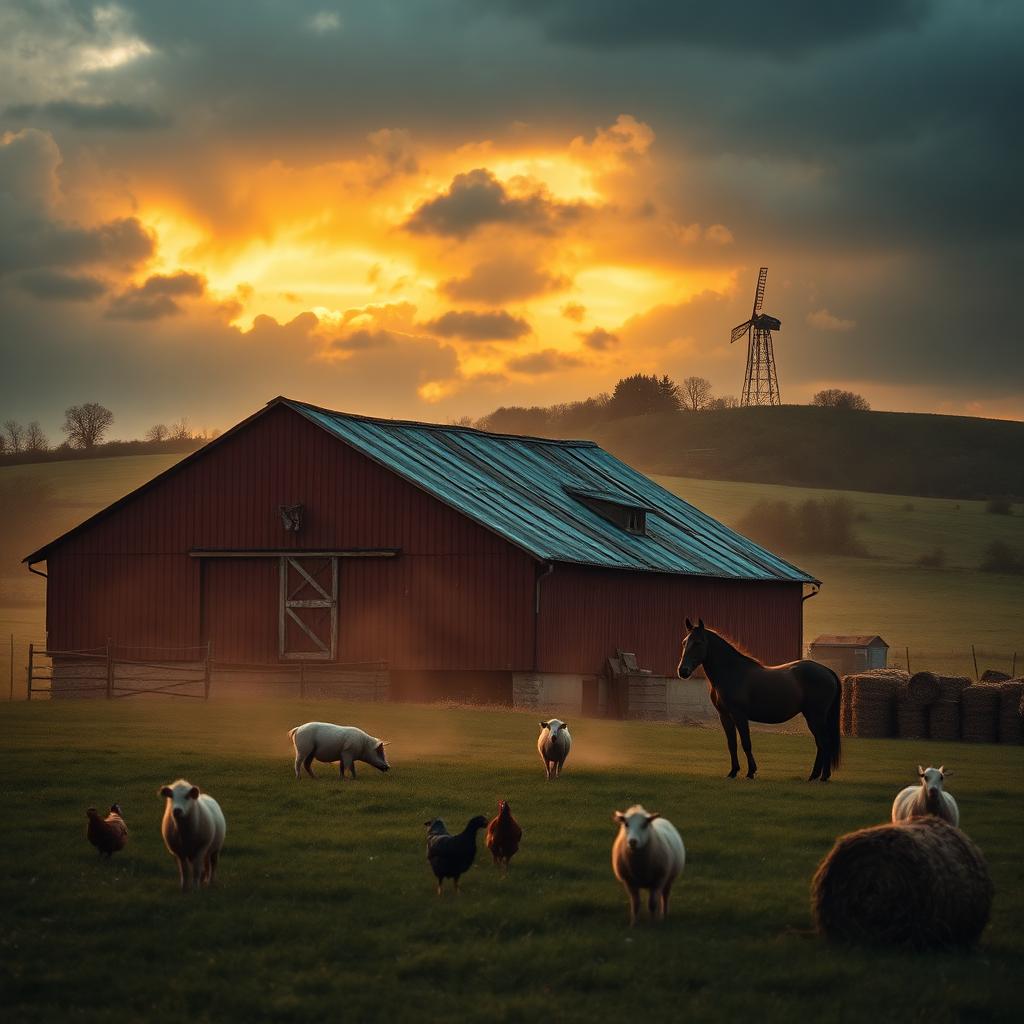
Disclaimer: This is an unofficial educational study aid created for students, teachers and readers of George Orwell's Animal Farm. It is not affiliated with the Orwell Estate or any examination board.
Quick Answer
The interactive quiz below packs 30 questions across three difficulty tiers, 10 Easy, 12 Medium and 8 Hard, mixing multiple choice and true or false formats. It tests plot recall, thematic understanding and the deep historical allegory Orwell embedded into every barnyard scene.
Every answer comes with a short explanation that anchors the moment back to the book or to the Russian Revolution, so the quiz works as both a check and a study tool. Six grading tiers (from "Old Major Himself" down to "The Sheep") let you see exactly where your comprehension sits.
Tap the button below to begin. Nothing leaves your device.
The Animal Farm Knowledge Quiz
30 questions, 3 tiers, instant context.
Mixed multiple choice and true/false. Every answer comes with a short note explaining the textual or historical context.
10
Easy
Plot
12
Medium
Themes
8
Hard
Allegory
Why this Animal Farm quiz is different
Most "test your Animal Farm knowledge" tools online ask the same five questions about Napoleon and Snowball, throw in the windmill, and call it a day. That works for a warm-up. It does not work as preparation for a real essay, a closed-book exam or a serious book-club discussion.
This quiz was engineered around the way Orwell actually structures the novella. Plot beats on the surface, propaganda and language manipulation in the middle, and historical allegory in the deepest layer. The 30 questions are weighted to mirror that structure, so a perfect score signals genuine literary comprehension rather than fan recall.
How the tiers are built
- Easy (10 questions): foundational plot, character introductions, the catalysts of the Rebellion and the early symbols of the farm.
- Medium (12 questions): propaganda, the changing Seven Commandments, the betrayal of Boxer, and the shifting trade relationships with neighbouring human farmers.
- Hard (8 questions): direct historical mapping (Trotsky, Stalin, Marx, Lenin, the Russian Orthodox Church), publication history, and the literary devices Orwell uses to make gaslighting feel inevitable.
Part 1: A deep dive into the easy tier
The first 10 questions establish a baseline. If a reader can answer these, they understand the timeline of the Rebellion, the cast of animals, and the early symbols of the new society. These are the moments Orwell uses to set up the book's later collapse.
1. The farm's identity
Manor Farm is owned by the volatile, neglectful and frequently drunken Mr. Jones. When the animals overthrow him in a sudden, almost accidental rebellion, the very first symbolic act is to paint over the old sign and rename the property Animal Farm. The name change is the visible birth of the new collective.
2. The ideological spark
Old Major, the prize-winning Middle White boar, gathers every animal in the big barn and shares a dream he had the night before. His speech provides the philosophical seed of the Rebellion. "All the evils of this life of ours spring from the tyranny of human beings," he declares, framing the working day, the slaughterhouse and the whip as a single connected system.
3. Boxer's tragic maxims
The magnificent cart-horse Boxer adopts two private mottos that govern every difficult moment of his life: "I will work harder" and "Napoleon is always right." His incredible strength rebuilds the windmill twice, and his uncritical loyalty makes his ultimate betrayal the emotional centre of the novel.
4. The revolutionary anthem
"Beasts of England" is the lyrical blueprint of the Rebellion, painting an evocative picture of a future in which hooks, lines, whips and spurs are banished forever. Orwell carefully tells us the melody is a rhythmic blend of "Clementine" and "La Cucaracha", a detail that explains how easily the anthem spreads beyond the farm.
5. Mollie's absence
Mollie, the superficial white mare who craves sugar and ribbons, is entirely absent during the Battle of the Cowshed. She panics, hides in her stall and buries her head in the hay. The only other animal missing from the defence is Moses the raven, a foreshadowing of how both characters represent forces that cannot be relied on during a real crisis.
6. The expulsion of Snowball
Just as Snowball is about to win the windmill debate on the strength of his oratory, Napoleon issues a high-pitched whimper. Nine massive dogs in brass-studded collars (the puppies he had quietly removed and indoctrinated) burst into the barn and chase Snowball off the property forever. The dogs are not a metaphor. They are a working secret police.
7. Occupying the farmhouse
On the night of the Rebellion the animals tour the farmhouse in awe and unanimously agree it must be preserved as a museum. The pigs only move into the building months later, quietly rewriting the Seven Commandments to justify each new privilege. The bed becomes acceptable. Then the sheets. Then the whisky.
8. The propaganda of brain work
Squealer's first major piece of propaganda is the milk and apples speech. He argues, with pseudoscientific confidence, that pig brains require apples and milk for the good of the farm. If the pigs fail, he warns, Mr. Jones will come back. The line "Surely there is no one among you who wants to see Jones return" becomes the regime's all-purpose silencer.
9. A satirical subtitle
When published in the United Kingdom in 1945, Animal Farm carried the official subtitle "A Fairy Story". Orwell chose the phrasing partly because the book uses a fable structure, and partly as biting irony given the very real political collapse it depicts. Many American editions later dropped the subtitle entirely.
10. Sugarcandy Mountain
Moses the raven tells the working animals about a mystical country in the sky called Sugarcandy Mountain. In this paradise it is Sunday seven days a week, clover is perpetually in season and lump sugar grows freely on the hedgerows. The pigs initially ban his stories, then quietly reinstate him with a daily ration of beer.
Part 2: A deep dive into the medium tier
The next 12 questions track the structural decay of the farm's democracy. The Seven Commandments are repainted. The dogs grow. Boxer is sold. These questions are where the novel pivots from hopeful revolution to recognisable totalitarianism.
11. Adapting human vices
The pigs' arc is the arc of every rule they slowly adopt. They move into the farmhouse. They sleep under blankets. They drink alcohol. They eventually walk upright in Mr. Jones's old clothes. Every habit they once forbade becomes a sign of their elevated status.
12. Benjamin's weary longevity
Benjamin the donkey is the oldest and worst-tempered animal on the farm. He can read as well as any pig, but chooses not to. His repeated line, "Donkeys live a long time. None of you has ever seen a dead donkey," is one of the bleakest jokes in English literature, and it lands harder once Boxer is gone.
13. The destruction of the windmill
During the Battle of the Windmill, Mr. Frederick's men drill a hole at the base of the stone windmill, pack it with gunpowder and reduce the entire structure to dust. The animals are devastated, but Squealer reframes the loss as a victory, claiming the farm "retained possession" of the ground on which the windmill stood.
14. The state poet
Minimus is the regime's creative mouthpiece. His poem "Comrade Napoleon" eventually replaces "Beasts of England" in the official rotation. By the end of the book, the only sanctioned art on the farm is the kind that praises the leader. This is how Orwell shows the slow privatisation of culture.
15. The two-legged procession
In one of the book's most chilling scenes, Clover sees Squealer walking upright across the yard. A long line of pigs files out of the farmhouse on two legs, capped by Napoleon walking last, a whip held proudly in his trotter. The sheep, freshly retrained, chant "Four legs good, two legs better."
16. The ultimate betrayal of Boxer
When Boxer's lungs finally fail on the windmill site, Napoleon claims he has arranged hospital treatment in Willingdon. As the van pulls away Benjamin reads the side: "Alfred Simmonds, Horse Slaughterer and Glue Boiler." Squealer later "explains" the sign was the property of the previous owner. The pigs use the proceeds from selling Boxer to buy a fresh crate of whisky.
17. The final reduction of law
Eventually the wall of the big barn is wiped clean of the original Seven Commandments. In their place stands a single, contradictory line: "All animals are equal, but some animals are more equal than others." This sentence is widely quoted because it captures the entire mechanism of the book in fourteen words.
18. The forged banknotes
Napoleon plays his neighbours against each other and demands payment for a stack of timber in five-pound notes from Mr. Frederick. Days later the intermediary, Mr. Whymper, discovers the notes are counterfeit. Frederick promptly launches an armed assault on the farm. The episode mirrors a real moment of historical betrayal that we cover in the hard tier.
19. The capitalist intermediary
Mr. Whymper is a sharp small-time solicitor from Willingdon. He visits every Monday to take supply orders and turns a blind eye to the food shortages, the animal funerals and the propaganda displays carefully staged for his benefit. His role explains how morally complicit "neutral" outsiders enable a regime.
20. The musical origins of revolution
Orwell explicitly describes the tune of "Beasts of England" as a stirring blend of "Clementine" and "La Cucaracha". The detail matters because it tells us the song spreads to surrounding farms through pure musical contagion, decades before pop culture would have a word for "going viral".
21. Snowball's battlefield heroics
Snowball studies Julius Caesar's campaigns and plans the defence at the Battle of the Cowshed. He charges Mr. Jones directly, takes a pellet wound to his back and earns the title "Animal Hero, First Class". Squealer later edits this history entirely, claiming Snowball was in league with Jones from the start.
22. Abolishing the revolutionary dream
Once Napoleon's grip is total, Squealer announces that "Beasts of England" is banned. He claims the song belongs to a revolutionary phase that is now complete. The real reason is simpler: the lyrics describe a liberated future the animals no longer enjoy, and singing them is the spark that could light a second rebellion.
Part 3: A deep dive into the hard tier
The final 8 questions are the ones that separate a confident reader from a serious one. They test allegorical mapping, publishing history and literary technique.
23. The expelled intellectual
Snowball directly mirrors Leon Trotsky, the brilliant Marxist theorist and military commander who pushed for rapid industrialisation and global revolution before being exiled by Stalin and assassinated in Mexico City in 1940. Trotsky's emphasis on the Soviet Union's industrial future is mapped onto Snowball's plan for the windmill.
24. Fusing the pillars of communism
Old Major is intentionally written as a composite figure. He embodies Karl Marx, the philosophical architect of the Communist Manifesto, and Vladimir Lenin, the tactical leader who turned philosophy into political reality. His preserved skull, displayed on a stump in the farm orchard, is a direct visual echo of Lenin's mausoleum in Red Square.
25. The opiate of the working class
Moses the raven represents the Russian Orthodox Church. The pigs first banish his Sugarcandy Mountain stories because religion competes with revolutionary ideology. Once the farm starts failing, however, Napoleon quietly allows Moses back and grants him beer, recognising that stories about a peaceful afterlife keep exhausted workers compliant.
26. Censorship in the shadow of war
Orwell finished the Animal Farm manuscript in 1944. The United Kingdom was at war with Nazi Germany and depended on Stalin's Soviet Union as a critical ally. Prominent publishers, including Jonathan Cape and T.S. Eliot at Faber & Faber, rejected the book for fear that its scathing critique of Stalinism would damage the wartime alliance. It was finally published by Secker & Warburg in August 1945.
27. The circular metamorphosis
The book closes on a profound and haunting image. The working animals look through the farmhouse window and watch the pigs and human farmers drink, cheer and cheat at cards together. As their eyes move from face to face they realise they can no longer tell which is which. The revolution has produced an identical version of the regime it overthrew.
28. Weaponised narrative erasure
Orwell's masterstroke is dramatic irony. The reader watches Squealer physically paint adjustments onto the barn wall (so "No animal shall drink alcohol" becomes "No animal shall drink alcohol to excess"), while the animals are left to doubt their own memories. The technique is the literary blueprint for gaslighting at a national scale.
29. The mirror of shifting geopolitics
Mr. Pilkington of Foxwood represents the Western capitalist nations, principally the United Kingdom and the United States. Mr. Frederick of Pinchfield represents Adolf Hitler's Nazi Germany. Napoleon's secret negotiation to sell his timber to Frederick allegorises the Molotov-Ribbentrop Non-Aggression Pact of 1939, which shattered when Germany launched Operation Barbarossa in 1941.
30. The silence of the working class
Clover represents the well-meaning, loyal working-class population. She possesses a strong moral compass and senses that the principles of the farm are being eroded. Because she cannot read fluently and lacks political education, she cannot find the language to challenge the pigs, and the corruption continues unchecked. Orwell's point is brutal: a working class that cannot read its own laws cannot defend them.
The Animal Farm character study matrix
Use this table as a revision cheat sheet for essays and oral exams. Each row maps a character to a historical counterpart and to the thematic concern Orwell uses them to explore.
| Character / Element | Historical Counterpart | Core Theme |
|---|---|---|
| Old Major | Karl Marx / Vladimir Lenin | The idealistic foundation of revolution before power corrupts it. |
| Napoleon | Joseph Stalin | The calculating consolidation of absolute power through force and fear. |
| Snowball | Leon Trotsky | The exiled intellectual scapegoated by state propaganda. |
| Squealer | Soviet State Media (Pravda) | The systematic manipulation of language, truth and historical record. |
| Boxer | The Soviet working class (Stakhanovites) | Blind loyalty that ends in institutional exploitation. |
| Clover | The silent citizenry | Moral doubt silenced by a lack of education and political language. |
| Benjamin | Cynical intellectuals | The detached observer who sees the corruption and refuses to intervene. |
| Moses | The Russian Orthodox Church | Religion used to pacify the working class with promises of heaven. |
| Mr. Jones | Tsar Nicholas II | The neglectful ruling class whose failure sparks revolution. |
| Mr. Frederick | Adolf Hitler / Nazi Germany | Untrustworthy foreign alliances, broken pacts and conflict. |
| Mr. Pilkington | Western democratic leaders | Capitalist powers willing to do business with brutal regimes. |
| Mr. Whymper | Western intellectuals and traders | Third-party facilitators who profit from totalitarian systems. |
Understanding the six grading tiers
The app calculates your score across six performance profiles modelled directly after characters from the novel. Each one is calibrated to a real comprehension level.
Old Major Himself (28 to 30 correct)
A flawless understanding of Orwell's work. You remember minor narrative details, comprehend structural literary devices like dramatic irony, and easily map the complex historical parallels of the Russian Revolution. You are ready to teach the novel.
Snowball the Scholar (24 to 27 correct)
Excellent literary comprehension. You understand the farm's changing laws and structural shifts, and plan your analytical answers with a clear view of the text's overarching political themes. A few subtle historical mappings still tripped you up.
Muriel the Literate (20 to 23 correct)
Like Muriel the goat, you have solid reading skills and can look past Squealer's distractions to see exactly what is written on the wall. You may miss a few minor historical dates or vocabulary markers, but the core narrative is firmly under control.
Clover the Thoughtful (15 to 19 correct)
You have a good handle on the main plot but you get caught by the pigs' systematic revisions. You feel the moral weight of the story but need to revisit the text to sharpen your detail recall and your sense of how Orwell sequences the betrayals.
Boxer the Committed (10 to 14 correct)
You show strong effort and a clear work ethic, but you are missing several key plot developments and structural shifts. Take Boxer's own advice and "work harder", review your notes, and your comprehension will climb quickly.
The Sheep (0 to 9 correct)
"Four legs good, two legs bad." If you land in this tier, you are likely repeating simple summaries without engaging with the actual text. Step back from the crowd, pick up the book, and give Orwell's classic a careful re-read before retaking the quiz.
Three lessons every reader should take from Animal Farm
1. The weaponisation of language
The novel's most devastating arc is the slow editing of the Seven Commandments. Orwell shows that totalitarian control is achieved less through physical force than through the systematic erosion of objective truth. When Squealer modifies the rules on the barn wall, he isolates the animals from their own memories and forces them to accept the state's narrative as reality.
2. The danger of an uncritical public
Through Boxer's tragic journey, Orwell delivers a clear warning about the dangers of blind loyalty. A well-meaning working class that surrenders its critical thinking and trusts a political slogan ("Napoleon is always right") inadvertently builds the very machinery that exploits and destroys it. Hard work without scrutiny is a tool of the regime.
3. The cyclical nature of tyranny
By tracing the shifting trade relationships with Mr. Frederick and Mr. Pilkington, Orwell shows that when a revolutionary elite cuts itself off from the public and operates without accountability, it inherits the corrupt habits of the regime it fought to replace. The final image of pigs and humans toasting each other is not pessimism. It is a warning.
How to use this quiz in a classroom
Teachers can use the quiz in a few practical ways. First, as a baseline diagnostic at the start of a unit, before any lecture, to see what students arrive with. Second, as a mid-unit check after the Battle of the Cowshed chapter, to confirm students are tracking the shift from idealism to control. Third, as a revision sweep before an exam, with the after-quiz review used as a guided re-read.
Students can use it as solo preparation. The quiz takes roughly twelve minutes, and the explanatory notes are written to function as flashcards. The grading tiers turn what is usually a private struggle into a clear, repeatable target.
The bottom line
Animal Farm is short enough to read in an afternoon and dense enough to fuel a lifetime of political conversation. A good quiz should respect both of those facts. The 30 questions in the tool above are designed to push you from surface plot recall into structural reading, and the contextual notes turn every wrong answer into a small lesson. Whether you are revising for an exam, preparing for a book club or simply checking how much of the novel you actually remember, the path to the top tier is the same: read the book carefully, mistrust the slogans, and pay attention to what is being painted on the barn wall.
See the full site-wide Disclaimer & Notice for the complete terms that apply to every quiz and tool on dmbio.