Quick Answer
For homes under about 2,500 square feet, running the same flooring throughout the main living areas is almost always the right call. It makes the home feel bigger, sells faster, and looks more intentional than mixing three or four products. Bathrooms, laundry rooms, and sometimes bedrooms are the exceptions where a different material earns its keep.
In larger homes you have room to break things up, but the rule still holds inside any one sight line: if you can see two rooms at once, the floors should match.
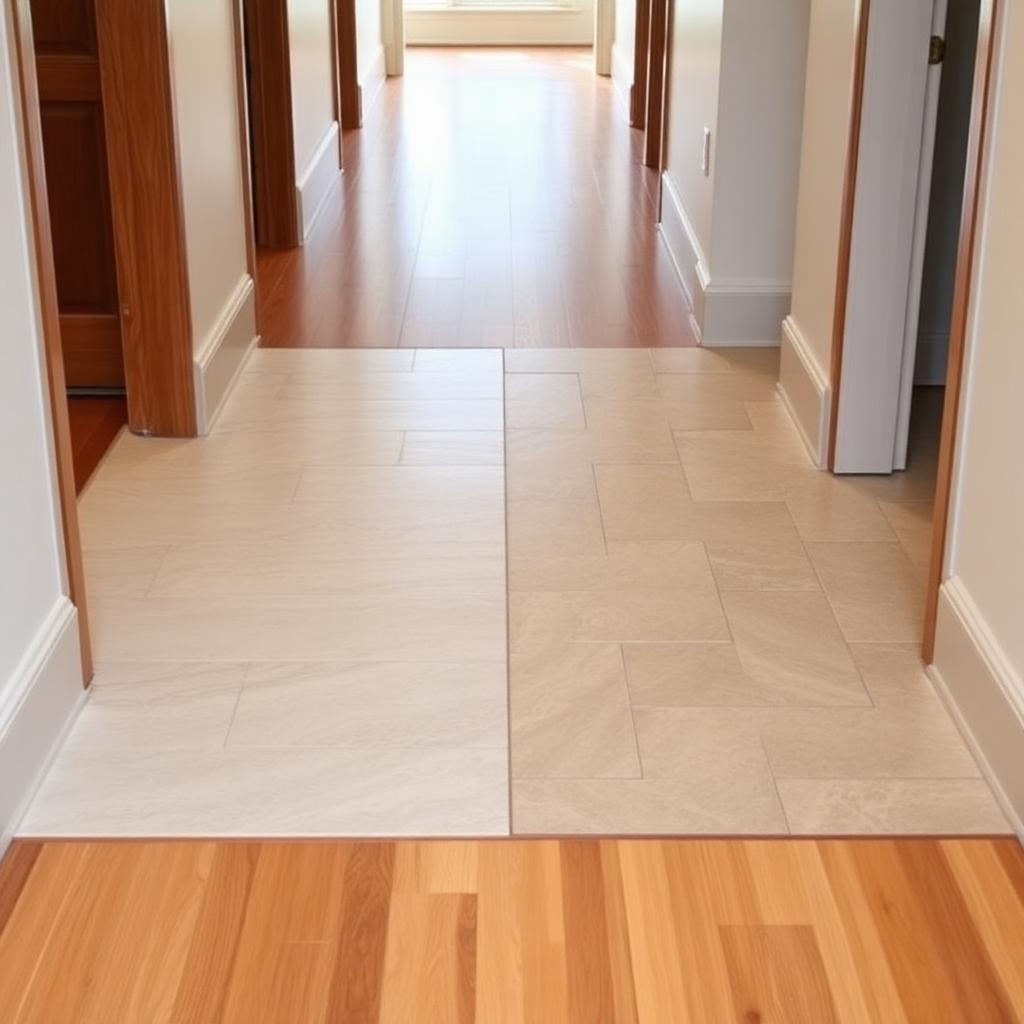
Why Consistency Wins
Hard flooring transitions break up the visual flow of a home. Every threshold strip is a line your eye has to cross, and three or four of them in a 30-foot sight line make the layout look chopped. The same plank or tile from the front door through the kitchen and living room reads as one open, bigger space.
Real-estate agents also prefer it. Listings with one continuous hard floor on the main level photograph cleaner and routinely appraise higher per square foot than homes with three or four flooring types.
Where to Break the Match
- Bathrooms. Wet rooms still do best with tile or a heavy 20 mil waterproof vinyl. A different material here is expected and not jarring because the bathroom is closed off behind a door.
- Laundry and mudrooms. Same logic, plus the floor takes more abuse.
- Bedrooms. Carpet is still preferred by about 60 percent of US buyers for bedrooms (per NAR 2024 data). Bedrooms are also behind a door, so a transition is invisible from the hallway.
- Basements. Often a different material because of moisture, but at least keep the basement floor consistent within itself.
The Two-Floor Rule
If you stand in one room and can see into another without closing a door, the floors should match. That is the simplest test. Open-concept kitchen, dining and living room should always share one floor. Walk into a hallway and see three bedroom doorways, and the carpet inside those bedrooms is fine to be different from the hallway hard floor.
When You Cannot Match Exactly
Renovating one room at a time, the old floor might be discontinued. Two compromises work:
- Match by color and width rather than brand. A 7-inch warm oak plank reads close enough to a 7-inch warm oak plank from a different maker.
- Use a true visual break (an arch, a tile inlay, a step down) so the eye reads it as intentional rather than mismatched.
Direction Matters Too
Even with the same plank, plank direction changes the look. Run planks parallel to the longest wall in each room, or in the direction of the main light source. Never change plank direction at an unmarked transition, it always looks like a mistake.
Resale Impact
The NAR Remodeling Impact Report for 2024 found that new hardwood floors recover 147 percent of their cost at sale, but only when the install is consistent. A choppy mix of three materials underperforms because buyers read it as "renovated room by room" not "designed."
What to Pick if You Are Replacing It All
The safe answer in 2026 is one continuous waterproof rigid-core LVP at 5 to 7 inch plank width and 12 to 20 mil wear layer, in a mid-tone oak look. It runs into kitchens and bathrooms, pets and kids do not damage it, and almost every buyer accepts it.
Bottom Line
Match the flooring across any space you can see from one spot. Use a different floor only where a closed door hides the transition. Keep plank direction consistent, pick mid-tone neutrals, and the home will read as larger and worth more.
FAQ: Matching Flooring Throughout the House
Do open-concept homes always need one floor?
Yes. Any open-concept layout reads best with a single continuous floor across kitchen, dining and living. Breaking it up at an arch or column always looks unfinished.
Can I run hardwood into a kitchen?
Yes, modern engineered hardwood handles kitchen humidity well as long as spills are wiped quickly. Most 2026 kitchens with hardwood use a 6 to 9 mil aluminum-oxide top coat for splash resistance.
What about stairs?
Stairs should match the upstairs floor if you can see one from the other. Carpeted bedrooms upstairs typically still have hardwood or vinyl on the stairs themselves for durability.
How much does mismatched flooring cost at resale?
Realtor surveys put the hit at 1 to 3 percent of list price for a choppy multi-material main floor versus one continuous floor. On a 400k home that is 4k to 12k.
Final Tips
- One floor through any space you can see from a single spot.
- Pick mid-tone neutrals for resale.
- Run planks parallel to the longest wall.
- Keep transitions hidden behind closed doors.