Quick Answer
Interior doors should swing into the room they serve, not out into the hallway. That keeps corridors clear, lets you reach the light switch on the inside wall, and gives the door a logical place to rest when fully open.
Residential front doors generally swing inward for weather and security reasons. Commercial exits, certain closets and most bathroom doors in public buildings swing outward because building codes require it for crowd flow and rescue access.
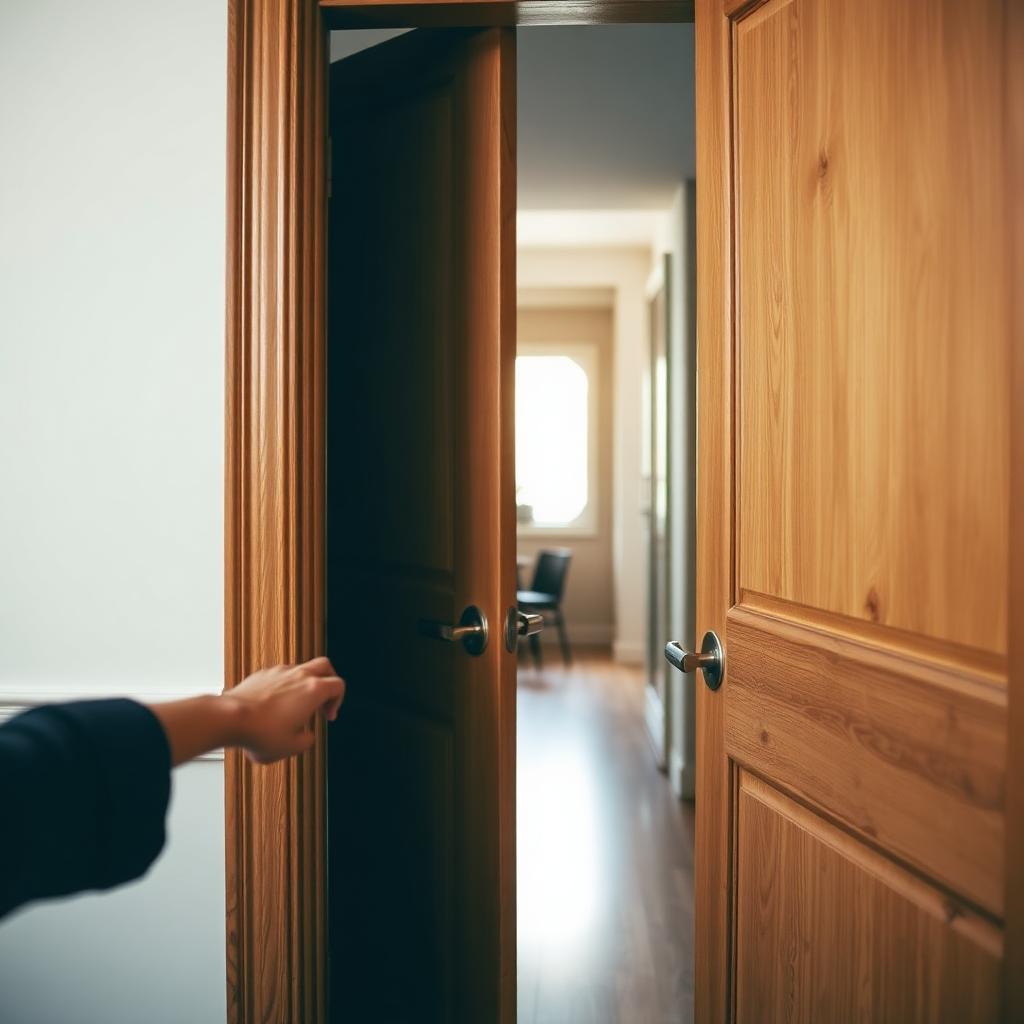
Interior Rooms
The general rule for bedrooms, offices and bathrooms is inswing. A door that opens into the room sweeps a clear arc, allows the light switch to be mounted on the latch side wall just inside the door, and tucks against an adjacent wall when fully open. If a door has to open into a hallway, anyone walking past gets clipped by the door every time someone enters or leaves.
The handing of the door, left or right, is decided by code and convention. Stand outside the room with your back to the hinges. If the knob is on your right, it is a right hand door. Most carpenters pick the side that puts the door against the closest perpendicular wall when open.
Exterior Front Doors
In the United States and most of Europe, the front door swings inward. An inswing door is harder to kick off its hinges from the outside, and the weather seal sits on the protected interior side of the jamb. An outswing front door is more common in hurricane prone coastal areas where high wind pressure on an inswing door can pop the latch.
Bathrooms and Closets
A residential bathroom door normally swings inward so it does not block the hallway. A commercial public restroom door usually swings outward for sanitation, so users do not have to pull a handle on the way out. Closet doors typically swing outward into the room because the closet itself is too shallow to accept the swing.
What Building Codes Require
The International Building Code requires any door serving a room with an occupant load of 50 or more, or any high hazard room, to swing in the direction of exit travel. That is why classroom doors, theater doors and assembly hall doors all push outward. For a normal home, code is silent and the choice comes down to layout.
Bottom Line
Default to inswing for interior rooms and the residential front door. Use outswing where code requires it, where the room is too small to absorb the swing, or where coastal wind loads call for it. Plan the swing before you frame the opening, because reversing a door later means new hinges, new latch mortises and often a new jamb.
More Practical Notes on Should Doors Swing In or Out
Beyond the headline rule, the real question of should doors swing in or out usually comes down to the specific room, climate and how the household actually uses the doorway. A guidance that works perfectly in a tight Victorian terrace can backfire in a draughty 1970s build or in a humid coastal home, so treat the answer here as a starting point rather than a final verdict.
If you are renovating, walk the space at different times of day before you commit. Lighting, foot traffic patterns and even the way furniture pushes against the wall all change the calculation. Builders and trim carpenters routinely see homeowners reverse a decision a week after moving in, simply because real life did not match the original sketch.
Common Mistakes Homeowners Make
The most frequent mistake on questions about should doors swing in or out is treating one online answer as universal. Codes, climates and finish trends drift, and what looked correct five years ago may already feel dated. Always cross check at least one manufacturer page and one current trade source such as Family Handyman or This Old House before you spend money.
The second mistake is ignoring what the rest of the house already looks like. Consistency across rooms almost always beats a single bold flourish, especially in resale photography. If every other doorway in the home follows one rule, breaking that rule in a single room reads as a mistake rather than an intentional design choice.
Quick Recap
To summarise the practical takeaway on should doors swing in or out: lead with the standard convention, check it against your specific room and climate, and only deviate when you have a clear reason and a sample to test. That keeps you safe on resale value and on day to day livability.
More Practical Notes (Part 2) on Should Doors Swing In or Out
Beyond the headline rule, the real question of should doors swing in or out usually comes down to the specific room, climate and how the household actually uses the doorway. A guidance that works perfectly in a tight Victorian terrace can backfire in a draughty 1970s build or in a humid coastal home, so treat the answer here as a starting point rather than a final verdict.
If you are renovating, walk the space at different times of day before you commit. Lighting, foot traffic patterns and even the way furniture pushes against the wall all change the calculation. Builders and trim carpenters routinely see homeowners reverse a decision a week after moving in, simply because real life did not match the original sketch.
Common Mistakes (Part 2)
The most frequent mistake on questions about should doors swing in or out is treating one online answer as universal. Codes, climates and finish trends drift, and what looked correct five years ago may already feel dated. Always cross check at least one manufacturer page and one current trade source such as Family Handyman or This Old House before you spend money.
The second mistake is ignoring what the rest of the house already looks like. Consistency across rooms almost always beats a single bold flourish, especially in resale photography. If every other doorway in the home follows one rule, breaking that rule in a single room reads as a mistake rather than an intentional design choice.
Quick Recap (Part 2)
To summarise the practical takeaway on should doors swing in or out: lead with the standard convention, check it against your specific room and climate, and only deviate when you have a clear reason and a sample to test. That keeps you safe on resale value and on day to day livability.