Quick Answer
You can paint interior doors the same color as the trim for a calm built in look, or paint them a contrasting color for a designer statement. Both are correct, and the right choice depends on how much the doors should announce themselves in the room.
White door on white trim is the default in production builder homes. Saturated colored doors with white trim are the look most often used by interior designers since around 2018.
Same Color as Trim
Painting the door the same color as the trim makes it disappear into the wall plane. The room reads as a clean envelope of architecture with no visual interruption. This is the safe choice for small rooms, neutral palettes, rentals and resale focused renovations.
It also reduces decision fatigue. One trim color, one trim sheen, one bucket of paint covers baseboards, door casings, window casings and door slabs.
Contrasting Door Color
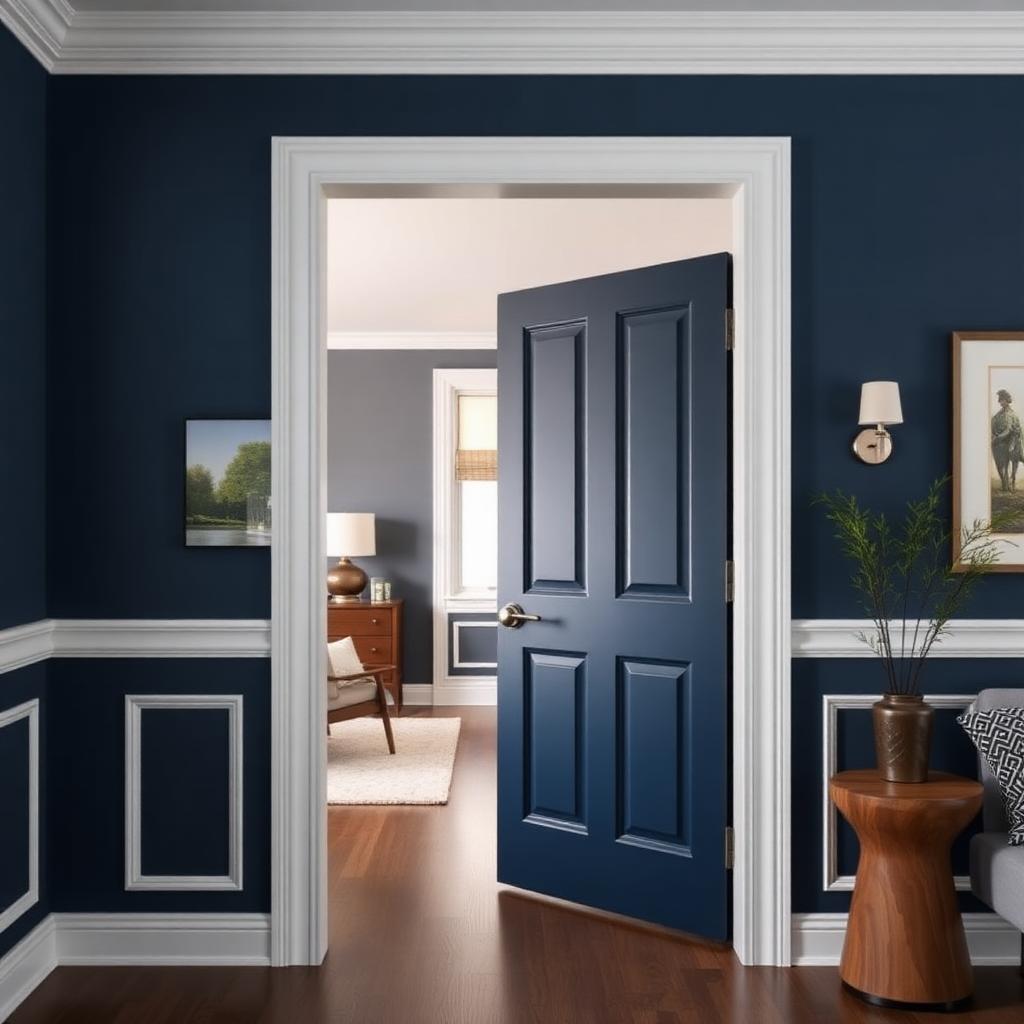
Painting the door slab a different color from the trim turns the door into a design moment. The trim stays as the white frame, and the door is the artwork inside it. Common high impact combinations include navy with white trim, black with white trim, sage green with off white trim, and deep terracotta with cream trim.
Farrow and Ball, Benjamin Moore and Sherwin-Williams all publish curated door colors specifically for this look. Their most reordered include Hague Blue, Hale Navy, Soft Fern and Black Magic.
What About Door Edges and Frames
When you paint a door a contrast color, paint the visible edges of the door the same color as the door face, not the trim. Paint the door frame the trim color. The rule is that anything that swings is the door color, anything fixed to the wall is the trim color.
Where the Same Color Rule Wins
Stick with door equals trim in:
- Small bedrooms and tight hallways where contrast feels claustrophobic.
- Open plan spaces with many adjacent doorways visible at once.
- Homes prepping for sale, where neutral broad appeal matters.
Where Contrast Wins
Pick a contrast door color in:
- Long hallways that need a visual focal point at one end.
- Front entries where the inside of the front door becomes a statement.
- Rooms with a clear color palette already established by furniture or fabric.
Bottom Line
Match the door to the trim for a quiet timeless look. Contrast the door against the trim for a designed in moment. Either way, commit fully: a half effort with three different whites looks worse than either pure approach.
More Practical Notes on Should Doors Be Painted the Same Color as Trim
Beyond the headline rule, the real question of doors painted same color as trim usually comes down to the specific room, climate and how the household actually uses the doorway. A guidance that works perfectly in a tight Victorian terrace can backfire in a draughty 1970s build or in a humid coastal home, so treat the answer here as a starting point rather than a final verdict.
If you are renovating, walk the space at different times of day before you commit. Lighting, foot traffic patterns and even the way furniture pushes against the wall all change the calculation. Builders and trim carpenters routinely see homeowners reverse a decision a week after moving in, simply because real life did not match the original sketch.
Common Mistakes Homeowners Make
The most frequent mistake on questions about doors painted same color as trim is treating one online answer as universal. Codes, climates and finish trends drift, and what looked correct five years ago may already feel dated. Always cross check at least one manufacturer page and one current trade source such as Family Handyman or This Old House before you spend money.
The second mistake is ignoring what the rest of the house already looks like. Consistency across rooms almost always beats a single bold flourish, especially in resale photography. If every other doorway in the home follows one rule, breaking that rule in a single room reads as a mistake rather than an intentional design choice.
Quick Recap
To summarise the practical takeaway on doors painted same color as trim: lead with the standard convention, check it against your specific room and climate, and only deviate when you have a clear reason and a sample to test. That keeps you safe on resale value and on day to day livability.
More Practical Notes (Part 2) on Should Doors Be Painted the Same Color as Trim
Beyond the headline rule, the real question of doors painted same color as trim usually comes down to the specific room, climate and how the household actually uses the doorway. A guidance that works perfectly in a tight Victorian terrace can backfire in a draughty 1970s build or in a humid coastal home, so treat the answer here as a starting point rather than a final verdict.
If you are renovating, walk the space at different times of day before you commit. Lighting, foot traffic patterns and even the way furniture pushes against the wall all change the calculation. Builders and trim carpenters routinely see homeowners reverse a decision a week after moving in, simply because real life did not match the original sketch.
Common Mistakes (Part 2)
The most frequent mistake on questions about doors painted same color as trim is treating one online answer as universal. Codes, climates and finish trends drift, and what looked correct five years ago may already feel dated. Always cross check at least one manufacturer page and one current trade source such as Family Handyman or This Old House before you spend money.
The second mistake is ignoring what the rest of the house already looks like. Consistency across rooms almost always beats a single bold flourish, especially in resale photography. If every other doorway in the home follows one rule, breaking that rule in a single room reads as a mistake rather than an intentional design choice.
Quick Recap (Part 2)
To summarise the practical takeaway on doors painted same color as trim: lead with the standard convention, check it against your specific room and climate, and only deviate when you have a clear reason and a sample to test. That keeps you safe on resale value and on day to day livability.