Quick Answer
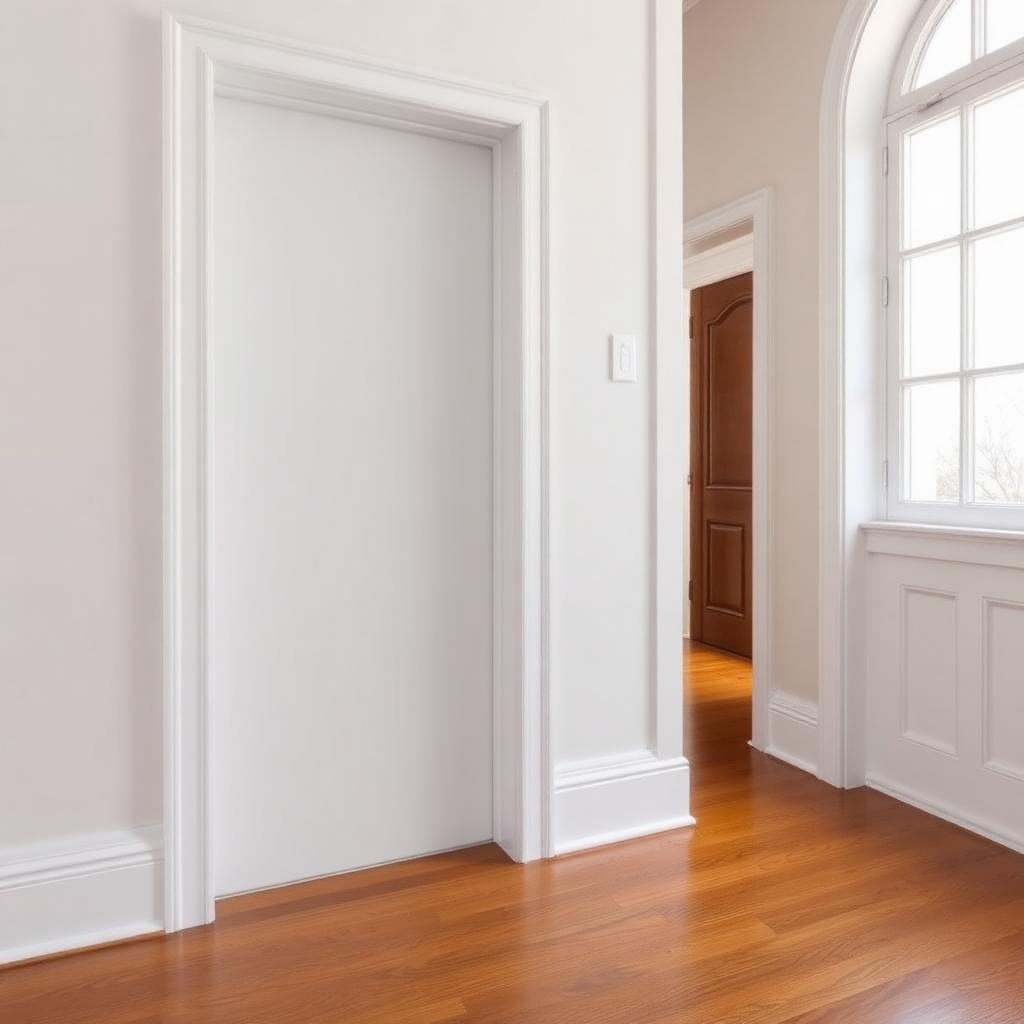
Yes, door trim and baseboards should be the same color in almost every room. The two pieces of millwork meet at every doorway and the eye reads them as one continuous frame. Painting them differently fragments the room and draws attention to the joint.
The only common exception is a stained wood door casing paired with a painted baseboard in a transitional or rustic interior.
Why They Should Match
Millwork works as a visual frame. Baseboard runs along the floor, door and window casings run vertically, and crown molding caps the top. When all of these share a color, the room feels intentional and the wall color reads cleanly inside the frame. When they do not, the eye stops at every transition and the architecture looks accidental.
Sherwin-Williams and Benjamin Moore both publish their trim color guides assuming a single trim color per room. Their popular whites (Pure White, Alabaster, Simply White, Chantilly Lace) are sold specifically as do everything trim colors.
Same Color, Same Sheen
Match the sheen as well as the color. A satin baseboard next to a semi gloss casing reflects light differently at the meeting joint and looks like a mistake. Pick one finish (most painters use satin or semi gloss on millwork) and run it across every piece of trim in the room.
When It Is OK to Vary
A few defensible reasons to break the rule:
- Stained wood casing with a painted baseboard, common in Craftsman and farmhouse interiors.
- A bold contrast trim moment, like black baseboards with white casings, used as a design statement in modern interiors.
- A historic restoration that documents the original trim scheme used different colors.
None of these happen by accident. They are intentional looks that require the rest of the room to support them.
Practical Tip
Mix one large batch of trim paint and keep it labeled in the basement. Touch ups are inevitable, and matching a custom white years later is a nightmare. A single gallon usually covers an average sized room of baseboards, door casings and window trim with two coats.
Bottom Line
Default to one trim color, one trim sheen across baseboards and door casings within a room. Break the rule only when the contrast is the design. The matched look ages better and never reads as a leftover.
More Practical Notes on Should Door Trim Match Baseboard Color
Beyond the headline rule, the real question of should door trim match baseboard color usually comes down to the specific room, climate and how the household actually uses the doorway. A guidance that works perfectly in a tight Victorian terrace can backfire in a draughty 1970s build or in a humid coastal home, so treat the answer here as a starting point rather than a final verdict.
If you are renovating, walk the space at different times of day before you commit. Lighting, foot traffic patterns and even the way furniture pushes against the wall all change the calculation. Builders and trim carpenters routinely see homeowners reverse a decision a week after moving in, simply because real life did not match the original sketch.
Common Mistakes Homeowners Make
The most frequent mistake on questions about should door trim match baseboard color is treating one online answer as universal. Codes, climates and finish trends drift, and what looked correct five years ago may already feel dated. Always cross check at least one manufacturer page and one current trade source such as Family Handyman or This Old House before you spend money.
The second mistake is ignoring what the rest of the house already looks like. Consistency across rooms almost always beats a single bold flourish, especially in resale photography. If every other doorway in the home follows one rule, breaking that rule in a single room reads as a mistake rather than an intentional design choice.
Quick Recap
To summarise the practical takeaway on should door trim match baseboard color: lead with the standard convention, check it against your specific room and climate, and only deviate when you have a clear reason and a sample to test. That keeps you safe on resale value and on day to day livability.
More Practical Notes (Part 2) on Should Door Trim Match Baseboard Color
Beyond the headline rule, the real question of should door trim match baseboard color usually comes down to the specific room, climate and how the household actually uses the doorway. A guidance that works perfectly in a tight Victorian terrace can backfire in a draughty 1970s build or in a humid coastal home, so treat the answer here as a starting point rather than a final verdict.
If you are renovating, walk the space at different times of day before you commit. Lighting, foot traffic patterns and even the way furniture pushes against the wall all change the calculation. Builders and trim carpenters routinely see homeowners reverse a decision a week after moving in, simply because real life did not match the original sketch.
Common Mistakes (Part 2)
The most frequent mistake on questions about should door trim match baseboard color is treating one online answer as universal. Codes, climates and finish trends drift, and what looked correct five years ago may already feel dated. Always cross check at least one manufacturer page and one current trade source such as Family Handyman or This Old House before you spend money.
The second mistake is ignoring what the rest of the house already looks like. Consistency across rooms almost always beats a single bold flourish, especially in resale photography. If every other doorway in the home follows one rule, breaking that rule in a single room reads as a mistake rather than an intentional design choice.
Quick Recap (Part 2)
To summarise the practical takeaway on should door trim match baseboard color: lead with the standard convention, check it against your specific room and climate, and only deviate when you have a clear reason and a sample to test. That keeps you safe on resale value and on day to day livability.