Quick Answer
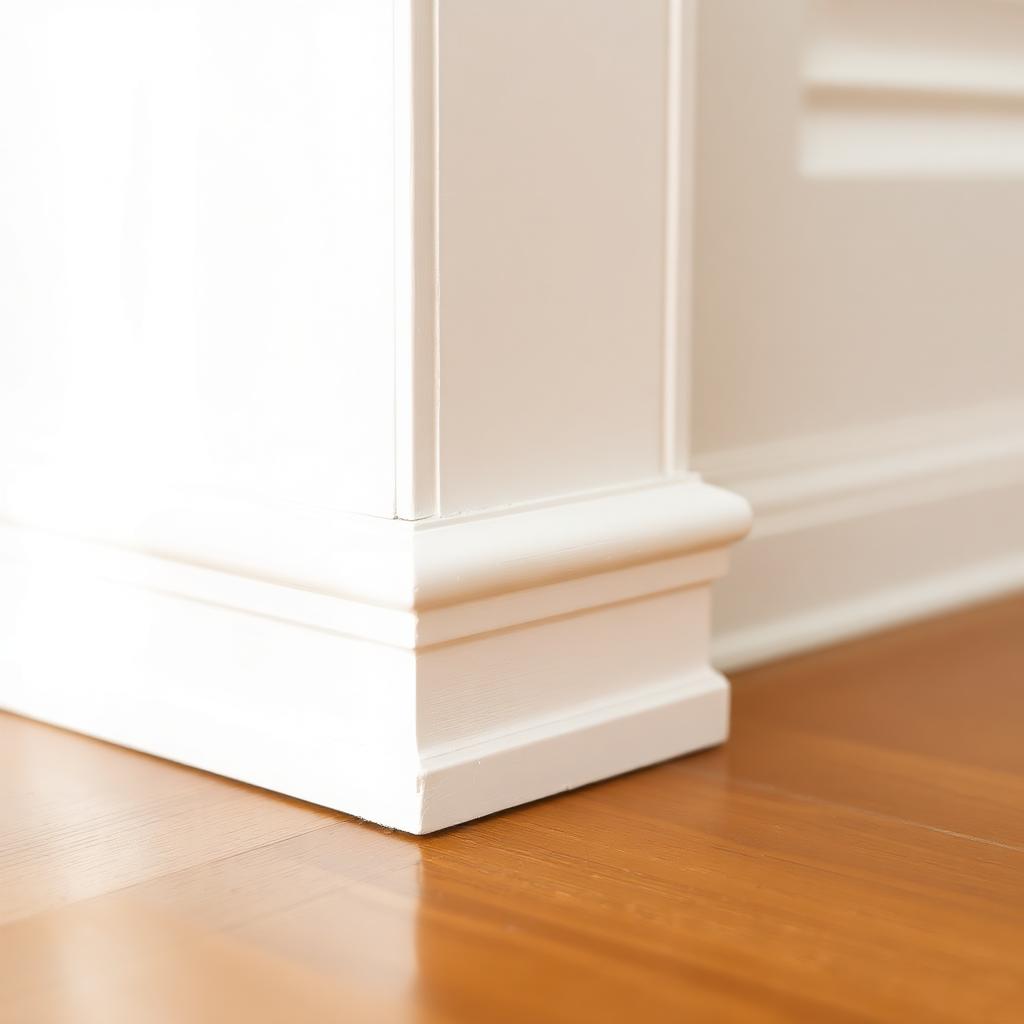
Yes, in a traditional house the door casing is normally about an eighth of an inch thicker than the baseboard. That small step lets the baseboard butt cleanly into the side of the casing without showing a hard joint.
In modern flat trim or contemporary millwork, casing and baseboard often share the same thickness for an intentional minimal look.
The Traditional Rule
Classic Federal, Colonial and Craftsman millwork follows a stack. Wall plane is thinnest. Baseboard projects out from the wall. Door casing projects out further still. Crown molding caps the wall the same way casing caps the door opening. The eye reads each layer as a step.
The most common spec is a casing nominally three quarters of an inch thick set against a baseboard that is five eighths of an inch thick, leaving an eighth inch reveal where they meet. Family Handyman and This Old House both teach this hierarchy in their trim install guides.
Why It Matters
If the baseboard is thicker than the casing, it cannot terminate cleanly. You have to either notch the casing, plow out the baseboard, or add a plinth block at every doorway to absorb the difference. None of these is wrong, but they add labor and visible joints. A thicker casing solves the problem with no extra cuts.
Modern Flat Trim
The contemporary look used by builders like Bobby Berk and modern remodels often calls for a flat one by four casing and a matching flat one by four or one by six baseboard, both the same three quarter inch thickness. Where they meet, the installer uses a thin reveal strip or a tight butt joint with caulk. It reads as a single continuous frame.
This works only when the materials are dimensionally consistent and the painter caulks every joint. With profiled trim it falls apart visually.
Practical Order of Work
Decide your stack before you order millwork. Most carpenters install the door casing first, then run the baseboard up to it. That way any thickness mismatch is solved by the baseboard, which is easier to scribe and trim than the casing.
Bottom Line
For a traditional look, make the casing the thicker piece. For a modern look, run them at the same thickness and lean on tight joints and caulk. Either way, decide the stack at the design stage so the installer is not solving it with a saw on the day of install.
More Practical Notes on Should Door Casing Be Thicker Than Baseboard
Beyond the headline rule, the real question of should door casing be thicker than baseboard usually comes down to the specific room, climate and how the household actually uses the doorway. A guidance that works perfectly in a tight Victorian terrace can backfire in a draughty 1970s build or in a humid coastal home, so treat the answer here as a starting point rather than a final verdict.
If you are renovating, walk the space at different times of day before you commit. Lighting, foot traffic patterns and even the way furniture pushes against the wall all change the calculation. Builders and trim carpenters routinely see homeowners reverse a decision a week after moving in, simply because real life did not match the original sketch.
Common Mistakes Homeowners Make
The most frequent mistake on questions about should door casing be thicker than baseboard is treating one online answer as universal. Codes, climates and finish trends drift, and what looked correct five years ago may already feel dated. Always cross check at least one manufacturer page and one current trade source such as Family Handyman or This Old House before you spend money.
The second mistake is ignoring what the rest of the house already looks like. Consistency across rooms almost always beats a single bold flourish, especially in resale photography. If every other doorway in the home follows one rule, breaking that rule in a single room reads as a mistake rather than an intentional design choice.
Quick Recap
To summarise the practical takeaway on should door casing be thicker than baseboard: lead with the standard convention, check it against your specific room and climate, and only deviate when you have a clear reason and a sample to test. That keeps you safe on resale value and on day to day livability.
More Practical Notes (Part 2) on Should Door Casing Be Thicker Than Baseboard
Beyond the headline rule, the real question of should door casing be thicker than baseboard usually comes down to the specific room, climate and how the household actually uses the doorway. A guidance that works perfectly in a tight Victorian terrace can backfire in a draughty 1970s build or in a humid coastal home, so treat the answer here as a starting point rather than a final verdict.
If you are renovating, walk the space at different times of day before you commit. Lighting, foot traffic patterns and even the way furniture pushes against the wall all change the calculation. Builders and trim carpenters routinely see homeowners reverse a decision a week after moving in, simply because real life did not match the original sketch.
Common Mistakes (Part 2)
The most frequent mistake on questions about should door casing be thicker than baseboard is treating one online answer as universal. Codes, climates and finish trends drift, and what looked correct five years ago may already feel dated. Always cross check at least one manufacturer page and one current trade source such as Family Handyman or This Old House before you spend money.
The second mistake is ignoring what the rest of the house already looks like. Consistency across rooms almost always beats a single bold flourish, especially in resale photography. If every other doorway in the home follows one rule, breaking that rule in a single room reads as a mistake rather than an intentional design choice.
Quick Recap (Part 2)
To summarise the practical takeaway on should door casing be thicker than baseboard: lead with the standard convention, check it against your specific room and climate, and only deviate when you have a clear reason and a sample to test. That keeps you safe on resale value and on day to day livability.