Quick Answer
Yes, laminate flooring is a true DIY project. Modern click-lock planks need no glue, no nails and no specialty trade skills. A homeowner with basic tools can floor a 200 square foot room in a single weekend and save roughly 50 to 70 percent versus hiring an installer.
The catch is the prep work. A floor that fails almost always fails at the subfloor stage, not the plank stage. Flat subfloor, correct underlayment, proper expansion gap, those three things decide whether the project lasts 20 years or buckles in 12 months.
Why Laminate Is the Easiest Hard Flooring
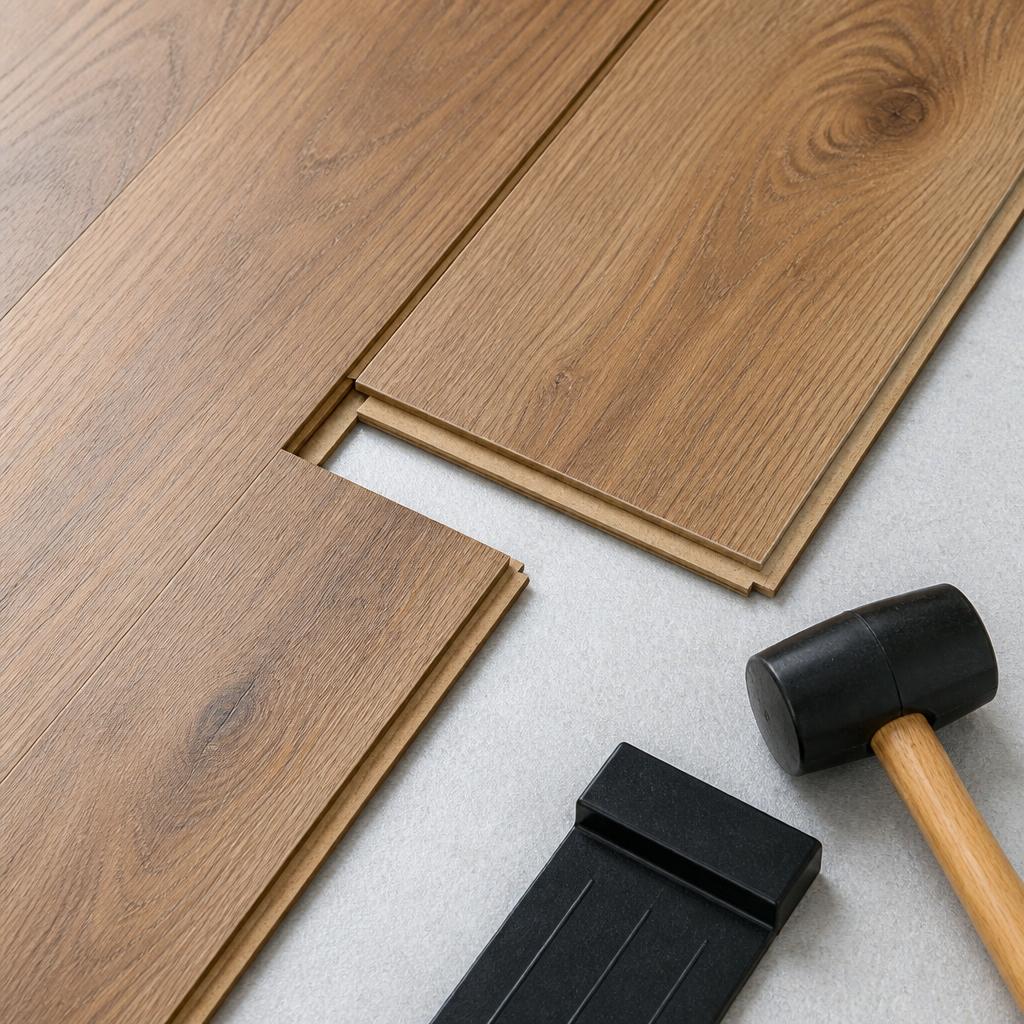
Unlike tile, hardwood or vinyl plank glue-down, laminate floats on top of the subfloor. The planks lock to each other, not to the floor below. That eliminates the two things most homeowners get wrong: adhesive coverage and nail placement. The system is forgiving enough that you can lift a misaligned plank and re-snap it.
The 2025 NWFA installation guidelines still rank floating laminate as the lowest-skill flooring category for owner installation, ahead of vinyl plank, engineered wood and tile.
Tools You Actually Need
- Tape measure, pencil, carpenter's square.
- Tapping block and pull bar (sold as a 25 dollar laminate kit).
- Spacers for the expansion gap.
- A jigsaw or miter saw for cuts. A multi-tool helps for door jambs.
- A long level or 6 foot straight edge to check the subfloor.
- Knee pads. You will be grateful by hour two.
No nail gun, no wet saw, no flooring stapler.
The Subfloor Is the Whole Job
The subfloor must be flat to within 3/16 inch over 10 feet. Anything worse and the click joints will separate under foot traffic. Use a long straight edge to find dips and high spots, then patch with floor leveler or sand high spots down. Skip this and the floor squeaks, bounces or pops apart within a year.
Concrete subfloors also need a moisture test. Tape a 2 foot square of clear plastic to the slab for 24 hours, if condensation forms underneath you need a vapor barrier underlayment.
Underlayment Matters More Than the Plank
Most laminate has attached foam padding, do not double up unless the manufacturer says so or the warranty voids. For unattached planks, use 3 mm closed-cell foam with a vapor barrier on concrete and standard foam on plywood.
The Expansion Gap
Leave a 1/4 to 3/8 inch gap around every wall, pipe and door frame. Laminate moves with humidity, and a tight gap is the single most common cause of buckled floors. Quarter-round trim covers the gap at the end.
Layout: Plan Before You Click
Measure the room width and divide by plank width. If the last row would be less than 2 inches wide, rip the first row narrower so both ends look balanced. Stagger end seams by at least 8 inches between rows to keep the floor from looking like brickwork that lined up.
Real Cost and Time
Materials in 2026 run 1.50 to 4.50 dollars per square foot for the plank, plus about 0.40 dollars for underlayment and 50 dollars in tools. Pros charge 3 to 6 dollars per square foot in labor on top. A 200 square foot room takes a first-timer about 10 to 14 hours, two for prep, two for the first row, the rest at roughly 30 to 50 square feet per hour once you get the rhythm.
When Not to DIY
- Rooms larger than 40 feet long need expansion T-molding mid-floor, often easier to hire out.
- Stairs are not DIY. They need nosing pieces and adhesive and are unforgiving.
- Wet rooms (full bathrooms, laundry) are better in vinyl plank.
Bottom Line
Laminate is the most DIY-friendly hard flooring you can buy. Spend your effort on the subfloor, not the planks, leave the expansion gap, and you will get a 20-year floor for the cost of materials and a weekend.
Common Questions About Laminate Flooring as a DIY Project
Can I lay laminate over existing flooring?
Over vinyl sheet, ceramic tile or hardwood, yes, if the surface is flat and stable. Never over carpet, never over peel-and-stick that has lifted, never over anything that flexes. Laminate is a floating floor and needs a rigid base.
Do I need to acclimate the planks?
Yes. Stack the unopened boxes flat in the room for 48 hours so the planks reach the room's temperature and humidity. Skipping this is the second most common reason laminate buckles after a tight expansion gap.
How long does laminate last?
Quality AC4 or AC5 planks rated for residential traffic last 20 to 30 years before needing replacement. Cheaper AC3 product lasts 8 to 15. The wear layer rating is on the box.
Can I get water-resistant laminate?
Yes. "Water-resistant" laminate uses a sealed core and tighter joints, rated to handle spills standing for 24 to 72 hours. It is not waterproof; full bathrooms and laundry rooms are better in vinyl plank.
What if I damage one plank later?
Floating floors can be partially disassembled. Pull base trim, unsnap planks from the nearest wall back to the damaged one, replace, and re-lock. Always buy 10 percent extra during the original install for this exact reason.