Quick Answer
Carry at least 1 gallon (3.78 liters) of fresh water per person per day as your absolute baseline. Scale up to 1.5 to 2 gallons per person per day in desert heat above 90°F, and to about 1.25 to 1.5 gallons at alpine altitude above 8,000 feet. Always split the payload across at least two or three containers so one leak cannot end the trip.
Water is the one overland resource that is not optional. Fuel range and battery capacity are conveniences. Water is survival.
Why the 1-gallon-per-day baseline is not arbitrary
Ready.gov, the American Red Cross, and the CDC all publish the same baseline for emergency planning: one gallon of potable water per person per day. Roughly half of that gallon goes to drinking, and the other half covers cooking dehydrated meals, cleaning cookware, and basic hygiene.
On overland trips I plan drinking, cooking, and hand-washing water on the same jerry cans. Shower water, if I carry any at all, is a separate story on top of the baseline.
Environmental modifiers you cannot ignore
Desert and arid trails
Once ambient temperatures push past 90°F, sweat rate climbs fast. NPS heat guidance for canyon and desert parks pushes hikers toward roughly a liter per hour of moderate activity, which quickly overwhelms the 1-gallon baseline. For desert overlanding I plan 1.5 to 2 gallons per person per day and treat that as the floor, not the ceiling.
High-altitude alpine passes
Above 8,000 feet the air is thin and dry. You lose measurable water with every breath, and altitude tends to suppress thirst until you are already behind. I bump the baseline to 1.25 to 1.5 gallons per person per day and drink on a schedule rather than by thirst.
Planning matrix by trip length
| Trip length | Party size | Weather | Baseline | Carry (with buffer) |
|---|---|---|---|---|
| Weekend (2 days) | 2 adults | Temperate forest | 4 gallons | 5 gallons (one standard jerry can) |
| Extended (4 days) | 2 adults | Alpine mountain | 10 gallons | 12 gallons in two tanks |
| Expedition (7 days) | 2 adults | Arid desert | 21 gallons | 25 gallons split across three containers |
Weight and placement matter more than people think
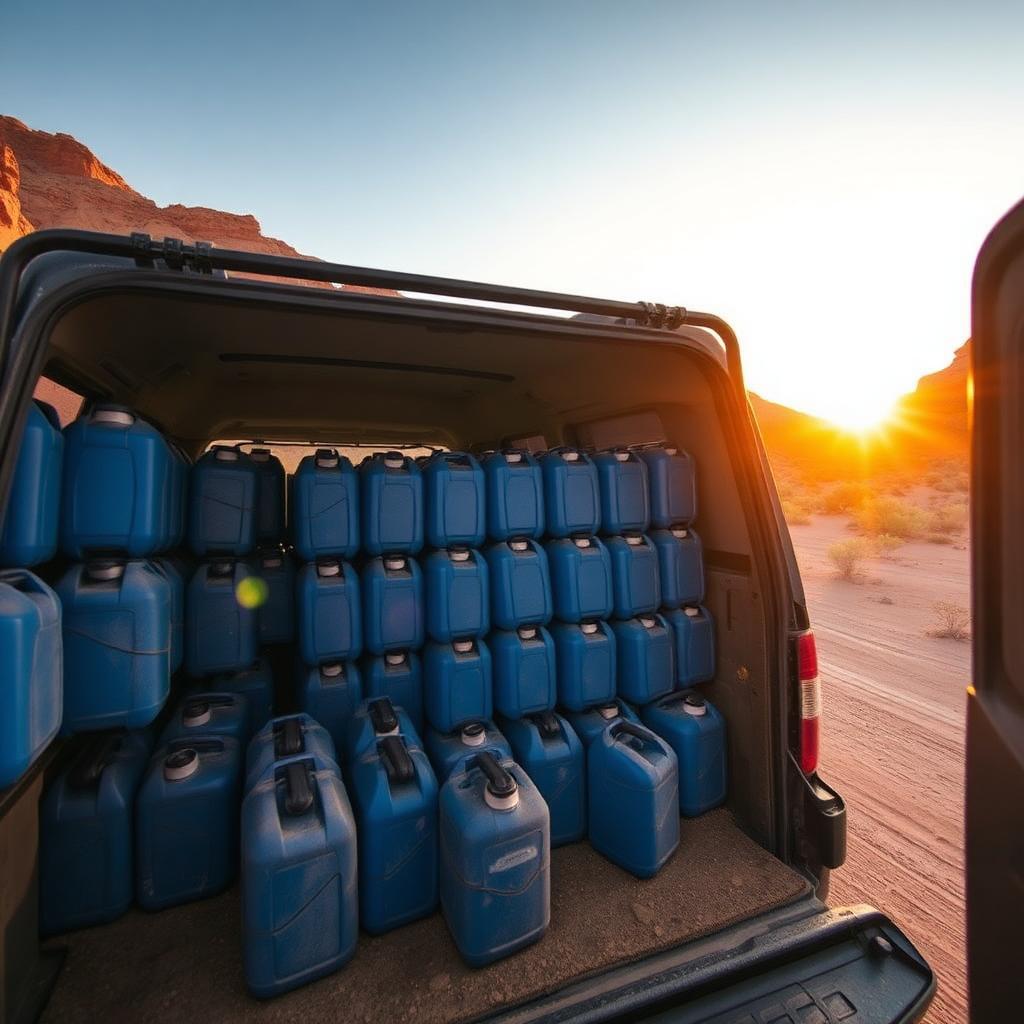
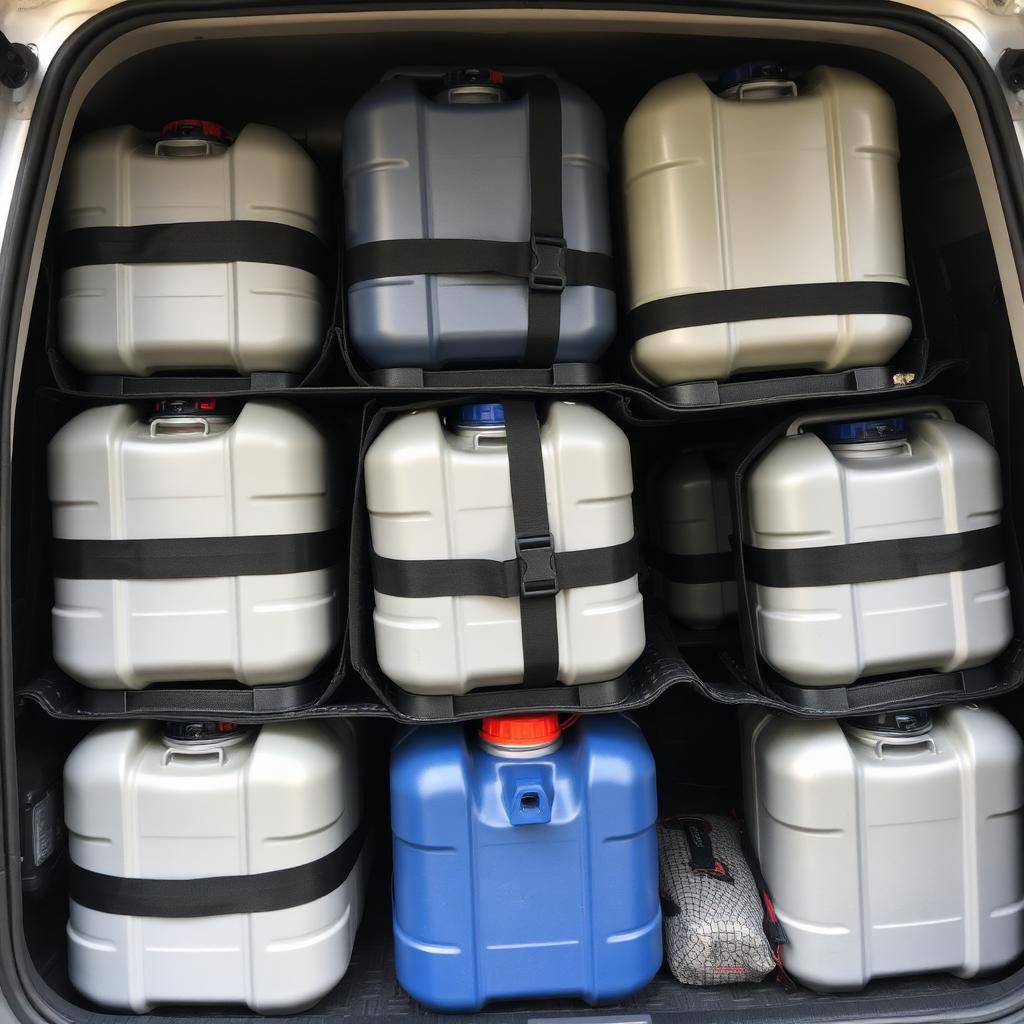
Water weighs 8.34 pounds per gallon per USGS reference values. A 25-gallon expedition load is roughly 208 pounds of unsprung, sloshing mass. Mount it low: floorboards, rear seat wells, or over the rear axle inside the cargo area. Never put a full 5-gallon jerry can on a roof rack. Raising 40 pounds of liquid above your head is exactly the wrong direction for center of gravity on off-camber trails.
Split the payload across containers
A single 25-gallon rotomolded tank looks tidy, but one rock strike or one stress fracture can end the trip. I carry water in at least two or three separate vessels: two rigid 5-gallon cans plus a smaller day-use jug is a common setup. If one fails, the other two keep the trip alive.
Frequently asked questions about overland water planning
Does coffee, tea, or soda count toward my gallon?
For planning purposes I count only plain water and the water I use to brew coffee or rehydrate meals. Caffeinated drinks are fine to consume, but I do not shave the baseline down for them, especially in heat where I would rather over-carry than under-plan.
Can I plan to refill at streams and lakes along the route?
Only if you carry a proven filter or purification system and the route actually has reliable surface water. In the western US, seasonal streams disappear. Never build a trip plan around a water source you have not personally verified in the current season.
What about water for dogs?
Plan roughly an extra 0.5 to 1 gallon per day per medium dog, more in the heat. Dogs pant instead of sweat and dehydrate quickly on trail.
How much water carry decisions change with vehicle and party size
How much water carry planning really answers depends on more than just headcount. Vehicle payload, cargo geometry, and party size all move the number. On a two-person weekend in a compact SUV, I run one 5-gallon jerry can plus two small day jugs. On a four-person week-long trip in a full-size truck, I plan around 40 to 50 gallons total and split it across four separate containers with dedicated rear-mount rack space.
Match container size to how you actually pour
A single 25-gallon rotomolded tank sounds efficient until you realize you cannot lift 210 pounds of water to top off a smaller day jug. I keep at least one 2 to 3 gallon container as my "working" jug that lives in the passenger footwell, and refill it every morning from the larger sealed jerry cans in the back. That habit alone stops the big tanks from getting contaminated during casual use.
Rotate the payload to keep it fresh
Sealed potable water stored in food-grade containers stays safe to drink for six to twelve months, but taste degrades faster than safety does. I dump and refill every trip, and I rinse the jerry cans with a mild bleach solution (about one teaspoon per gallon) at the start of every season to keep the interior surfaces clean.
Emergency reserves you should carry separately
Beyond your daily planning water, I always tuck away an untouchable emergency reserve of at least 1 gallon per person in a sealed container I never open unless the main supply fails. Label it, tape it shut, and treat it as insurance. If you never touch it, you never had to. If you do reach for it, you already have one full day of survival water while you plan the exit.
Bottom line
Anchor your plan on 1 gallon per person per day, scale up for desert and altitude, keep the load low in the vehicle, and split it across multiple containers. Do that and water stops being the resource that ends your trip.