Quick Answer
To use a winch safely off-road, anchor to a solid tree or heavy vehicle with a wide tree-saver strap and a rated shackle, drape a heavy line dampener across the middle of the cable, clear everyone at least one and a half line-lengths away, then pull in short 3 to 5 second bursts while the driver assists with light throttle.
A winch line under tension stores massive kinetic energy. A snapped cable or a failed hook can kill someone. The safety routine is not optional.
Step 1: Rig to a proper anchor
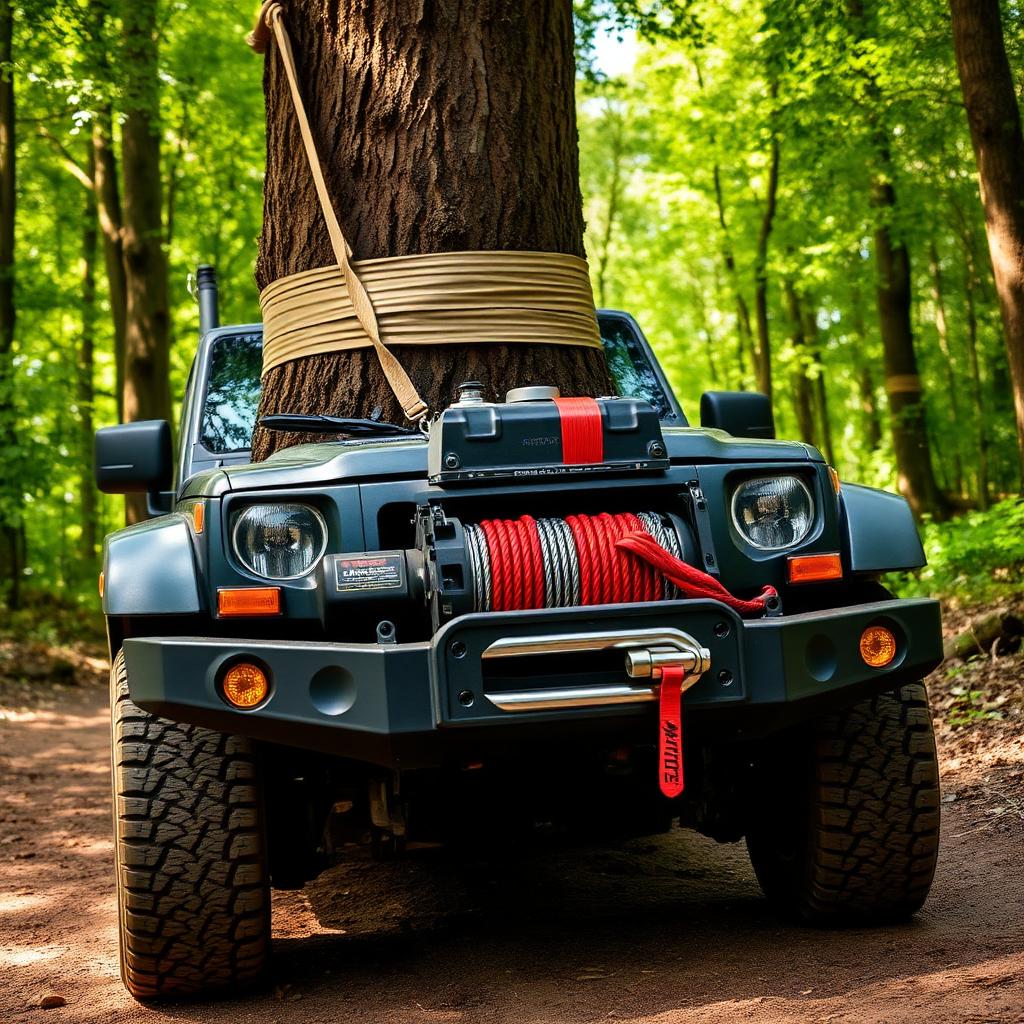
Never wrap the winch cable directly around a tree. It kinks the line, damages the tree, and creates uneven load points. Use a wide fabric tree-saver strap around the trunk instead, then connect the two loop ends with a rated D-ring shackle or a synthetic soft shackle.
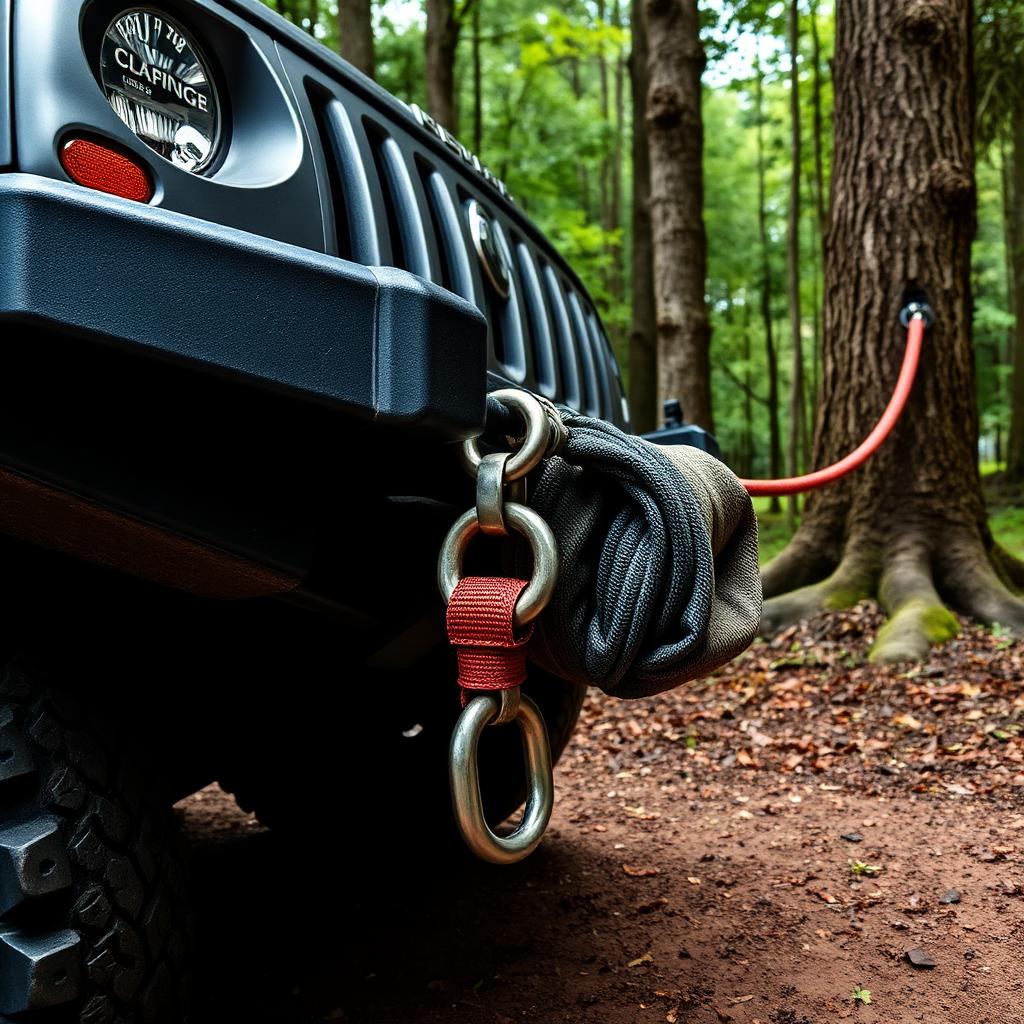
If I hook to a metal recovery point on another vehicle, it has to be a real frame-mounted point, not a tow-ball, not a bumper eyelet, and not a hitch pin. Tow balls have sheared off in recoveries and become lethal projectiles.
Which way does the hook face?
Point the hook throat downward when connecting to a shackle. If the hook ever fails, it snaps toward the ground instead of at head level.
Step 2: Deploy a line dampener
Before applying tension, drape a heavy line dampener across the middle of the extended winch cable. Purpose-built dampeners work best. A heavy blanket, floor mat, or thick winter coat will do in a pinch.
If the line snaps under load, the weight of the dampener absorbs the escaping energy and drives the cable down to the ground instead of letting it whip toward either vehicle.
Step 3: Clear the danger zone
Nobody stands in line with the cable. Nobody walks over an active line. Bystanders stay at least one and a half times the extended line length away. If I have a 100-foot pull, everyone is at least 150 feet clear.
Step 4: Prepare the stuck vehicle
- Engine running to keep the winch battery charged.
- Transmission in neutral (or first gear on a manual with the clutch out for controlled crawling assist).
- Emergency brake released.
- Wheels aligned straight so tires roll instead of scuffing.
Step 5: Pull in short controlled bursts
Most electric off-road winches have a 3 to 5 minute duty cycle at full load. Beyond that the motor overheats and can burn out. I hold the remote button for 3 to 5 seconds, release for 10 seconds, and repeat. If the pull is long I pause every 30 seconds to let the motor cool.
The driver of the stuck vehicle assists with light, smooth throttle in first gear. Match the tire rotation to the winch line speed. Too much throttle drags the truck over the cable and tangles the drum.
Step 6: Secure and pack up
Once the truck is on solid ground: shift to park, apply the emergency brake, spool out a foot of line to release tension, unhook the shackle, and pack the tree-saver strap. Keep a light gloved grip on the cable as I spool it back onto the drum so it winds evenly in tight rows.
Common winching mistakes
| Mistake | Why it is dangerous | Correct approach |
|---|---|---|
| Wrapping cable around the tree | Kinks the line, damages the tree | Use a fabric tree-saver strap |
| Hooking to a tow ball or bumper eyelet | Can shear and become a projectile | Use a rated frame recovery point |
| No line dampener | Snapped cable whips at head height | Drape a dampener across the middle |
| Continuous winching for minutes | Motor overheats and can burn out | Pull in 3 to 5 second bursts |
| Standing beside the winch line | Direct line of fire on failure | Clear everyone 1.5x line length away |
Synthetic line versus steel cable
Modern synthetic winch lines (Dyneema or Amsteel) are lighter, easier to handle, and fail safer than steel cable. When a synthetic line snaps it falls limp rather than whipping. Most new winches ship with synthetic. If I still run older steel cable, I take the dampener rule even more seriously.
Common questions about using a winch off-road
Do I need a snatch block?
Yes, if the pull is straight-forward and heavy. A snatch block (or pulley) doubles the line to halve the load on the winch motor at the cost of half the pulling speed. It also lets me redirect a pull around obstacles.
How big of a winch do I need?
Rule of thumb: winch rating equals 1.5 times the vehicle's gross weight. A 6,000 lb SUV wants a 9,000 to 10,000 lb winch. A one-ton truck wants 12,000 to 16,500 lb.
Can I winch alone?
Yes, but slower and more carefully. Set the anchor, dampener, and pull path, then work from inside the driver seat with a wireless remote so I am not standing beside the line under load.
How do I self-recover with no anchor?
Use a ground anchor like a Pull-Pal, or dig one in with a spare tire buried in the sand. Absent any anchor, the winch is not useful and I switch to traction boards or a kinetic pull.
Bottom line
A winch is a precision tool for extraction, not a crowbar. Rig to a proper anchor with a tree-saver and rated shackle, deploy a line dampener across the middle, clear everyone well away, and pull in short controlled bursts. Follow the routine every time and the winch does its job without incident.