Quick Answer
To drive on sand dunes without getting stuck, I air my tires down to 10 to 12 psi (6 to 8 psi on beadlocks), keep steady momentum in 4-High, avoid hard braking, park facing downhill, and back out immediately if my tires start digging in. Sand is all about flotation and smooth inputs.
Highway pressure on a dune is a recipe for burying the axles in under a minute.
Step 1: maximize flotation with ultra-low pressure
Dry sand has almost no cohesion. At 35 psi my tires are round and narrow and they slice down through the surface like a rotating knife. Dropping to 10 to 12 psi flattens the tire into a long, wide paddle. That larger footprint spreads the vehicle's weight across more grains, so the truck floats instead of digging a hole.

Beadlock wheels let me safely drop lower, into the 6 to 8 psi range, because the bead is mechanically clamped to the rim. On standard non-beadlock wheels I stay at 10 psi minimum and I keep speeds moderate to avoid popping a bead off during a sharp turn.
Step 2: manage momentum
Momentum is my best friend on sand. The instant a heavy chassis stops moving forward, it settles into the loose grains and the tires start digging in.
- Steady throttle. On soft dune valleys or open climbs I keep the RPMs up and the throttle input smooth. I let the automatic hold a lower gear or manually pick third or fourth so the engine stays in its torque band.
- No sudden braking. Hard braking locks the tires and plows walls of sand in front of each wheel. When I want to stop, I lift off the throttle and let the sand's natural rolling resistance do the work.
- Wide, gentle turns. Sharp steering scrubs the tires sideways and dumps speed. I plan lines with big, sweeping arcs.
Step 3: park with gravity in mind
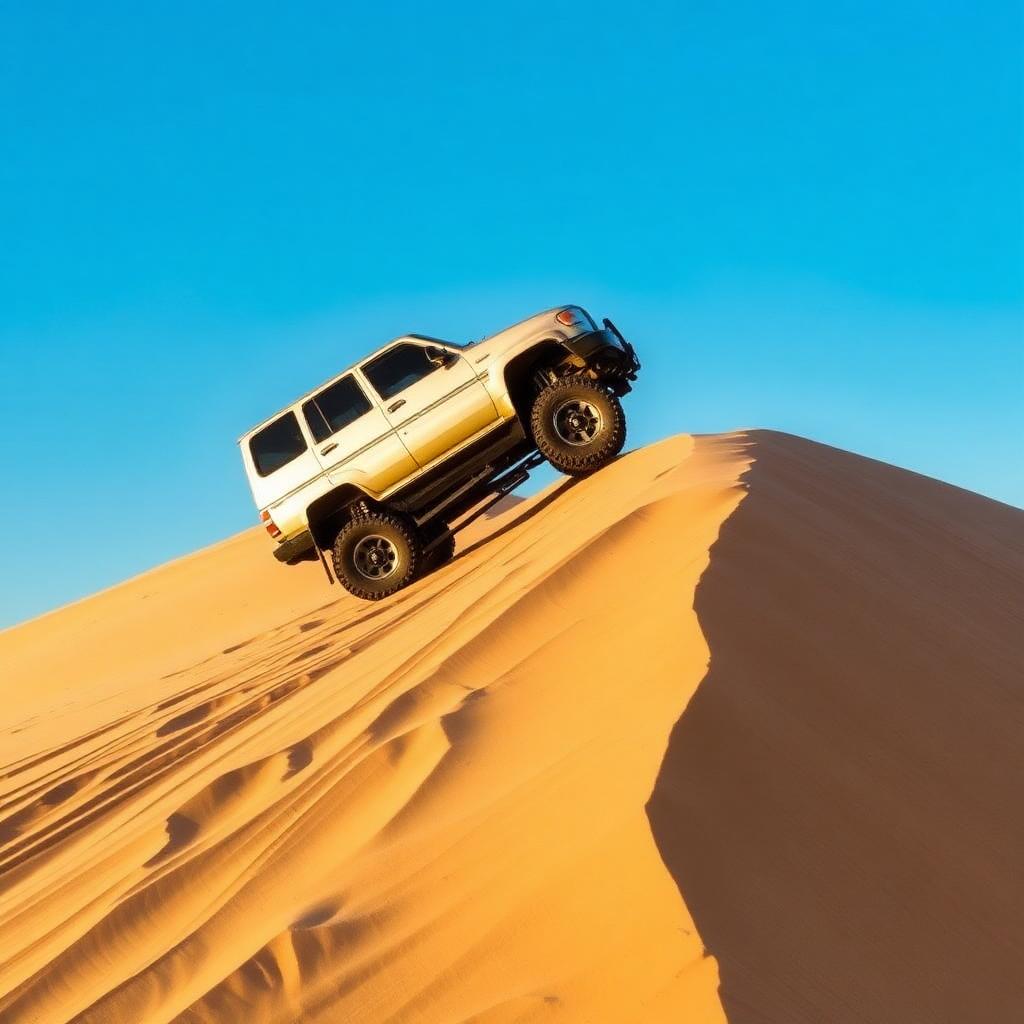
Where I stop determines whether I can start again. I never park in the flat bottom of a bowl and I never point uphill. The correct habit is to pull up onto the ridge and park facing down the slope. When it is time to leave, gravity gives me momentum for free.
Step 4: what to do if you start to sink
If I feel forward progress stop and the engine start to rev higher, I stop accelerating instantly. Burying the throttle turns spinning tires into excavators that dig the frame down to the sand until the truck is high-centered on its own belly.
The escape protocol
- Lift off the throttle the second forward progress ends.
- Shift into reverse.
- Slowly back down the exact tracks I drove up. The sand in those tracks is already packed, so the tires grip.
- Gather more momentum, pick a fresh line, and try again.
Sand driving reference table
| Situation | Target PSI | Drivetrain | Speed range |
|---|---|---|---|
| Firm coastal beach | 15 to 18 | 4-High | Up to 25 mph |
| Open soft dunes | 10 to 12 | 4-High | 15 to 25 mph |
| Steep climb or bowl | 10 to 12 | 4-High, sport mode | Committed steady throttle |
| Beadlock wheels only | 6 to 8 | 4-High | Under 20 mph |
Frequently asked questions about sand driving
Can any 4x4 handle sand dunes?
Any competent 4x4 with a functioning low range can handle moderate sand if the tires are aired down properly. Where things get harder is on the steepest dune faces, where power-to-weight ratio starts to matter. Heavy diesel trucks tend to struggle more than lighter gas rigs on soft climbs, but airing down solves most of the problem for either one.
Do I need a sand flag to drive on the dunes?
Most state and federal dune recreation areas require a tall whip-mounted safety flag while driving on open dunes. The reason is simple: you cannot see over a dune crest until you are already on top of it, and neither can anyone coming the other way. A visible flag gives you both a chance to react before a blind head-on collision.
Is it bad for the engine to run at high RPM in sand?
Sustained high RPM is normal on soft sand climbs and modern engines handle it fine. Watch coolant temperature, not the tachometer. If temperature starts creeping up, back off and let the airflow cool the radiator before the next big push.
Should I disengage the sway bar on sand?
On soft dunes I usually leave the sway bar connected because sand is smooth and lateral stability matters more than articulation. On mixed sand and rock terrain I disconnect the front sway bar for better wheel travel and reconnect it before any high-speed run on the pavement drive home.
Bottom line
Sand is a physics problem, not a horsepower problem. Air down for flotation, keep momentum smooth, coast to natural stops on downhill ridges, and back out the second the tires start to spin. Follow those rules and any competent 4x4 can cover a full day of dunes without touching a shovel.