Quick Answer
Start by scoping the flicker. If one bulb shimmers, tighten or replace it. If a whole room flickers, kill the breaker and check the switch and fixture wire nuts for loose connections. If lights dim every time a large appliance starts, the lighting circuit is sharing too much load with a motor and needs its own line.
Whole-house flickering, especially flickering that comes with a burning smell, scorched outlet faces, or warm switch plates, is not a DIY fix. That pattern usually means a loose main neutral connection at the service panel or at the meter, which is a documented fire and shock hazard. Shut things down and call a licensed electrician or your utility's emergency line.
Scope first: where is the flicker happening?
| Pattern | Likely cause | First step |
|---|---|---|
| One bulb shimmers | Loose bulb or wrong bulb for the dimmer | Tighten, replace with a dimmer-rated bulb |
| One room or circuit | Loose wire splice in a switch or fixture | Kill the breaker, check connections |
| Dims when a big appliance starts | Inrush current from a motor | Move the appliance to its own circuit |
| Whole house, random rooms | Loose main neutral or utility issue | Stop and call an electrician or the utility |
Step 1: handle the single-bulb case
If only one fixture is misbehaving, the fix is almost always at the bulb. Turn the fixture off, let the bulb cool, and check that it is screwed in firmly. A loose bulb arcs intermittently at the socket contact, which looks exactly like a flicker.
If the bulb is tight and still flickering, swap it out. Modern LED bulbs are especially fussy on older homes because most homes built before about 2010 still have analog triac dimmers that were designed for the resistive load of incandescent bulbs. Pair a non-dimmable LED with one of those dimmers and you get visible strobing as the dimmer chops the waveform. Buy a bulb marked Dimmable on the box, and if your dimmer is older than the bulb, upgrade the dimmer to one rated for LED/CFL.
Step 2: an entire room is flickering
Now you are dealing with the circuit, not the bulb. Walk to the service panel, identify the breaker for the affected room, and switch it firmly to off. Use a non-contact voltage tester on the wall switch leads before you touch anything. The tester should be silent and dark.
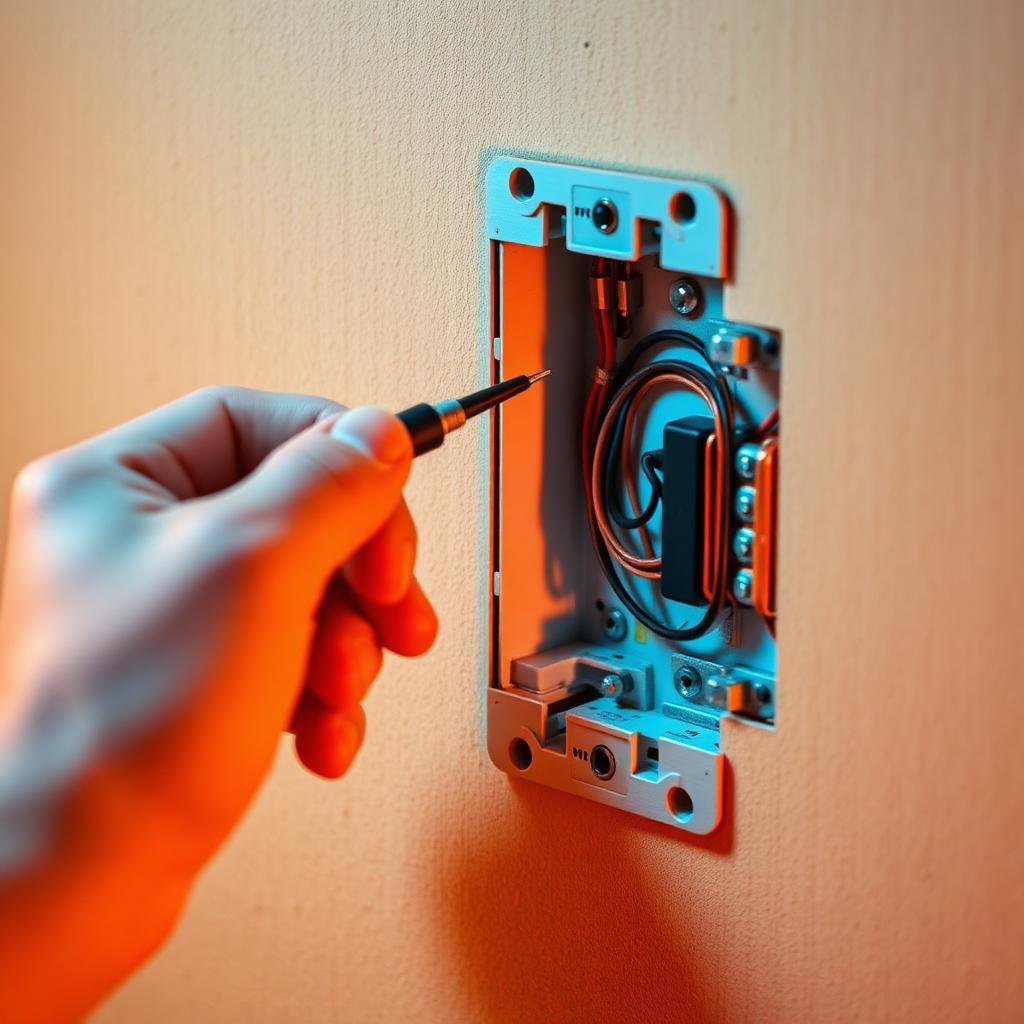
Remove the wall switch faceplate and pull the switch body out. Inspect the terminal screws. If a wire is held in only by a back-stab push-in connector, move it to a proper screw terminal; the back-stabs loosen with age and arc. Then go to the fixture itself. Drop the canopy, look at the wire nuts joining the supply, neutral, and ground. A wire nut that was twisted loosely will have one strand of copper visibly free, often with a small black scorch mark from arcing. Re-strip the wires, twist them clockwise, cap with a fresh nut sized for the gauge, and reseat the fixture.
Step 3: lights dim when the AC or fridge kicks on
If the dim is a half-second drop that always coincides with a compressor or motor starting, your lighting circuit is sharing a branch with a high inrush load. A large motor briefly pulls four to seven times its running current at start, which yanks voltage down across everything else on the same circuit.
The proper fix is a dedicated 20-amp (or larger, depending on the unit) circuit for the appliance, run straight from the service panel. For central air specifically, an HVAC technician can install a hard-start kit on the compressor that stores starting energy in a capacitor, taking the demand off the household wiring. Either way, you are not solving this with a brighter bulb.
Step 4: the whole house flickers, and that is different
Whole-house flicker, especially flicker that affects multiple unrelated circuits at the same time, is the symptom that should stop you. The most common explanation in older homes is a loose main neutral connection at the service entrance, the meter, or the utility drop. As the neutral connection loosens, voltage on each half of the 240V split-phase service stops balancing. One side spikes high (lights burn brighter and bulbs fail early) while the other sags (lights dim and motors strain). It is also a fire risk because the loose connection generates heat where it sits.
Signs to take seriously: warm outlet covers, a burnt-plastic smell near the panel, multiple bulbs burning out faster than usual, or visible scorching at the meter base. Cut the main breaker if you can do it safely, leave it off, and call a licensed electrician. If the suspect connection is on the utility side of the meter, your power company will send a crew, often the same day, and the call is usually free because the hazard is on their equipment.
What about smart bulbs?
Smart bulbs (Wi-Fi or Zigbee LED bulbs) flicker for a few additional reasons worth knowing. The most common is that you have left a physical dimmer in line with a smart bulb. The bulb expects full 120V and chops its own output internally; a dimmer cutting the upstream waveform produces visible flicker. Replace the dimmer with a plain on/off switch, or replace the bulb with a smart dimmer plus a non-smart LED. The second cause is a marginal Wi-Fi signal: when the bulb loses and reacquires its connection, it sometimes flashes during the rejoin. Move the access point or the bulb closer.
When to stop and call a pro
- You smell burning plastic anywhere near a switch, fixture, or panel.
- An outlet or switch is warm or discoloured.
- The flicker correlates with neighbours' lights, which points to a utility issue.
- You opened a switch box and saw aluminum wiring (silver-colored solid wire from the 1965-1973 era). Aluminum needs special connectors and is best left to a licensed electrician.
- The breaker for the affected room trips when you reset it.
The takeaway
A flicker is information. Scope it by asking how many fixtures are affected and when the flicker happens. One bulb is a bulb job, one room is usually a loose splice you can fix with the breaker off, and a half-second dim during an appliance start is a circuit-loading problem. Whole-house flicker, warm switches, or any burning smell is the stop sign. None of these symptoms get better if you leave them alone.