Quick Answer
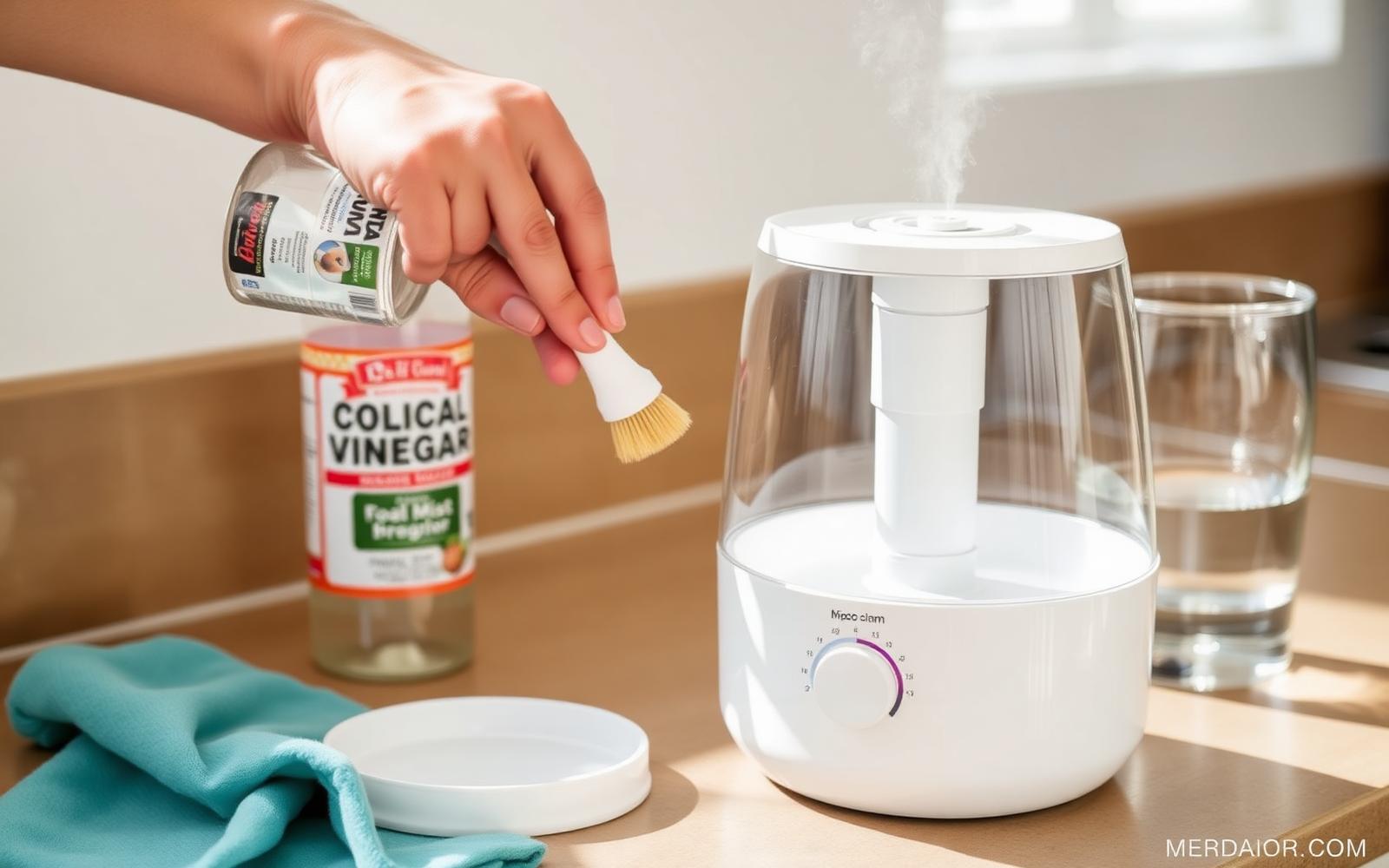
To descale a humidifier safely, unplug it, take it apart, fill the base with undiluted white vinegar (5 percent acidity) for 20 to 30 minutes, gently scrub the soft residue away with a brush, rinse, then sanitise with 3 percent hydrogen peroxide for about 10 minutes and rinse again with clean water. Do this every week if you run the humidifier daily, and rinse the tank with fresh water every single morning between deep cleans.
Skip the deep clean and you are not just running a noisy appliance, you are aerosolising whatever is growing inside the tank.
Why scale and biofilm matter for what you breathe
Tap water carries dissolved minerals, mostly calcium and magnesium carbonates. When the water evaporates, the minerals stay behind and slowly cement themselves onto every wet surface as scale. Scale is rough, porous, and effectively a microscopic apartment block for bacteria and mould.
An ultrasonic humidifier in particular can break that bacterial film into a fine aerosol and push it into the air you are breathing. This is the mechanism behind so called "humidifier lung" and the white mineral dust you sometimes see settling on furniture. Hard water plus a dirty tank is the worst combination.
What you need before you start
- Plain white vinegar, 5 percent acidity (do not use cleaning vinegar, which is far stronger and can damage plastics)
- 3 percent hydrogen peroxide
- A soft bristled brush, an old toothbrush is perfect
- Microfibre cloths
- A clean towel
Avoid bleach inside the tank. Residual chlorine can be released into the mist on the next run. Avoid abrasive sponges or steel wool, they scratch plastic and create more places for biofilm to hide.
The full descale, step by step
1. Unplug and disassemble
Unplug the humidifier from the wall and let it cool if it is a warm mist unit. Lift off the water tank and separate the mist nozzle, the float, and any wick or filter.
2. Empty and rinse
Pour any remaining water down the drain. Rinse the tank with cool water to flush loose debris. Wipe the base with a dry cloth so you can actually see where the scale is.
3. Vinegar soak
Pour undiluted white vinegar into the base reservoir up to the maximum fill line, and add about a cup of vinegar with warm water into the tank itself. Vinegar reacts with calcium carbonate to form soluble calcium acetate, water, and carbon dioxide, which is why the scale softens and lifts. Leave it for 20 to 30 minutes. For very heavy scale, you can leave it for an hour, no longer.
4. Gentle scrub
Tip the vinegar out, and use the soft brush to lift any remaining patches from corners, around the transducer disc on an ultrasonic unit, and inside the mist tower. Be especially careful around any rubber seals, which can swell if soaked too long.
5. Sanitise
Rinse everything with cool water, then add about half a cup of 3 percent hydrogen peroxide to the base and swirl it around for 10 minutes. Peroxide kills bacteria and mould spores and decomposes into water and oxygen, so there is no residual disinfectant scent.
6. Final rinse and air dry
Rinse with clean water until you can no longer smell vinegar. Stand the parts on a clean towel and let them air dry completely before reassembly. A dry tank between uses is the single best mould preventer.
How often to clean
- Every 24 hours of use: empty the tank, rinse with fresh water, refill.
- Once a week: the full vinegar and peroxide routine above.
- End of season: deep clean, fully dry, then store with the tank inverted so air can circulate.
Slowing scale in the first place
You cannot stop scale entirely, but a few habits cut buildup dramatically. Use distilled or demineralised water if your tap water is hard, and replace any demineralisation cartridge or filter on the schedule the manufacturer states. Empty the tank fully between uses rather than topping it up, because standing water is where biofilm starts. And do not run essential oils through an ultrasonic humidifier unless the manual specifically allows it, oils degrade the transducer disc and gum up the seals.
The takeaway
A humidifier should make your air feel fresher, not move bacteria around the room. Weekly vinegar plus a quick peroxide pass takes 30 minutes, costs almost nothing, and protects both the appliance and your lungs. Do it on a fixed day, treat it like changing the bed sheets, and you will get years out of even a budget unit.