Quick Answer
The theoretical turning radius of a remote control car is found with the kinematic bicycle model. Measure three things on a flat bench: wheelbase L (front to rear axle), track width W (left to right wheel centres), and the maximum steering angle of the inner front wheel.
The radius measured from the centre of the rear axle is R equals L divided by sin(angle). To find the clearance your body shell needs from a wall, add half the track width: R_outer equals R plus W divided by 2.
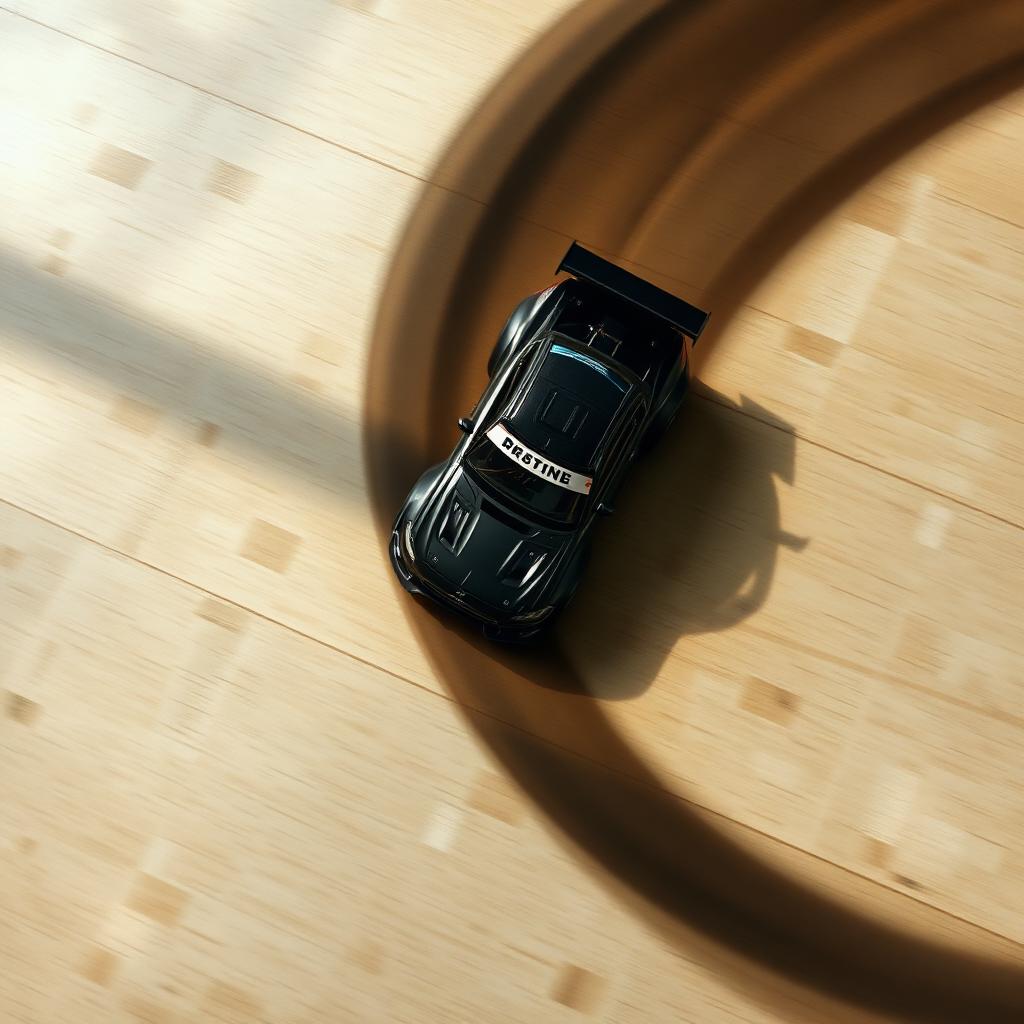
For a typical 1:10 scale drift chassis with a 260 mm wheelbase, 190 mm track width, and 35 degrees of steering lock, the answer is roughly 548 mm of clearance for a full U turn.
The three measurements you need
- Wheelbase (L). Distance from the centre of the front axle pin to the centre of the rear axle pin, measured along the chassis. Use a digital caliper.
- Track width (W). Distance between the centre of the left tyre tread and the centre of the right tyre tread. Measure both front and rear; the wider of the two is what limits clearance.
- Steering lock angle. The maximum angle of the inner front wheel relative to the chassis centre line when you hold full lock on the transmitter. Easiest method: put a printed protractor under the wheel and read it directly.
The bicycle model formula
Real cars use Ackermann geometry where the inner and outer wheels turn at slightly different angles. For low speed planning that level of detail is not necessary. We collapse the two front wheels into one virtual wheel at the centre of the front axle. That is the bicycle model used in almost every robotics textbook.
R = L / sin(angle)

R       = turning radius at rear axle centre (m)
L       = wheelbase (m)
angle   = steering angle of the front wheel (degrees, then convert)
To get the radius traced by the outer edge of the car (the bumper line that hits the wall first), add half the track width:
R_outer = R + (W / 2)Worked example: 1:10 drift chassis
- L = 260 mm (0.260 m)
- W = 190 mm (0.190 m)
- angle = 35 degrees
Step 1. sin(35) = 0.5736.
Step 2. R = 0.260 / 0.5736 = 0.4533 m, or 453 mm.
Step 3. R_outer = 0.4533 + (0.190 / 2) = 0.5483 m, or roughly 548 mm.
So the car needs about 1.1 m of free floor (twice the radius) to swing a complete U turn without scuffing the body shell against a barrier.
Worked example: 1:8 buggy
- L = 325 mm
- W = 310 mm
- angle = 28 degrees
sin(28) = 0.4695. R = 0.325 / 0.4695 = 0.692 m. R_outer = 0.692 + 0.155 = 0.847 m. Buggies turn wider because their steering lock is limited to keep tyres from rubbing the suspension arms.
Quick reference table
| Class | Typical L (mm) | Lock (deg) | Approx R_outer (mm) |
|---|---|---|---|
| 1:24 mini Z | 98 | 30 | 240 |
| 1:18 short course | 175 | 32 | 410 |
| 1:10 touring | 257 | 30 | 610 |
| 1:10 drift | 260 | 35 | 548 |
| 1:8 buggy | 325 | 28 | 847 |
| 1:5 large scale | 505 | 26 | 1310 |
Why the real world is wider
The formula gives you a geometric minimum. Actual driving radius is almost always larger because of:
- Tyre slip. At any meaningful speed the rubber slides, the car understeers, and the radius grows.
- Locked rear differential. Most drift cars run a spool. Both rear wheels spin at the same speed and the car pushes straight, widening the arc.
- Camber and toe. Setup choices that improve straight line grip steal some steering response.
- Throttle on entry. Power adds load to the rear and reduces the effective steering angle.
For race track or indoor course design, add 15 to 25 percent to the calculated R_outer to leave safe clearance.
Frequently asked questions
Where do I measure the angle from?
From the chassis centre line to the centre line of the inner front tyre at full lock. A printed paper protractor and a phone camera shot from directly above gives a reading within one degree.
Does Ackermann steering change the formula?
Yes slightly, but only by a few percent at typical RC angles. Use the inner wheel angle in the bicycle model and you stay within 5 percent of reality.
Why do my real laps show a wider arc than the math says?
Slip. The formula assumes zero tyre slip. Anything above creeping speed will widen the arc.
The takeaway
Three measurements and one formula get you a usable turning radius for any RC chassis. R equals wheelbase divided by sine of the steering angle, then add half the track width for the outer body clearance. The math is the floor; pad it by a quarter for slip and you have a reliable number for laying out an indoor race track or planning a tight drift line.