Quick Answer
For roughly 85% of off-road driving (rocks, sand, forest trails, overland routes) a modern all-terrain tire beats a mud-terrain. You only truly need an M/T if your local trails are dominated by thick, slick, axle-deep clay mud.
The internet is biased toward aggressive-looking M/T tires. The physics are biased toward A/Ts.
Tread geometry, not marketing
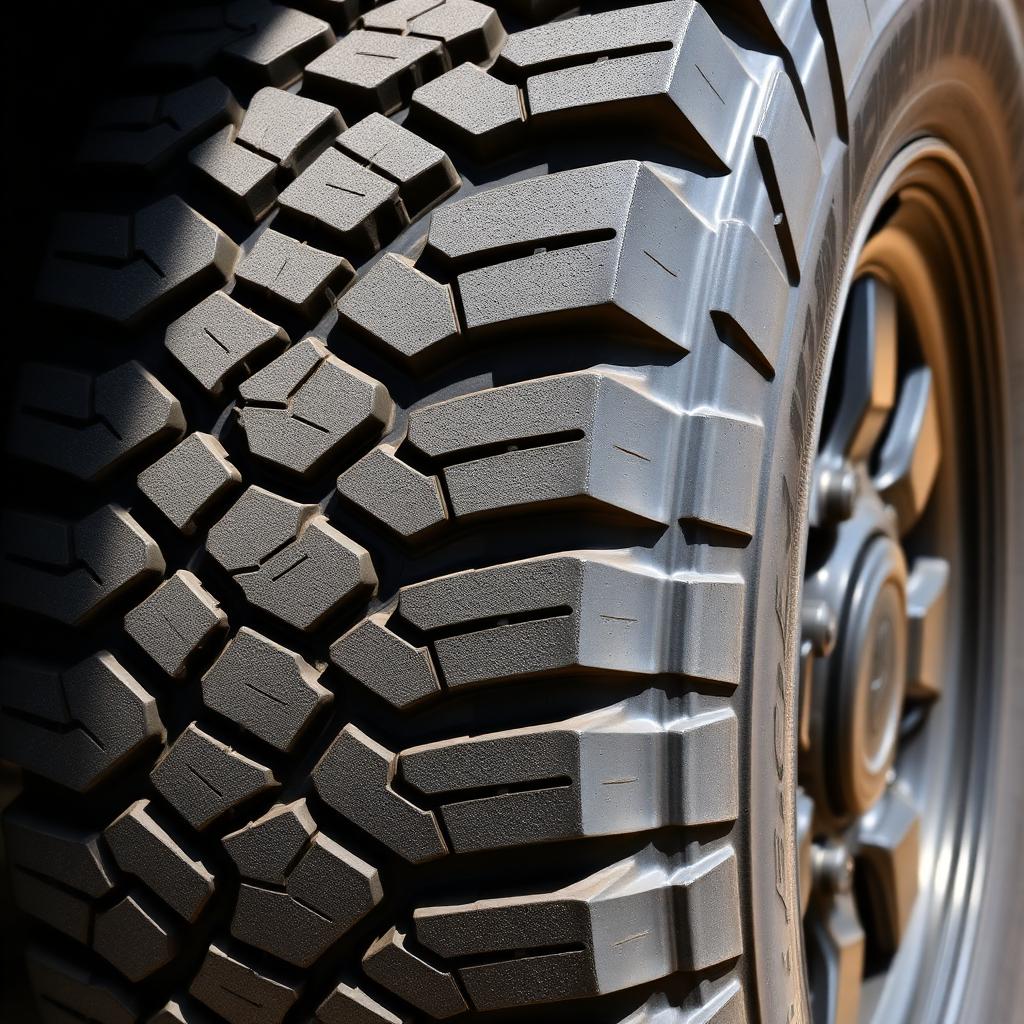
An all-terrain tire packs its tread blocks tightly with narrow void channels and micro-siping. That maximizes rubber-to-surface contact for grip on hard rock, dry pavement, and hard-packed snow.
A mud-terrain tire uses massive tread blocks separated by huge void spaces (mud channels). Those voids act like rotating paddles, scooping and flinging soft mud out of the tread so clean rubber keeps meeting the surface.
Where A/Ts actually win on trail
Dry rock and granite
Grip on clean rock is about contact patch. A tightly-packed A/T places more rubber on a flat rock face than a knobby M/T that only touches at lug tips.
Loose sand and dunes
Sand success is about flotation. An aggressive M/T with sharp paddle edges digs down through topsoil into a self-made hole. A flexible A/T flat-plates over the surface, which is what you want.
Snow and ice
Modern A/Ts (Wildpeak AT4W, BFG KO3, Toyo Open Country A/T III) carry the 3-Peak Mountain Snowflake severe snow rating. M/Ts almost never do, because their tread voids do not evacuate snow the way winter siping does.
Where M/Ts genuinely win
Thick clay mud, deep organic bog, and swamp trails where an A/T's tightly-packed tread instantly clogs and turns into a slick. In that specific environment, an M/T's self-cleaning paddle action is a real advantage.
Decision matrix
| Surface | All-Terrain | Mud-Terrain | Winner |
|---|---|---|---|
| Slick clay and deep bogs | Poor | Excellent | M/T |
| Dry rock crawling | Excellent | Very good | A/T |
| Loose sand and dunes | Excellent | Poor | A/T |
| Daily highway commute | Quiet, ~55k mi life | Loud, ~35k mi life | A/T |
The hybrid option
If you want more sidewall bite than a pure A/T without the road noise of an M/T, look at hybrid rugged-terrain tires like the Nitto Ridge Grappler or Toyo Open Country R/T. They keep a tight center block cluster (quiet highway) but run aggressive M/T-style shoulder lugs.
Frequently asked questions
Do I need to air down my A/Ts more than M/Ts?
A little, because A/Ts have stiffer sidewalls. My typical A/T airdown for rocks is 18 to 22 psi. For a similar-size M/T I would run 15 to 18 psi.
Will an A/T pass 3-Peak Mountain Snowflake rating?
The best modern A/Ts do. Look for the actual 3PMSF symbol on the sidewall, not just "all-weather" marketing.
Are hybrid R/Ts a good compromise?
They are excellent for someone who daily drives to a technical trailhead. Expect 40,000 to 50,000 miles of tread life and slightly more noise than an A/T.
Bottom line
Yes, you can absolutely off-road with A/Ts, and for most trail profiles they are the smarter choice. Save the M/Ts for genuine mud country.
Load rating matters more than tread pattern for most builds
Whether I run an A/T or a hybrid, I pay closer attention to load range than to tread pattern. An LT-rated (Light Truck) tire in Load Range C or E has significantly stronger sidewalls than the equivalent P-metric (passenger) tire. Stronger sidewalls resist punctures on rock trails and allow safe airing down for traction. Tread pattern gets the credit online. Sidewall construction does the real work.
Real-world tread life expectations
Modern all-terrain tires from Falken, BFGoodrich, Michelin, and Toyo routinely deliver 55,000 to 65,000 miles of tread life when rotated properly. A traditional mud-terrain often taps out at 35,000 to 45,000. Over the ownership life of the vehicle that is a real dollar difference, on top of the daily fuel economy penalty of the M/T's higher rolling resistance.
When I would still buy a mud-terrain
If I lived in the Pacific Northwest with wet clay logging roads, or in the Southeast with deep organic bogs, I would run an M/T without hesitation. If I lived in Colorado, Arizona, Utah, or Nevada where rock, sand, and dry alpine dominate, an A/T or hybrid R/T wins every single trip.
Safety notes for aggressive tread patterns
Mud-terrains have less siping (small slits inside the tread blocks) than A/Ts. That translates to noticeably longer wet-pavement stopping distances. In rain-heavy climates the highway safety penalty of an M/T is a real consideration, not a theoretical one. A/Ts and hybrid R/Ts hydroplane later and stop shorter on wet asphalt.
Airing down is the biggest performance multiplier
Whether I run A/Ts, hybrids, or M/Ts, airing down from street pressure to trail pressure is the single largest traction improvement I can make in 5 minutes. On rock I drop to 18 to 22 psi, on sand I drop to 12 to 15 psi, and I always carry a portable air compressor to reinflate at the trailhead. That single habit outperforms any tread pattern upgrade for a beginner driver.