
Quick Answer
Choose a home IPL device only after checking that its exact model permits your skin tone, hair color, and intended treatment area. Clear instructions, appropriate safety sensors, reliable support, and a schedule you can follow matter more than cooling claims, flash counts, or a universal ranking.
Home IPL can reduce hair growth for suitable users, but it can also cause burns, pigment changes, and eye injury when misused. I would read the full manual before buying, especially its tanning, medication, pregnancy, skin-condition, and body-area restrictions.
Understand what IPL targets
Intense pulsed light uses broad-spectrum light rather than a single laser wavelength. Pigment in hair absorbs light and converts it to heat. Because hair grows in cycles, repeated sessions may be needed, and results and maintenance requirements vary by device and individual.
Skin pigment also absorbs light, which is why compatibility matters for safety. Darker skin can be unsuitable for a particular home device even when hair is dark. Lowering intensity does not automatically make an excluded skin tone safe to treat.
Very light blond, red, gray, and white hair often responds poorly or is excluded because it does not provide the pigment target the device needs. Check the actual chart, including the specific body area, since skin and hair color can vary across your body.
Screen suitability before comparing features
Use the manufacturer's current manual for the exact model, not a chart copied from another product listing. Check permitted ages, treatment areas, and restrictions for medical conditions or medicines. If the manual is unavailable or unclear, that is a reason to pause the purchase.
Ask a clinician or pharmacist about medicines that may increase light sensitivity, and tell them the device you are considering. Do not stop prescribed treatment to qualify for IPL. Follow exclusions for pregnancy or breastfeeding rather than assuming a lack of proof of harm means permission to use it.
Do not treat damaged, infected, inflamed, or recently sunburned skin. Tattoos, permanent makeup, and dark lesions can absorb excessive energy. Follow the model's instructions about avoiding these areas; an improvised cover does not automatically make it safe to flash over them.
Eye safety is not optional
Never use home IPL on eyebrows, eyelids, or near the eyes. Closing your eyes, wearing sunglasses, or placing a towel over them does not convert a prohibited treatment area into a safe one. Facial-use permission below a specified boundary is not permission for the whole face.
Follow the device's eye-safety instructions exactly, including any protective-equipment requirements. Do not look into the treatment window or deliberately fire it away from the skin. Keep other people and pets away from stray flashes and avoid demonstrating the lamp for entertainment.
Contact sensors are useful safeguards, not a reason to bypass the manual. Do not defeat a sensor, tape a switch down, or repeatedly try to force a flash when the device refuses. A refusal can reflect unsafe skin tone, poor contact, or a fault.
Features that are worth evaluating
A manageable handle, readable controls, and attachments appropriate for permitted areas can make consistent use easier. Compare the weight, cord arrangement, and whether you can comfortably reach the intended body area without stretching or losing contact.
Cooling may affect comfort, but it cannot eliminate burn risk or expand the device's approved skin-tone range. Avoid claims that a particular cooling material guarantees a safe surface temperature in every situation. Marketing photographs are not evidence of clinical superiority.
Lamp life and flash counts can help compare ownership requirements, but they do not reliably translate into a promised number of years. Corded and cordless designs both need evaluation on their own merits. A charged cordless device is not automatically weaker or unsuitable.
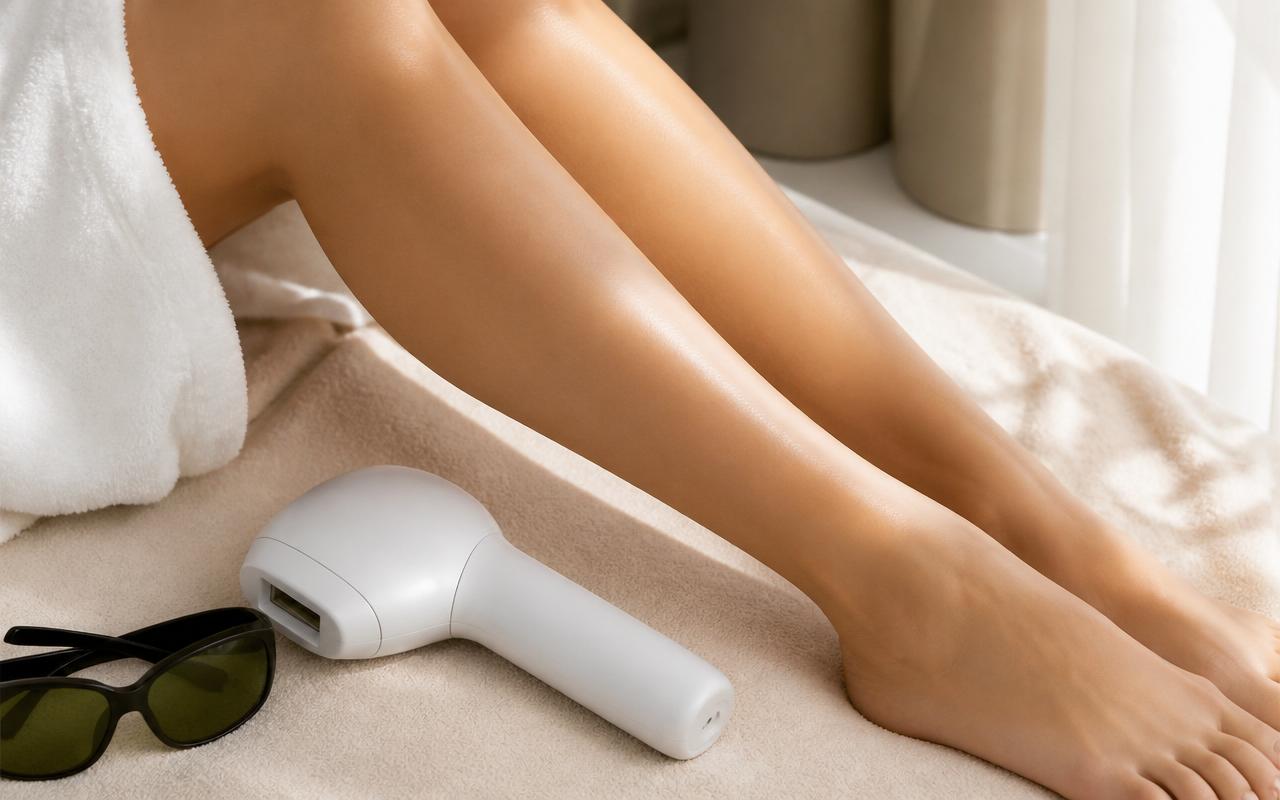
The illustration shows treatment on a leg, not a universal application protocol. Follow the model's instructions for spacing, stamping, or gliding. Its retained caption's simplified heat statement should not be treated as a measured dose rule for all IPL devices.
Prepare according to your own manual
Perform the prescribed skin test on each new treatment area and observe the required waiting period. Repeat testing when the instructions call for it, such as after a change in skin tone or a long break. A successful test does not guarantee that every future session will be reaction-free.
Remove hair using a method allowed for that device. Many systems specify shaving, while preparation instructions can differ. Do not transplant a fixed waxing or plucking restriction from another brand. Clean and dry the skin, removing products as directed.
Check the window and attachment for damage, residue, and correct assembly. Choose a well-lit, stable workspace. Do not use the unit in water or beside a filled sink unless its instructions explicitly permit that environment; most treatment devices should be kept dry.
Follow a model-specific schedule
There is no universal eight-to-twelve-week weekly course. Some models specify different initial intervals and maintenance schedules. More frequent flashes, extra passes, or increasing intensity every session do not necessarily improve results and can increase skin injury.
Use the setting established through the manual's testing process rather than aiming automatically for the maximum. Treatment should not require tolerating significant pain. Stop if the sensation becomes painful, the device becomes unusually hot, or skin develops concerning changes.
Sun and tanning restrictions often extend beyond a simple forty-eight-hour window. Follow the exact guidance before and after treatment, including rules for self-tanner. Sunscreen does not cancel a waiting period or make newly tanned skin safe for a device that excludes it.
Care and troubleshooting
Switch off and unplug before cleaning, and let the unit cool if instructed. Use only the recommended cleaning method on the light window and attachments. Do not immerse electrical parts or use abrasive products that could scratch the window.
Store the device dry and protected from damage. If it will not flash, review contact, attachment fit, skin-tone suitability, and fault indicators. Do not repeatedly flash the same spot while troubleshooting. Contact the manufacturer for unresolved problems or damage.
If progress seems slow, check compatibility and whether you followed the specified course before increasing exposure. Hair-reduction claims do not guarantee a completely hair-free result, permanent removal of every hair, or the same outcome as professional treatment.
FAQ
What should I do after a suspected burn?
Stop using the device. Seek medical advice for blistering, persistent pain, marked swelling, skin breakdown, or significant color changes. Eye pain or vision changes after exposure require prompt medical assessment. Do not continue treatment to finish the area.
Can I use it on a beard or intimate area?
Only if the exact manual permits the specific area. Many devices restrict male facial hair and genital or mucosal areas. A bikini-line attachment does not mean permission for every nearby surface.
Is home IPL suitable for everyone with unwanted hair?
No. Other options include shaving, carefully selected depilatories, or professional treatments suited to the person. A dermatologist can advise when skin tone, hair color, a medical condition, or unexplained new hair growth makes home IPL a poor fit.
Bottom line
Compatibility and disciplined use come before features. Read the exact manual, respect eye and skin restrictions, patch test as directed, and follow its schedule. Cooling, sensors, and large flash counts cannot make an unsuitable user or prohibited body area safe.