Quick Answer
They are not banned in the US, but the American Academy of Pediatrics (AAP) and most pediatricians recommend avoiding them. Injuries from falls and door-frame failure are well documented, and posture/hip experts flag the suspended position as suboptimal for developing hips and toes.
A freestanding stationary activity center is the safer alternative if you want hands-free time. It offers the same upright play position without the door-frame, swinging, or fall risks.
Why door jumpers raise safety concerns
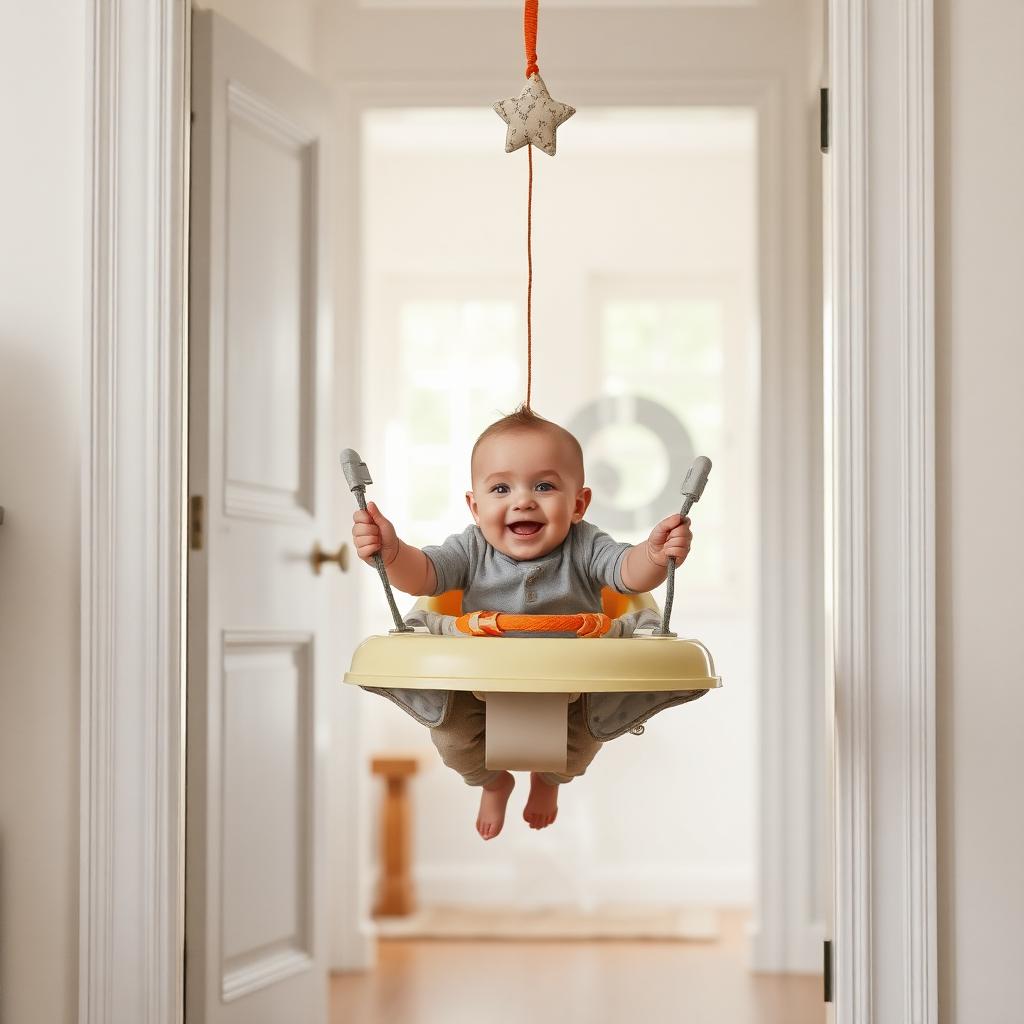
Door jumpers hang from a doorframe clamp using straps and a fabric seat. The CPSC has tracked recurring incident patterns: the clamp slipping or breaking and dropping the baby, the baby swinging hard into the doorframe, fingers and toes pinched in the strap or seat, and head injuries from the baby tipping over the bouncing tray on a stationary surface.
The AAP's longstanding guidance is to avoid baby walkers entirely and to use any jumper or activity device sparingly. Health Canada banned baby walkers outright in 2004 and warns against unsupervised jumper use.
Hip and foot development concerns
The International Hip Dysplasia Institute notes that any device that holds the legs in an extended, dangling position for long periods is not ideal for developing hip joints. Pediatric physical therapists also flag the "tippy toe" bouncing pattern (babies push off the balls of their feet because their legs cannot fully reach the floor) as a potential contributor to delayed walking patterns in heavy users.
Safer use guidelines if you choose to use one
Limit sessions to 15 to 20 minutes, no more than once or twice a day. Check the clamp on a solid wood doorframe at least 5 inches thick with no glass nearby. Adjust the strap so the balls of the baby's feet rest flat on the floor (not on tiptoe). Never use one near stairs, on a glass door, on a folding door, or with siblings/pets nearby. Stop using as soon as the baby can climb out, reach 25 lb / 11 kg, or starts walking.
Safer alternatives
Stationary activity centers (Skip Hop Explore & More, Fisher-Price Sit-Me-Up) provide upright play without the doorframe risk. Tummy time, supervised floor time with a play gym, and the parent's lap remain the developmental gold standard.
When to skip them entirely
Skip door jumpers if your home has hollow-core doorframes, glass-paneled doors, or stairs nearby. Skip if your baby is under 4 months, cannot fully support their head, or shows hip clicks or asymmetric leg movement (check with your pediatrician).
Bottom line
Door jumpers are legal but not pediatrician-recommended. If you use one, keep sessions short and supervised, or choose a stationary activity center for the same hands-free benefit without the suspended risks.
What recent recall data shows
CPSC recall searches consistently surface door jumper incidents tied to two failure modes: clamp slip on slick or painted doorframes, and seat strap separation from the spring assembly under repeated bouncing load. Always register a new jumper with the manufacturer so you receive recall notifications by email.
Developmental window for jumper use
Pediatric guidance generally lines up around 4 to 6 months at the earliest (independent head control is mandatory) and ending by 9 to 12 months or whenever the baby can stand, climb, or pull themselves out. Outside that window, the device is either unsafe (too young) or pointless and potentially restrictive (too old).
Talk to your pediatrician about hip screening
If you have any family history of developmental hip dysplasia or your baby was breech, raise the jumper question at your 4-month check-up. Most pediatricians will say "fine in moderation" for low-risk babies and "skip it" for higher-risk profiles. That single conversation costs nothing and replaces internet guessing.
What pediatric physical therapists actually recommend
Most pediatric PTs prioritize floor-based play above any container device. Tummy time, supported sitting on a parent's lap, and supervised floor exploration build core strength, hip mobility, and visual tracking far better than any jumper, walker, or bouncer can. Container devices have a role for short hands-free windows, not for daily development time.
Safe alternatives at every age
0 to 3 months: tummy time on a play mat, contrast-pattern visual cards. 3 to 6 months: supervised floor play with a play gym, supported sitting with a Boppy. 6 to 9 months: stationary activity center for 15 to 20 minutes, lots of floor time. 9 to 12 months: push-walker (the kind they push, not sit in), cruising along furniture.
Quick safety audit before every session
Inspect the clamp, the springs, the seat fabric, and the doorframe wood for any wear, rot, or paint chipping. Make sure no glass, stairs, pets, or older siblings are within striking distance. Set a timer for 15 minutes so you do not lose track. Stop immediately if the baby seems uncomfortable or the doorframe sounds stressed.