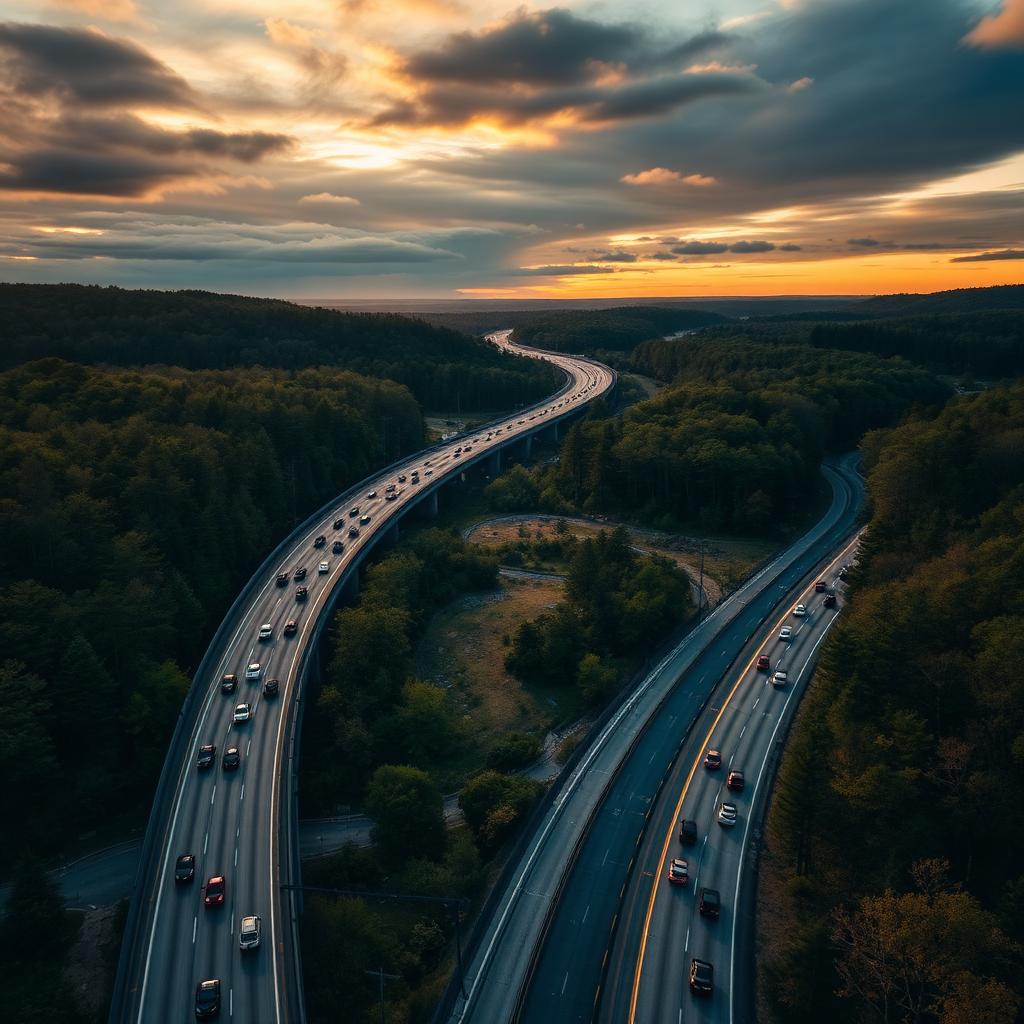
Quick Answer
Interstate 95 is the longest north to south Interstate in the United States, running about 1,920 miles from the Canadian border at Houlton, Maine down to its southern terminus at US 1 in Miami, Florida.
It passes through 15 states plus the District of Columbia corridor and connects most of the largest metro areas on the East Coast: Boston, Providence, New Haven, New York, Newark, Philadelphia, Baltimore, Washington, Richmond, Jacksonville, and Miami.
The corridor it serves is home to more than 110 million people and produces a very large share of the country's gross domestic product, which is why a single closure on I-95 can disrupt freight, commuting, and travel along the entire eastern seaboard.
The Scale of I-95 in Plain Numbers
Before getting into how to drive it, it helps to picture the size of the system.
- Total length: approximately 1,920 miles (about 3,090 km).
- States crossed: 15, from Maine to Florida, plus a passage through the DC area road network.
- Population served: the I-95 corridor is home to roughly one third of the US population.
- Freight role: a major share of east coast trucking moves on or feeds into I-95, especially the New Jersey to Virginia segment.
The highway was funded under the Federal Aid Highway Act of 1956 and built piece by piece over the following decades. The final original gap, a missing link in central New Jersey near the Pennsylvania Turnpike, was closed in 2018, finally making I-95 a continuous route from Maine to Florida.
The Three Personalities of I-95
Even though it carries one number, I-95 behaves like three different highways depending on where you are on it.
1. The Northeast and New England Stretch (Maine to New York)
From Houlton, Maine the road starts quiet and rural, threading through forests and small towns. By the time it reaches Massachusetts, Rhode Island and Connecticut it is a dense, multi lane commuter route. Two themes dominate this segment.
The first is tolls. Bridges, turnpikes and express lanes on the northeast section rely heavily on E-ZPass. Drivers without a transponder usually get billed by mail with a surcharge, so a transponder pays for itself quickly on a single Maine to Virginia run.
The second is winter weather. From late November through March, this segment is exposed to nor'easters, lake effect snow and freezing rain. Checking each state's 511 service before and during a drive is the simplest way to avoid getting trapped behind a winter shutdown.
2. The Mid Atlantic Congestion Zone (New Jersey to Virginia)
This is the hardest section to drive. It connects New York City, Philadelphia, Wilmington, Baltimore and Washington in one continuous urban band.
In New Jersey, I-95 runs along the New Jersey Turnpike and splits into separate roadways for cars and for trucks and buses. Pay attention to the lane signs well in advance, because once you commit to the car only lanes you cannot pull a heavy trailer back across.
Around Washington, I-95 intersects the Capital Beltway (I-495). Congestion here is not limited to rush hour. Crashes, construction, and special events around the capital regularly back traffic up in the middle of the day.
3. The Southern Corridor (North Carolina to Florida)
South of Richmond the personality of the road changes completely. Lane counts drop, speed limits rise to 70 mph in much of Virginia, the Carolinas and Florida, and the surroundings become long stretches of pine forest, farmland and coastal marsh.
The classic landmark is South of the Border, a kitschy roadside complex straddling the North and South Carolina line that has been advertised for hundreds of miles in advance since the mid twentieth century. Past Jacksonville, the road runs straight down the Florida coast and ends at the intersection with US 1 in downtown Miami.
Tolls, E-ZPass, and Cashless Lanes
If you drive any meaningful portion of I-95 north of Washington, you will hit tolled infrastructure. The pattern to remember is simple.
- E-ZPass works almost everywhere on the corridor. One transponder covers Maine, New Hampshire, Massachusetts, Rhode Island, New York, New Jersey, Pennsylvania, Delaware, Maryland, Virginia, and several others.
- Many toll points are now cashless. The Massachusetts Turnpike, large parts of the New York system, and several Maryland facilities use overhead gantries. If you do not have a transponder, a camera reads your plate and a bill is mailed to the registered owner, typically with an administrative fee.
- Florida uses SunPass. SunPass and E-ZPass are increasingly interoperable, but if you live in the northeast and drive often in Florida, check the current interoperability list before you go.
The Worst Bottlenecks and How to Time Them
A short list of points where I-95 traffic predictably falls apart, and the practical workaround for each.
- The George Washington Bridge approach (Bronx, NY). Avoid 7 to 10 in the morning and 3 to 7 in the evening. Late evening or before sunrise is dramatically faster.
- The Cross Bronx Expressway. Often the slowest urban stretch in the country. If you can shift a long drive to overnight, do it.
- The Delaware Memorial Bridge and the JFK Memorial Highway in Maryland. Friday afternoon and Sunday evening are the worst.
- The Washington Capital Beltway interchange. Mid morning (10 to noon) and mid afternoon (1 to 3) are usually the calmest windows.
- The Florida turnpike connector near Miami. Late afternoon backs up badly. Aim to arrive before 3 or after 8.
A Practical Checklist for a Long I-95 Drive
If you are planning a multi day trip down the corridor, the same short checklist saves time and money for everyone.
- Get an E-ZPass transponder. Even residents of non toll states benefit on a single end to end run.
- Plan fuel and food stops by service area, not city. The New Jersey Turnpike, Delaware, and Maryland have dedicated service plazas; in the south you exit and re enter.
- Build a weather buffer. Add half a day to any November to March drive that crosses the northeast.
- Use both navigation and a 511 service. State 511 lines and apps catch incidents and construction faster than consumer navigation.
- Pre book hotels on the long southern stretch. Once you are south of Richmond, exits with multiple hotels are spaced farther apart.
- Carry physical maps as a backup. Cellular coverage drops in parts of Maine, eastern North Carolina, and southern Georgia.
Safety: What Actually Causes I-95 Crashes
State troopers along the corridor cite the same handful of causes year after year. Speeding above conditions, following too closely in heavy truck traffic, distracted driving (especially on the long flat sections in the south where it is easy to zone out), and inappropriate use of the left lane. Two simple rules cut your risk noticeably: keep at least three to four seconds of following distance behind any tractor trailer, and treat the left lane as a passing lane, not a cruising lane.
The Bottom Line
I-95 is not really one highway. It is a quiet northern segment, a brutal mid Atlantic urban gauntlet, and a long fast southern run, stitched together by one route number. Treat each section on its own terms: an E-ZPass and a weather plan for the north, patience and good timing for the middle, and disciplined cruising habits for the south. Do that and the longest north to south Interstate in the country becomes a manageable, even enjoyable, drive.