Quick Answer
Onions make you cry because cutting them releases a volatile sulfur compound called syn-propanethial S oxide. When that gas reaches the surface of your eyes, it reacts with the water in your tear film to form a mild sulfuric acid.
Your nervous system reads the sting as an irritant and triggers your tear ducts to flush the area with extra fluid. The reaction is fast, harmless and incredibly consistent.
The short answer
Onions make you cry because cutting them releases a volatile sulfur compound called syn-propanethial S oxide. When that gas reaches the surface of your eyes, it reacts with the water in your tear film to form a mild sulfuric acid. Your nervous system reads the sting as an irritant and triggers your tear ducts to flush the area with extra fluid.
The reaction is fast, harmless and incredibly consistent. Almost everyone has the same response within seconds of slicing into a fresh onion, regardless of age, country or cooking experience.
The chemistry behind the tears
An intact onion stores two key ingredients in separate parts of its cells: amino acid sulfoxides and an enzyme called alliinase. As long as the cells stay whole, the two never meet and the onion smells almost neutral. The moment a knife crushes those cells, the enzyme floods into the amino acid pool and starts a chain of reactions that ends in the airborne irritant.
The compound is light enough to drift upward toward your face within seconds. Once it lands on the moist surface of your eyes, it converts into a small amount of sulfuric acid and a few related sulfur acids. The amounts are tiny, but the corneal nerves are extremely sensitive, so even a fraction of a microgram is enough to set off a flood of tears.
Why some onions hurt more than others
- Yellow and white storage onions have the highest sulfur content and produce the strongest reaction.
- Red onions are usually milder because they contain less of the precursor amino acids.
- Sweet onions like Vidalia and Walla Walla are bred specifically to have lower sulfur, which is why they barely sting.
- Spring onions and shallots sit somewhere in the middle.
- Older onions often produce more gas because the enzyme activity rises in long stored bulbs.
Why do they sting more on some days?
The same onion can feel different from one day to the next. Warm kitchens speed up the reaction because heat helps the gas evaporate. Dull knives crush more cells than they slice, which releases more enzyme. A dry onion that has been sitting on the counter for a week often hits harder than one fresh from the fridge.
How to slice without crying
- Chill the onion for 15 minutes before cutting. Cold slows the enzyme.
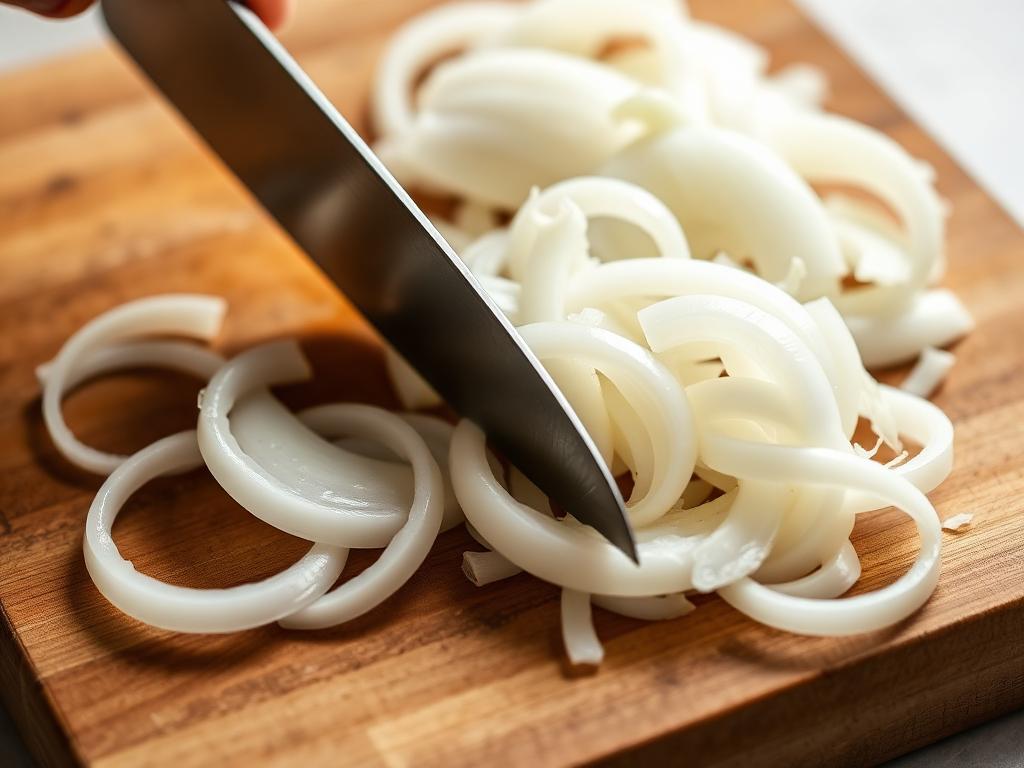
- Use a very sharp knife so you slice through cells rather than crushing them.
- Cut near a running tap or an open window so airflow carries the gas away from your face.
- Wear close fitting glasses or onion goggles to physically block the gas.
- Light a candle near the cutting board. The flame oxidizes some of the sulfur gas before it reaches your eyes.
- Leave the root end intact for as long as possible. The root holds the highest concentration of the enzyme.
What about contact lenses?
Contact lens wearers often notice less stinging because the lens covers part of the cornea and reduces direct exposure to the gas. The trade off is that any irritant that does land on the eye sticks around longer in the tear film between the lens and the eye, so the discomfort can last a little longer once it does start.
Does cooking destroy the irritant?
Yes. Heat denatures the enzyme almost instantly, which is why a sauteed or roasted onion is sweet and aromatic rather than sharp. The sulfur compounds rearrange into different molecules during cooking, including the ones responsible for the deep savory flavor of caramelized onions and French onion soup.
What about the lachrymatory factor synthase?
For decades, scientists believed the tear inducing gas formed spontaneously the moment the enzyme alliinase met its amino acid target. Then in 2002, a team of Japanese researchers identified a second enzyme they named lachrymatory factor synthase, or LFS. It is the actual culprit responsible for converting the intermediate compounds into the airborne irritant. Their discovery opened the door to a tearless onion bred by silencing the LFS gene, which preserves the flavor compounds while eliminating the gas.
Tearless onions have been grown commercially in New Zealand and the United States, marketed under names like Sunions and Redon. They taste milder and sweeter, but they have not displaced traditional onions because most cooks still want the deep flavor that comes from the very same sulfur chemistry that makes their eyes water.
Why does your nose run too?
The same gas that hits your eyes also irritates the lining of your nose. Your nasal passages respond by producing extra mucus to flush the irritant out, which is why a long onion chopping session often ends with both teary eyes and a runny nose. People with sinus sensitivities or seasonal allergies often notice the reaction more strongly because their mucous membranes are already primed to react.
Are some people immune?
Almost nobody is fully immune, but sensitivity varies a lot. Children often react more strongly than adults because their faces are physically closer to the cutting board and their tear reflex is brisker. Some long time professional cooks report that they barely tear up anymore, which seems to be a mix of practiced technique, sharper knives and a slight desensitization of the corneal nerves over years of exposure.
The takeaway
Onions cry because they evolved to defend themselves. The sulfur gas that stings your eyes is a chemical weapon aimed at insects and grazing animals, and we humans are simply collateral damage. A sharp knife, a cold onion and a little airflow are usually enough to keep your kitchen tear free.
Quick recap
If you remember only one thing, it is that the tears are a chemistry response, not an emotional one, and the chemistry can be slowed down. Cold the onion, sharpen the knife, move the air, and the most aggressive bulb in your kitchen turns into a manageable ingredient. Cooking destroys the irritant entirely, which is why nobody has ever cried over a finished bowl of French onion soup.
The bonus is that learning the chemistry also explains the flavor. The same sulfur compounds that make your eyes water are the same family of molecules that make a slow caramelized onion taste so deeply savory. The sting in your eyes and the depth on your plate are two sides of one biological story.