Quick Answer
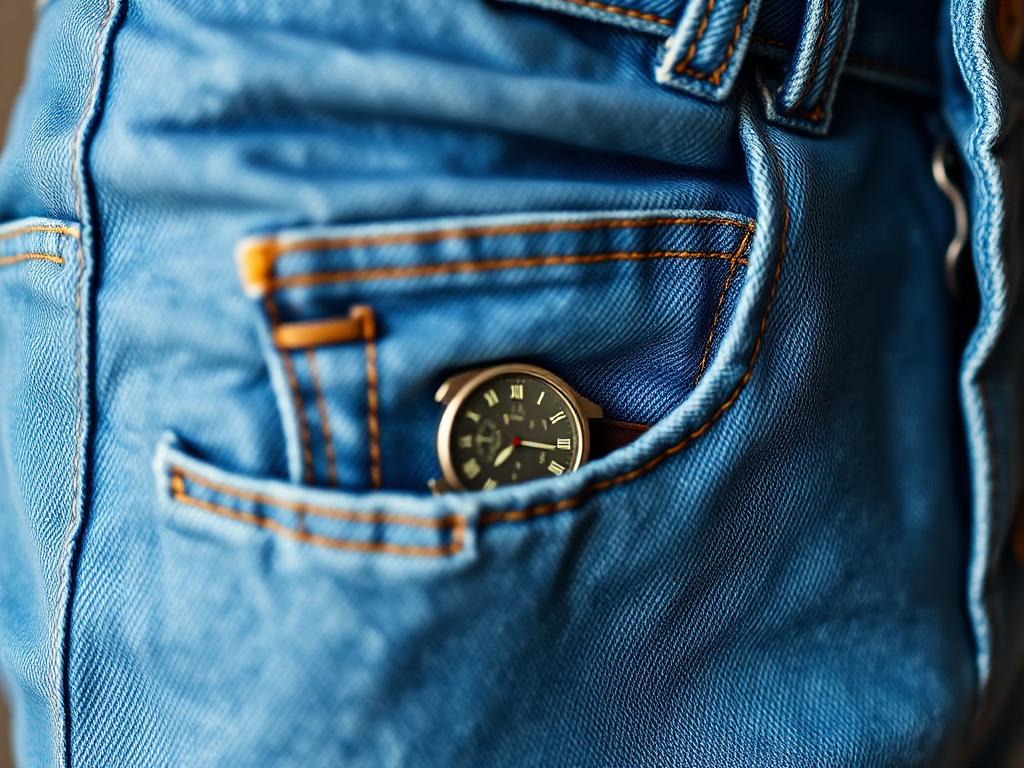
The tiny front pocket on a pair of jeans is a watch pocket, designed in the 1870s to safely hold a pocket watch for cowboys, miners and railway workers. It predates the wristwatch by more than fifty years and survived purely because nobody ever bothered to redesign it out of the pattern.
It is one of the clearest examples of fashion fossilizing function. The original purpose disappeared a century ago, but the feature is still stitched into almost every pair of jeans made today.
The short answer
The tiny front pocket on a pair of jeans is a watch pocket, designed in the 1870s to safely hold a pocket watch for cowboys, miners and railway workers. It predates the wristwatch by more than fifty years and survived purely because nobody ever bothered to redesign it out of the pattern.
It is one of the clearest examples of fashion fossilizing function. The original purpose disappeared a century ago, but the feature is still stitched into almost every pair of jeans made today.
Why does this pocket even exist?
When Levi Strauss and Jacob Davis patented the riveted denim work pant in 1873, the standard timekeeper for working men was a chain attached pocket watch. Wristwatches were considered jewelry for women and were not widely worn by men until after World War I.
A loose pocket watch in a deep front pocket was a recipe for a cracked crystal. The tiny pocket sat right at the waistband, held the watch snug and let the chain run cleanly to a belt loop or buttonhole. It was a practical, almost obvious bit of work wear engineering.
Why did it survive into the wristwatch era?
By the 1930s, wristwatches had taken over and pocket watches were rare. But by then the watch pocket had become part of the visual identity of jeans, especially the iconic Levi's 501. Removing it would have made the jeans look wrong to customers who had grown up with the design.
It also turned out to be quietly useful. Generations of wearers have used it for coins, lighters, guitar picks, ticket stubs, lip balm, USB drives and small folded notes. The pocket persisted because it never really stopped being convenient.
What people actually use it for today
- A few coins for parking meters or vending machines.
- A house key with a slim keyring.
- Earbuds, when wired earbuds were still common.
- A guitar pick for musicians who reach for one mid set.
- A lip balm or small tube of medication.
- A folded receipt or a single dollar tip.
Are there other names for it?
It goes by many names depending on the brand and the era. Levi's calls it the "watch pocket." Wrangler refers to it as the "coin pocket." Some workwear brands list it as a "frontier pocket" or simply the "fifth pocket," since the standard jean pattern has four other pockets.
The rivet next door
Look closely at the watch pocket on classic Levi's and you will see two small copper rivets reinforcing the corners. Those rivets were Jacob Davis's actual patent. They were added to all the high stress points on the jeans because miners kept ripping the pocket corners under the weight of tools and ore samples. The watch pocket happened to need the same reinforcement because the metal pocket watch was surprisingly heavy for its size.
Why has nobody removed it?
Designers have tried, especially during the slim fit boom of the 2010s, when several brands experimented with sleeker, pocket free fronts. Customers responded poorly. The pocket carries a strong sense of authenticity and heritage that buyers seem unwilling to give up.
It also costs almost nothing to include. A few extra inches of fabric, a few stitches, two rivets. The economics never made it worth removing.
How big was a real pocket watch?
A typical 19th century railroad pocket watch was about 50 millimeters across and weighed close to 100 grams. That is roughly the size of a modern stack of five poker chips. Slip one into the watch pocket of a pair of vintage Levi's 501s and it fits with almost no room to spare, which is the clearest physical proof that the pocket was sized for exactly that purpose. Modern jeans have kept the dimensions almost unchanged, even though virtually nobody now carries a watch that big.
Did women's jeans get the same pocket?
Almost always, yes, but with a catch. Women's jeans tend to have shallower main pockets, and the watch pocket is often even smaller or sewn shut as a decorative detail. This frustrating shrinkage has nothing to do with the original watch design and everything to do with twentieth century fashion choices that prioritized a slim silhouette over function. Several modern brands now market women's jeans with full depth pockets and a usable fifth pocket as a deliberate selling point.
The cultural afterlife of the watch pocket
The watch pocket has shown up in unexpected places. It is the favorite hiding spot for engagement rings during proposals, because the pocket holds a small ring box snugly without obvious bulges. Bartenders and waiters tuck folded bills into it for quick access. Hikers use it for a single emergency painkiller or a tiny compass. It has also become a quiet status marker on heritage denim, where the depth, stitching and rivet pattern of the watch pocket signal which era of jean design the maker is referencing.
What about smart watches?
It is a small irony that the wristwatch killed off the pocket watch, and now the smartwatch has nudged the wristwatch toward decline. Yet the pocket made for the original technology is still right there on every pair of jeans, more than a century after its job ended. Few design choices in everyday clothing have outlasted their purpose for so long.
The takeaway
That tiny pocket is a pocket watch holster from the American frontier, still riding around on your hip in the 21st century. Most fashion details fade in a decade. This one has survived 150 years, two world wars and the entire smartphone era, simply because it is small, useful and impossible to imagine jeans without.
Quick recap
The watch pocket is a perfect case study in how design choices outlive the problems they solved. It was born for a specific tool, kept alive by visual identity, and quietly repurposed by every generation that wore the jeans. None of those generations needed a pocket watch, but each found something small and important to slip inside.
The next time you reach for a coin or a guitar pick in that pocket, you are using a piece of nineteenth century industrial design that has refused to retire. Few details on any garment in your closet can claim such a long, continuous working life.