Quick Answer
Doors were invented at least 5,500 years ago. The oldest preserved door in Europe is the Robenhausen door, found at a pile-dwelling site near Zurich, Switzerland and dated to around 3063 BCE.
Egyptian tomb paintings show single-leaf and double-leaf doors with pivots in use by 2000 BCE. The Romans introduced double doors with bronze hinges, sliding doors, and folding doors that remain the basis of modern designs.
The oldest known door
In 2010, Swiss archaeologists in Zurich excavated a wooden door dated to around 3063 BCE during a parking garage dig. Built of poplar planks held together with crossbeams and tight-fitting hinge holes, the door belonged to a Neolithic pile-dwelling village called Robenhausen. It is on display at the Swiss National Museum and is considered the oldest preserved European door.
Even older mentions in art and writing
Egyptian tomb paintings from around 4000 to 2000 BCE depict single-leaf and double-leaf doors. Mesopotamian texts and reliefs describe doors of cedar and bronze on temples and palaces by 2500 BCE. Doors are explicitly mentioned in some of the earliest surviving written records, including the Epic of Gilgamesh.
The Roman contribution
Romans introduced engineering improvements that still define modern doors: bronze pivot hinges, double doors that meet in the middle, sliding doors on rollers, and folding doors for large openings. Excavations at Pompeii uncovered doors with locks, knockers, and decorative bronze fittings essentially identical in concept to modern hardware.
The medieval era
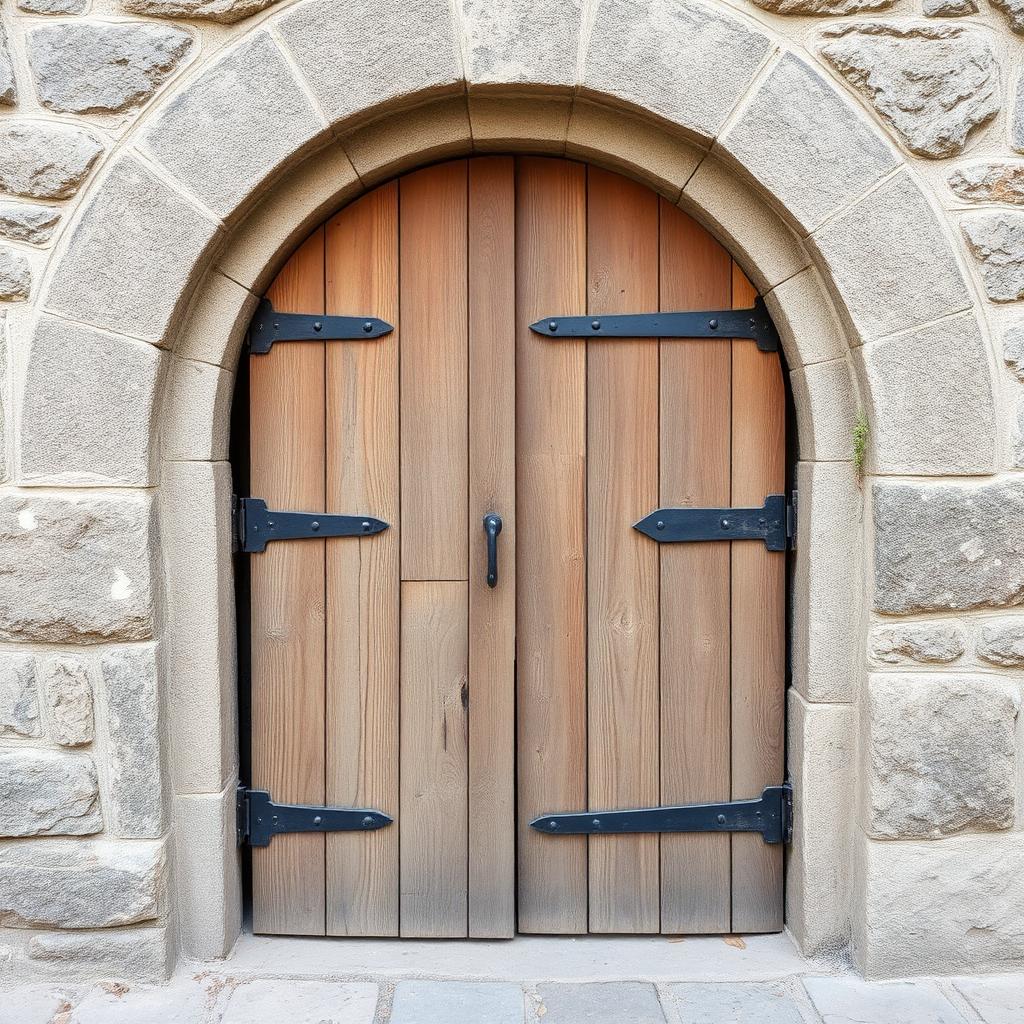
Medieval European doors emphasized defense: heavy oak planks bound with iron straps, deep door frames in stone walls, and massive locks with elaborate keys. The pointed arch doorways of Gothic cathedrals doubled as architectural statements.
Hinges replace pivots
Pivot hinges (the door spins on a vertical post) dominated for thousands of years. Modern butt hinges (two leaves joined by a pin) became standard in Europe during the 13th to 14th centuries. They are simpler to install, last longer, and remain the default residential hinge today.
Industrial revolution and mass production
By the 18th and 19th centuries, doors began to be mass-produced in millwork shops, with standardized sizes, machine-cut panels, and factory-made hardware. This is when the now-familiar six-panel raised door pattern became the default in English-speaking countries.
20th-century materials revolution
Hollow-core flush doors arrived in the 1930s. Aluminum and glass commercial doors dominated mid-century. Fiberglass entry doors emerged in the 1980s. PVC bathroom doors and engineered MDF interior doors took over budget construction in the 1990s and 2000s.
Automatic doors
The first commercial automatic sliding door was patented by Dee Horton and Lew Hewitt in 1954 and installed in 1960 at a Texas restaurant. Automatic doors have since become standard at supermarkets, airports, and accessible buildings worldwide.
What has not changed in 5,000 years
The basic problem is the same: provide a movable barrier in an opening, secure it when closed, easy to operate when needed. Materials and mechanisms have evolved, but the Robenhausen door from 3000 BCE still solves the same problem your front door solves today.
When doors were invented depends on how strictly you define "door," but humans have been hanging panels in wall openings for at least 5,500 years and likely much longer.
Door symbolism across cultures
Doors appear in mythology as thresholds between worlds. Janus, the Roman god of doors, gives us January (looking back at the old year and forward to the new). Many cultures paint or carve door symbols for protection. The door as metaphor predates written history.
The hinge revolution
Pivot hinges date back to ancient Egypt and Mesopotamia. Iron strap hinges dominated the medieval era. Modern butt hinges (the two-leaf hinge most doors use today) standardized in the 18th and 19th centuries with the rise of factory metalwork.
Doors in art and architecture
The bronze doors of Florence Baptistery (15th century) are Renaissance masterpieces. Japanese fusuma sliding doors influenced modern minimalist design. Frank Lloyd Wright famously designed entries that compressed visitors before opening into expansive spaces. The door has always been more than a barrier.
Where to see ancient doors today
Swiss National Museum (Robenhausen door, ~3000 BCE). British Museum (Egyptian and Mesopotamian fragments). Museo Egizio in Turin (Egyptian tomb doors). Pompeii archaeological site (Roman doors with hinges and hardware). Most of these displays are open to the public for the price of museum admission.
The oldest still-in-use doors
Some medieval cathedral and monastery doors in Europe have been hanging on the same hinges for 700 to 900 years. Westminster Abbey's Pyx Chamber door dates to the 1050s. Doors built well from solid hardwood can last a millennium with basic maintenance.
Why door inventions accelerated in industrial times
Mass production, standardized hardware, factory paint, and modern adhesives all arrived in the 18th and 19th centuries. The door went from craftsman work to factory product, with prices dropping by orders of magnitude and quality becoming consistent enough to fit a hole sight unseen.
Bottom line
Humans have been hanging doors for at least 5,500 years. The materials evolved; the basic idea has not.