Quick Answer
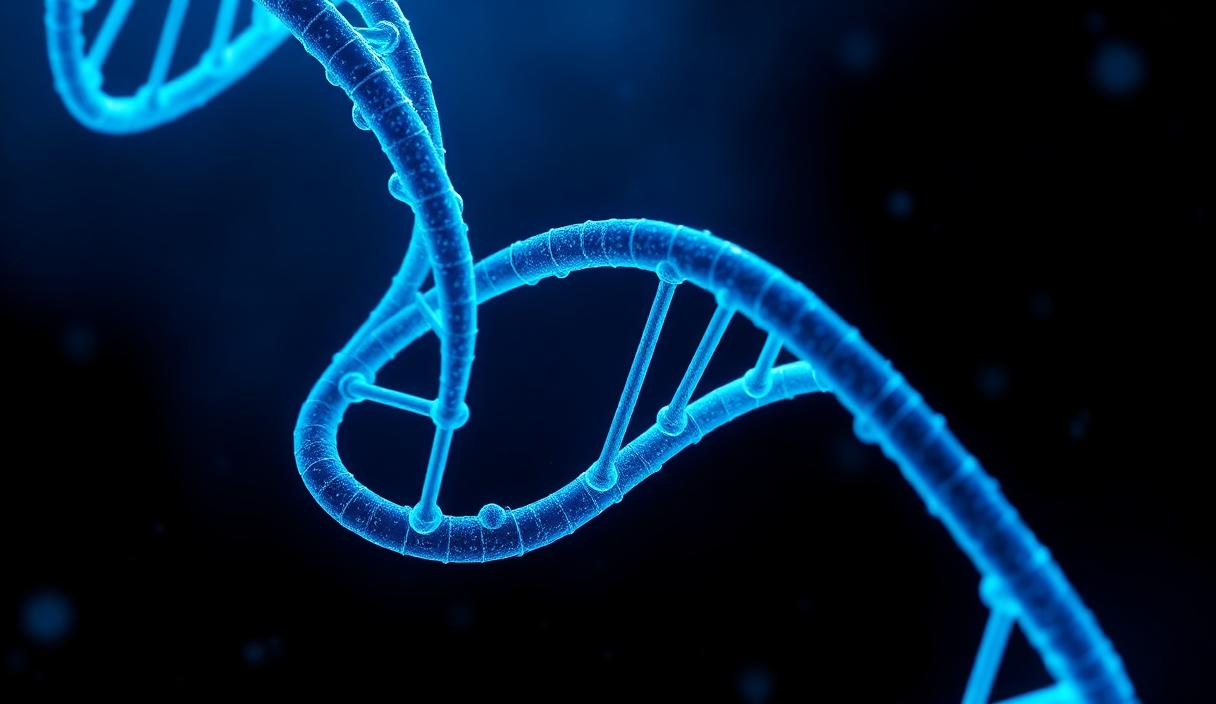
The DNA double helix is the three dimensional structural shape of the deoxyribonucleic acid molecule. It looks like a long ladder that has been twisted into a spiral, with two outer strands forming the sides and pairs of nitrogenous bases forming the rungs in the middle. This shape allows DNA to store an organism's entire genetic blueprint in a remarkably compact, stable, and replicable form.
The structure was famously published by James Watson and Francis Crick in 1953, with critical X-ray diffraction data contributed by Rosalind Franklin and Maurice Wilkins. It is the foundation of modern genetics, forensic science, evolutionary biology, and personalized medicine.
The Ladder Analogy: Sides and Rungs
The simplest way to picture DNA is as a long ladder. The two outer rails are called the sugar phosphate backbone, made of alternating deoxyribose sugar molecules and phosphate groups. The rungs of the ladder are made from pairs of nitrogenous bases held together by weak hydrogen bonds.
That ladder is then twisted into a right handed spiral, with one complete turn of the helix occurring roughly every 10 base pairs. The twist is not cosmetic. It compacts the molecule, helps protect the genetic information held inside, and creates a geometry that proteins inside the cell can recognize and interact with.
The Sugar Phosphate Backbone
The two strands of the double helix run in opposite directions, a feature biologists describe as being antiparallel. One strand runs in what is called the 5 prime to 3 prime direction; the partner strand runs 3 prime to 5 prime. Those labels refer to which carbon atoms on the deoxyribose sugar are exposed at each end of the strand.
That antiparallel arrangement is not a detail; it is a requirement. The enzymes that read, copy, and repair DNA only work in one direction, and the antiparallel structure ensures that both strands can be processed simultaneously during replication and transcription.
The Four Bases and the Pairing Rules
The actual genetic information is stored in the order of four nitrogenous bases attached to the inside of the backbone. Those bases are Adenine (A), Thymine (T), Guanine (G), and Cytosine (C). They pair according to strict chemical rules, often called Chargaff's rules:
- Adenine pairs with Thymine. The A and T bases are held together by two hydrogen bonds.
- Guanine pairs with Cytosine. The G and C bases are held together by three hydrogen bonds, making this pairing slightly stronger.
Because the pairing is strict, the two strands of DNA are complementary. If you know the sequence on one strand, you can predict the sequence on the other with perfect accuracy. That property is the secret to how DNA copies itself without losing information.
How DNA Replicates Itself
When a cell prepares to divide, it must produce an exact copy of its entire DNA library so each daughter cell receives a complete genome. The double helix structure makes that possible through a process called semi conservative replication.
An enzyme called DNA helicase acts like a microscopic zipper, breaking the hydrogen bonds between paired bases and unwinding the helix into two single strands. Each separated strand then serves as a template for building a new partner strand. Free floating nucleotides inside the cell nucleus bind to their complementary bases on the exposed templates: A finds T, G finds C.
A second enzyme, DNA polymerase, links those incoming nucleotides into a continuous new strand, then proofreads its own work for errors. When the process is complete, the cell has two identical double helices where there was previously one, each containing one original strand and one newly synthesized partner.
Why the Double Helix Matters Beyond Biology
The discovery of the double helix did far more than answer a structural question. It unlocked an entire generation of practical science:
- Genetic medicine. Understanding base pair sequences is the foundation of gene therapy, CRISPR editing, and targeted cancer treatments.
- Forensic science. DNA profiling, which relies on comparing sequences in evidence samples to suspect samples, has reshaped criminal justice since the late 1980s.
- Evolutionary biology. Comparing DNA sequences across species lets researchers reconstruct the tree of life with unprecedented precision.
- Personalized health. Consumer genetic testing services use double helix sequencing to flag inherited disease risk and ancestry markers.
- Agriculture. Crop and livestock improvement programs rely on DNA analysis to select traits like drought tolerance, yield, and disease resistance.
The Human Story Behind the Discovery
The 1953 paper in Nature by James Watson and Francis Crick is one of the most cited scientific publications in history. It described the double helix in just over 900 words and ended with one of the most understated sentences in modern science: a quiet note that the proposed pairing immediately suggested a possible copying mechanism for genetic material.
The discovery, however, was not the work of two men alone. Rosalind Franklin, working at King's College London, used X-ray crystallography to produce the now legendary Photo 51, a diffraction image that showed the unmistakable X shaped pattern of a helical structure. Maurice Wilkins, also at King's, shared that image with Watson without Franklin's explicit consent.
Franklin's precise measurements of the helix's geometry, including its diameter and the spacing between turns, gave Watson and Crick the final numerical constraints they needed to build their model. She died of ovarian cancer in 1958, four years before the Nobel Prize for the discovery was awarded to Watson, Crick, and Wilkins. The Nobel committee does not award posthumously, but historians today widely treat her as a co discoverer in everything but the formal citation.
The Takeaway
The double helix is more than a striking visual icon; it is the structural reason life can store, copy, and pass down information across billions of generations. Its antiparallel backbone, strict base pairing rules, and self templating replication mechanism solve some of the hardest problems in biology with breathtaking economy. Behind that elegance sits a human story of brilliant minds, contested credit, and the slow, generations long process by which a single 1953 paper rewrote what we understand about ourselves.