Quick Answer
On May 14, 2026, a research team led by University College London (UCL) and Thailand's Department of Mineral Resources officially named a brand new dinosaur species: Nagatitan chaiyaphumensis. It is a long necked sauropod from the Early Cretaceous period, estimated at 27 tonnes in body weight and roughly 27 metres in length.
That makes it the largest dinosaur species ever discovered in Southeast Asia.
The short answer
On May 14, 2026, a research team led by University College London (UCL) and Thailand's Department of Mineral Resources officially named a brand new dinosaur species: Nagatitan chaiyaphumensis.
It is a long necked sauropod from the Early Cretaceous period, estimated at 27 tonnes in body weight and roughly 27 metres in length. That makes it the largest dinosaur species ever discovered in Southeast Asia.
The fossils were excavated from a public pond in Chaiyaphum province, north eastern Thailand, where they had been entombed in rock for more than 113 million years.
How was Nagatitan discovered?
The story did not start in 2026. It started in 2016, when a local resident named Thanom Luangnan noticed unusually large rock formations sticking out of the bank of a pond in Chaiyaphum province.
Once the find was reported to Thailand's Department of Mineral Resources, palaeontologists began a careful, decade long excavation. They eventually recovered a remarkably complete partial skeleton, including vertebrae, ribs, hip bones, and a single front leg bone measuring 1.78 metres, roughly the height of an average adult man.
It took a further joint study with UCL Earth Sciences to formally describe and name the species in a peer reviewed paper published this month.
What does the name Nagatitan chaiyaphumensis mean?
The full name is a layered tribute to mythology, biology, and place.
- Naga refers to the mythical aquatic serpent deeply rooted in Thai and wider Southeast Asian folklore.
- Titan nods to the giants of Greek mythology, a common suffix used for the largest sauropods.
- chaiyaphumensis simply translates to "from Chaiyaphum," the province where the fossils were found.
How big was Nagatitan, really?
27 tonnes is hard to picture, so a few comparisons help:
- Roughly the weight of nine adult Asian elephants standing on a single scale.
- About four to five times heavier than an average adult Tyrannosaurus rex.
- Long enough at 27 metres to span more than half the length of an Olympic swimming pool.
For context, the previous largest known dinosaur from Southeast Asia was significantly lighter, which is why Nagatitan is being described as a regional record holder rather than just another sauropod.
Why scientists call Nagatitan "the last titan" of Thailand
Lead author Thitiwoot Sethapanichsakul, a Thai PhD student at UCL Earth Sciences, has called Nagatitan "the last titan" of Thailand. The reasoning is geological, not poetic.
The fossils came from the youngest dinosaur bearing rock formation in the country. The layers above are marine, suggesting the region became a shallow sea soon after Nagatitan's lifetime. In other words, this may be the final massive land dinosaur species we ever find from this part of Thailand.
Where Nagatitan fits in the dinosaur family tree
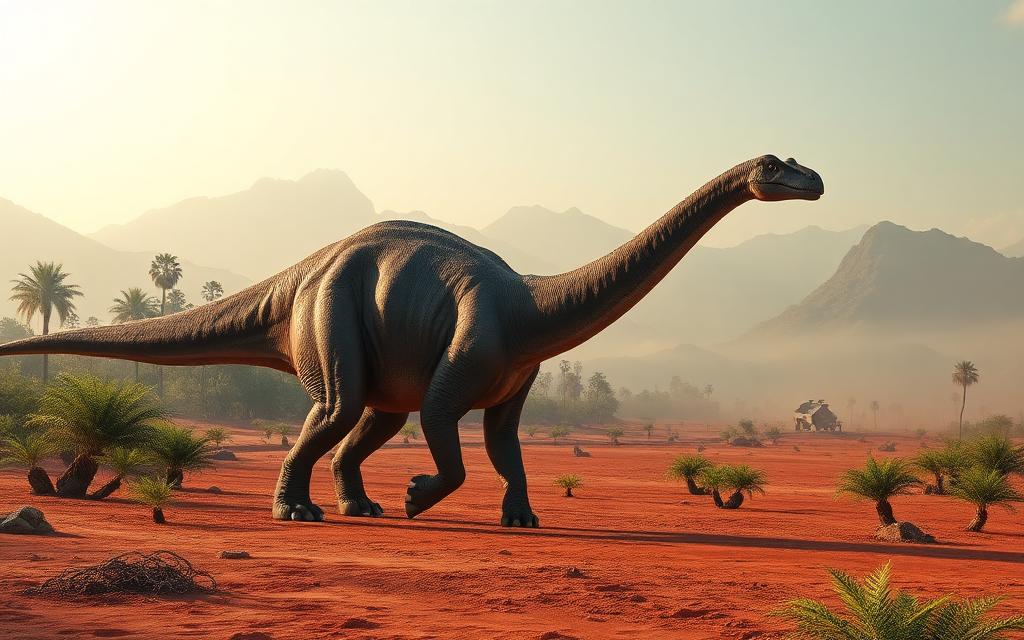
Nagatitan belongs to the sauropods, the iconic long necked, long tailed, plant eating giants that include Diplodocus and Brontosaurus. More specifically, it sits inside a subgroup called somphospondylans, and within that, an Asian cluster known as Euhelopodidae.
UCL palaeontologists noted two distinctive features that helped place it in this cluster:
- Exceptionally long forelimbs that gave it a tall, slightly forward leaning stance.
- A wide hip and limb posture that helped distribute its enormous weight across soft riverbank ground.
What did Nagatitan's world look like?
During the Early Cretaceous, roughly 110 to 120 million years ago, north eastern Thailand was a warm, semi arid landscape of open shrublands cut through by braided rivers. It was not the lush jungle that the modern region suggests.
That open environment is exactly the kind of habitat that pushed sauropods toward gigantism. A long neck made it easier to graze across wide patches of low vegetation without moving the body, and also helped the animal shed excess heat under a strong tropical sun.
Nagatitan would have shared its territory with:
- Iguanodontians and ceratopsians, smaller herbivorous cousins of Triceratops.
- Spinosaurids, sail backed carnivorous predators that hunted along the rivers.
- Pterosaurs, flying reptiles that picked fish out of the same waterways.
Why this 2026 discovery matters
Beyond the spectacle, Nagatitan is a milestone for international and digital palaeontology. The UCL and Thai teams used 3D scanning and printing to study the bones globally without flying the fragile fossils across the world, sharply reducing the project's carbon footprint.
It also brings the official tally of named dinosaur species from Thailand to 14, cementing the country's reputation as a quietly important global hotspot for palaeontology.
The takeaway
Nagatitan chaiyaphumensis is more than just a new name on the dinosaur list. It is the heaviest known dinosaur in Southeast Asia, a story that took ten years of careful excavation to tell, and possibly the last giant of its kind ever to be pulled out of Thai rock.
For palaeontologists, it is a reminder that some of the largest creatures that ever lived are still hiding under ponds, fields, and farmland, waiting for someone to look closely at the rocks.