Quick Answer
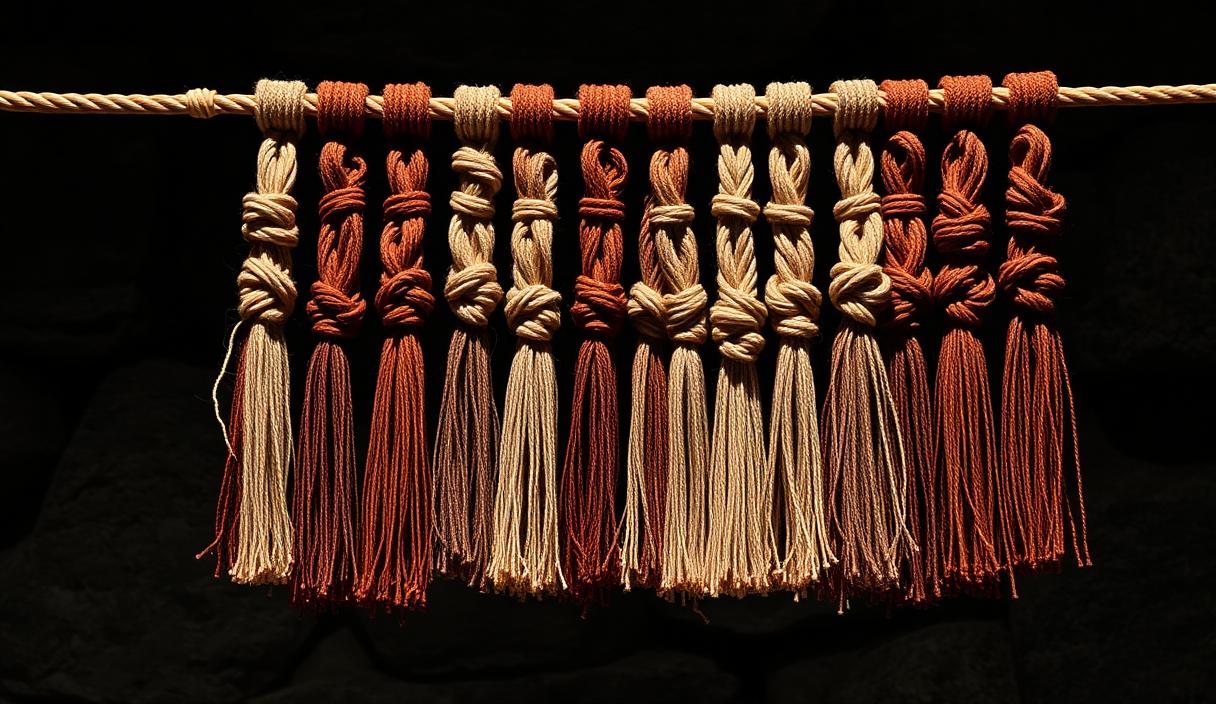
A quipu (also spelled khipu, meaning knot in Quechua) is an ancient Andean information storage device made of a thick primary cord with dozens or hundreds of smaller, often colorful strings hanging from it. The Inca Empire used quipus as a portable, precise record keeping system, encoding numerical data through the type, position, and count of knots tied along each hanging cord.
Quipus worked on a base 10 decimal system that closely mirrors modern positional notation. They tracked census data, tribute payments, livestock counts, military logistics, and warehouse inventories across an empire that stretched thousands of kilometers without a written alphabet.
The Empire That Ran Without Writing
At its peak in the early 1500s, the Inca Empire stretched along the Andes from modern day Colombia to central Chile. It managed millions of subjects, a standing army, monumental road systems, and a sophisticated agricultural network of terraced fields and irrigation canals.
What stunned early European chroniclers was that all of this ran without a phonetic writing system. There were no scrolls, no carved tablets, no painted manuscripts of the kind the Maya and Aztec produced further north. Instead, the empire ran on textile data: knotted cords that traveled by relay runner across the imperial road network.
For decades, scholars dismissed the quipu as a primitive mnemonic device. Modern research, fueled by computational analysis and ethnographic fieldwork in surviving Andean communities, has overturned that view. The quipu is now understood as one of the most sophisticated non alphabetic information systems ever developed.
The Anatomy of a Quipu
Every quipu starts with a thick primary cord, usually held horizontally. From this primary cord hang dozens to hundreds of thinner secondary cords called pendant cords. Some pendant cords have their own sub pendants attached, creating a hierarchical tree structure.
The cords were spun from cotton or from camelid fibers like llama and alpaca wool, then dyed with natural pigments derived from plants, minerals, and insects. Color was not decorative; it was part of the data. A red cord might denote military information while a yellow cord might track gold tribute, with the exact color coding varying by region and administrative function.
The Math of the Knots
Numbers were encoded through three distinct knot types, each tied at a specific vertical position along the pendant cord. Reading from top to bottom corresponded to reading from highest place value to lowest:
- Single knots. Simple overhand knots tied near the top of the cord, used for tens, hundreds, thousands, and higher powers of ten.
- Long knots. Knots with multiple internal loops tied lower on the cord, used for the digits 2 through 9. The number of internal loops indicated the digit, so a long knot with four loops meant 4.
- Figure eight knots. Tied at the very bottom of the cord, the figure eight always represented the value 1.
To read a value like 327, an accountant would look for three single knots clustered at the top (the hundreds), then a gap, then two single knots (the tens), then a long knot with seven loops at the bottom (the ones). Blank spaces between knot clusters served as visual separators between place values, functioning much like the zero in a modern positional system.
This structural elegance allowed an Inca administrator to record, transport, and audit large datasets with very little ambiguity. Two trained quipu readers handed the same cord would arrive at the same numerical totals.
The Khipu Kamayuq: Imperial Knot Masters
The specialists who created, maintained, and read quipus were known as khipu kamayuq, which translates roughly to knot keeper or knot master. They were a professionalized administrative class trained from a young age, and their position within Inca society was prestigious and hereditary in many regions.
Whenever the empire absorbed a new province, the first wave of imperial agents to arrive included a team of khipu kamayuq. They conducted population censuses, classified residents by age and labor capacity, surveyed agricultural output, and inventoried livestock. The resulting data was knotted into quipus and dispatched back to the capital at Cusco.
The transport network was the chasqui system, a relay of elite runners stationed at posts roughly every few kilometers along the Inca road network. A quipu sent from a remote province could reach the emperor in Cusco within days, faster than most equestrian courier systems operating in Europe at the same time.
Did Quipus Record More Than Numbers?
While the majority of surviving quipus appear to be quantitative records, a growing body of scholarship argues that some quipus encoded non numerical information as well. The argument rests on several lines of evidence.
First, certain surviving quipus contain knot patterns that do not parse cleanly as numbers under the base 10 system. Second, colonial era Spanish chroniclers explicitly described khipu kamayuq reciting genealogies, songs, treaties, and histories from cords. Third, ethnographic work in modern Andean villages has uncovered ceremonial quipus still used to track ritual obligations, calendrical cycles, and community narratives.
The most provocative recent work, including computational analyses of pendant cord structure, suggests that combinations of color, fiber type, knot direction, and spin orientation may have functioned as a logosyllabic encoding system. If that interpretation holds, the quipu may belong to a small set of true three dimensional writing systems in human history.
What Happened to the Quipus
The Spanish conquest of the Inca Empire between 1532 and 1572 was catastrophic for the quipu tradition. Spanish authorities initially relied on quipu readers to administer the new colonial economy, but as the colonial church gained power, quipus were increasingly framed as idolatrous objects.
In 1583, the Third Council of Lima formally ordered the destruction of quipus as instruments of pagan religion. Thousands were burned, buried, or thrown into rivers. The hereditary khipu kamayuq class lost its institutional role, and within a generation the deep technical knowledge of how to encode and decode complex quipus was largely lost.
Today, only a few hundred authentic Inca era quipus survive in museum collections in Berlin, Lima, New York, and a handful of other institutions. Each one is a fragile, irreplaceable data artifact from a civilization that built one of the most sophisticated information systems of the pre modern world.
The Takeaway
The quipu is not a curiosity from the margins of history; it is a serious, structured information technology that allowed the Inca to manage a continental empire without paper or alphabet. Its base 10 knot encoding, color coding, and hierarchical cord structure prefigure ideas that we now take for granted in databases and spreadsheets. As researchers continue to decode the surviving quipus with the help of computational analysis, the Andean knot system is finally being recognized for what it always was: a brilliant, durable, and uniquely Andean way of remembering.