Quick Answer
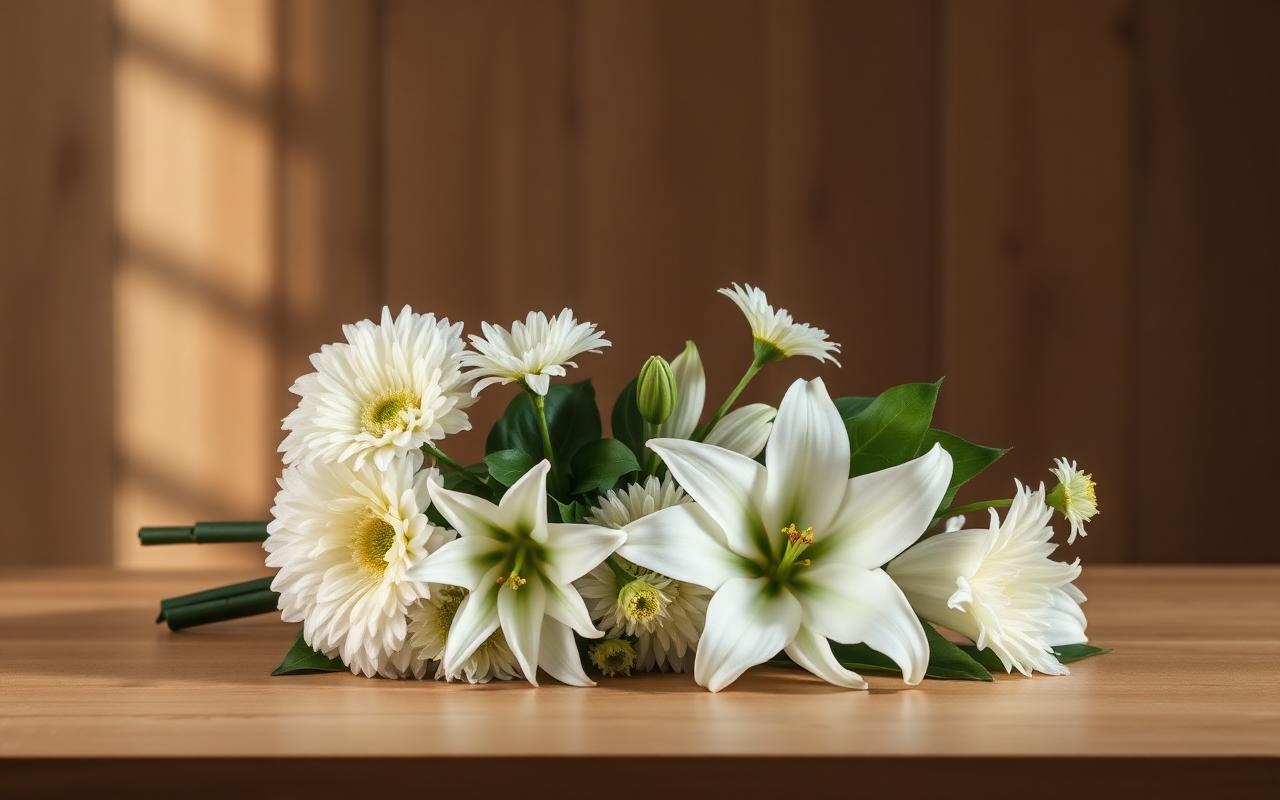
White lilies, white roses, chrysanthemums, carnations and gladioli are the safest and most traditional funeral flowers in Western practice.
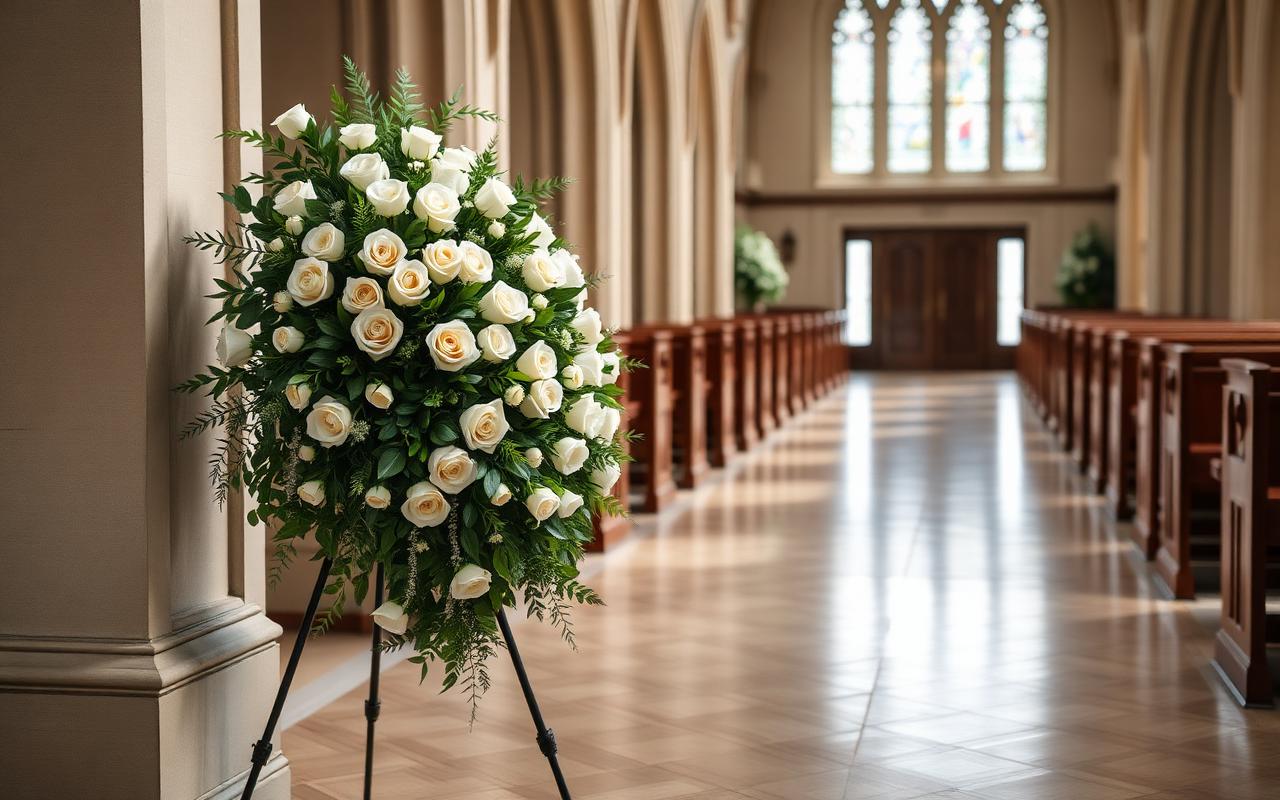
Large standing arrangements, wreaths and casket sprays go to the funeral home or the service. Smaller bouquets, baskets and plants go to the family's home.
Always check the obituary or notice first. If it says the family has requested donations in lieu of flowers, send the donation and a card instead.
Match the Arrangement to the Setting
Funeral flowers fall into two groups, and sending the wrong type creates work for a grieving family.
- For the service: standing sprays on easels, wreaths, crosses and hearts. These are designed to be seen from a distance and are collected or donated afterwards.
- For the family home: hand tied bouquets, arrangements in a vase or basket, and living plants. These do not need a vase found for them at a bad moment.
- Casket flowers are chosen by the immediate family only. Never order a casket spray unless you are asked.
Send home arrangements in a container that holds water. Handing over loose stems means someone has to stop and deal with them.
What the Traditional Flowers Mean
Lilies are the classic funeral flower in Christian tradition, associated with restored innocence and peace. White oriental lilies are the usual choice, though their scent is strong in a small room.
Roses work in almost every colour. White reads as reverence, red as love and respect, pink as gratitude, and yellow as friendship.
Chrysanthemums mean death and mourning across much of Europe and Asia, so they are used almost exclusively for funerals there. In the US they are a more general sympathy flower.
Carnations last well and travel well, which is why standing sprays use so many of them. Pink carnations traditionally signify remembrance.
Gladioli stand for strength of character and are a standard structural flower in tall arrangements.
Orchids as a living plant are a good long term gift, since they keep going long after cut flowers have gone.
Colour Choices That Work
White and green is the traditional palette and never looks wrong. It reads as calm rather than celebratory.
Soft colours such as pale pink, lavender and cream are widely accepted and are common at services for older relatives and at celebrations of life.
Bright colours are increasingly common where the family has asked for them, especially for a child or for someone whose personality was vivid. Follow the family's lead, not your own taste.
Avoid anything that looks like a birthday arrangement, including balloons, unless the notice specifically invites it.
Religious and Cultural Differences
Traditional Jewish funerals do not use flowers at all. Food sent to the family during shiva, or a donation to a named charity, is the correct gesture.
Islamic funerals are typically simple, with flowers modest or absent. Check with the family or the mosque before sending anything.
Hindu services often use garlands, frequently marigolds and jasmine, arranged by the family. Ask before sending Western style arrangements.
In many Buddhist traditions white flowers are appropriate and red is avoided.
Chinese custom treats white and yellow chrysanthemums as the mourning flowers, and red as strictly celebratory and therefore inappropriate.
When you do not know the tradition, ask the funeral home. They answer this question every day and will tell you plainly.
What to Write on the Card
Short is better. "With deepest sympathy", "Thinking of you and your family", or "In loving memory of Ann" are all sufficient.
Sign with your full name and, if the family may not know you, one line of context such as "worked with David at the hospital". Families receive many cards and cannot always place first names.
Avoid explanations of what the death means, and avoid anything beginning with "at least".
When Not to Send Flowers
If the notice says "in lieu of flowers", respect it exactly. Make the donation, and if the charity offers it, ask them to notify the family.
For a direct cremation with no service, flowers sent to a funeral home may not reach anyone. Send to the family home instead.
For a small flat or a family travelling for the funeral, a food delivery, a supermarket voucher or a meal service is often more useful than flowers that will be left behind.
A memorial tree or a plant that can be put in a garden gives something that lasts past the week.
Practical Ordering Notes
Order through a florist local to the funeral home, and give them the name of the deceased and the exact service time. National relay services frequently mis-time deliveries.
Arrangements should arrive at the funeral home an hour or two before the service, not during it.
Ask what happens to the flowers afterwards. Many families ask for them to go to a care home or hospice, which is a good reason to choose something sturdy.
Frequently Asked Questions
What is the most appropriate funeral flower?
White lilies are the traditional first choice in Western practice, followed by white roses. Both are appropriate at any service where flowers are welcome.
Is it acceptable to send flowers after the funeral?
Yes, and it is often kinder. The weeks after a funeral are quieter and lonelier than the days before it.
How much should you spend on funeral flowers?
Small bouquets start around 40 to 60 dollars, standing sprays typically run 100 to 250. Closeness to the family matters more than size.
Can you send flowers to the family home instead?
Yes, and for anyone outside the immediate circle it is often the better option. Choose an arrangement that arrives in its own container.
What flowers should you avoid?
Avoid bright red at Chinese services, chrysanthemums for a non funeral occasion in Europe, and any arrangement with balloons or celebratory props unless the family asked.
Bottom Line
White lilies, roses and carnations are safe everywhere flowers are welcome, standing arrangements go to the service and smaller ones to the home.
Read the notice, respect a donation request, and check the tradition when you are unsure. A short, clearly signed card matters more than the size of the arrangement.