Quick Answer
What low fat actually means is fixed in law. In the United States it means 3 grams of fat or less per serving, and in the European Union and the United Kingdom it means no more than 3 grams of fat per 100 grams of solid food or 1.5 grams per 100 millilitres of liquid.
Reduced fat is a different and much weaker claim. It only means at least 25 or 30 percent less fat than the standard version of the same product, which can still be a high fat food.
Fat free means under 0.5 grams per serving in the United States and under 0.5 grams per 100 grams or millilitres in Europe. None of these claims say anything about sugar, salt or total calories.
The exact thresholds
Claims about fat are among the most tightly defined in food labelling, which is helpful once you know the numbers.
- Fat free: under 0.5 grams per serving in the United States, under 0.5 grams per 100 grams or 100 millilitres in the European Union and United Kingdom
- Low fat: 3 grams or less per serving in the United States, 3 grams per 100 grams of solids or 1.5 grams per 100 millilitres of liquids in Europe
- Reduced fat: at least 25 percent less fat than the reference product in the United States, at least 30 percent less in Europe
- Light or lite: usually the same reduction requirement as reduced, with the basis of comparison stated on pack
The difference between the American per serving basis and the European per hundred grams basis matters. A per serving rule can be satisfied by shrinking the serving, while a per hundred grams rule cannot.
Reduced fat is the claim to watch
Reduced fat is relative, and the reference product is often high in fat to begin with. Reduced fat crisps, reduced fat peanut butter and reduced fat cheese can all be reduced by a quarter and still sit well above any low fat threshold.
Regulations require the comparison to be identified, usually in small type near the claim. Read that line. It tells you whether the 30 percent came off a standard product or off the brand's own richest version.
Reduced fat also says nothing about what replaced the fat. In cheese it is usually water and protein, which is fine. In sweet baked goods it is very often sugar, which is not.
What replaces the fat
Fat carries flavour, provides mouthfeel and holds aroma compounds. Take it out and something has to fill the gap, or the product tastes thin.
Common substitutions include added sugar, maltodextrin, modified starches, gums such as xanthan and guar, extra salt for flavour intensity and additional emulsifiers to restore texture.
None of these are dangerous, and several are entirely ordinary ingredients. The point is that a low fat version is not simply the full fat version minus the fat. It is a differently formulated product, and its calorie count is frequently within ten or fifteen percent of the original.
Fat is not one thing
A single fat number on the front of a pack collapses several very different components. The panel underneath breaks it out, and that breakdown carries more information than the headline.
Saturated fat is the figure most dietary guidance targets, with recommendations across major health bodies to keep it under about ten percent of daily calories. Unsaturated fats, both monounsaturated and polyunsaturated, are associated with better cardiovascular outcomes when they replace saturated fat.
That is why a low fat claim on olive oil would be meaningless and why full fat nuts, oily fish and avocados are recommended despite being fat dense. The claim is about quantity, and the useful question is usually about type.
Where low fat genuinely helps
There are real uses for the claim. Low fat dairy reduces saturated fat intake meaningfully for people who drink several glasses of milk a day. Low fat cooking sprays cut the oil used in a pan without changing the meal.
Lean meat and low fat versions of processed meat products reduce both saturated fat and calories at once, because there is no sugar route to compensate for the loss in savoury foods.
In clinical situations such as gallbladder disease or pancreatitis, a low fat diet is prescribed for direct physiological reasons, and the labelling rules make those products easy to identify.
Where it usually misleads
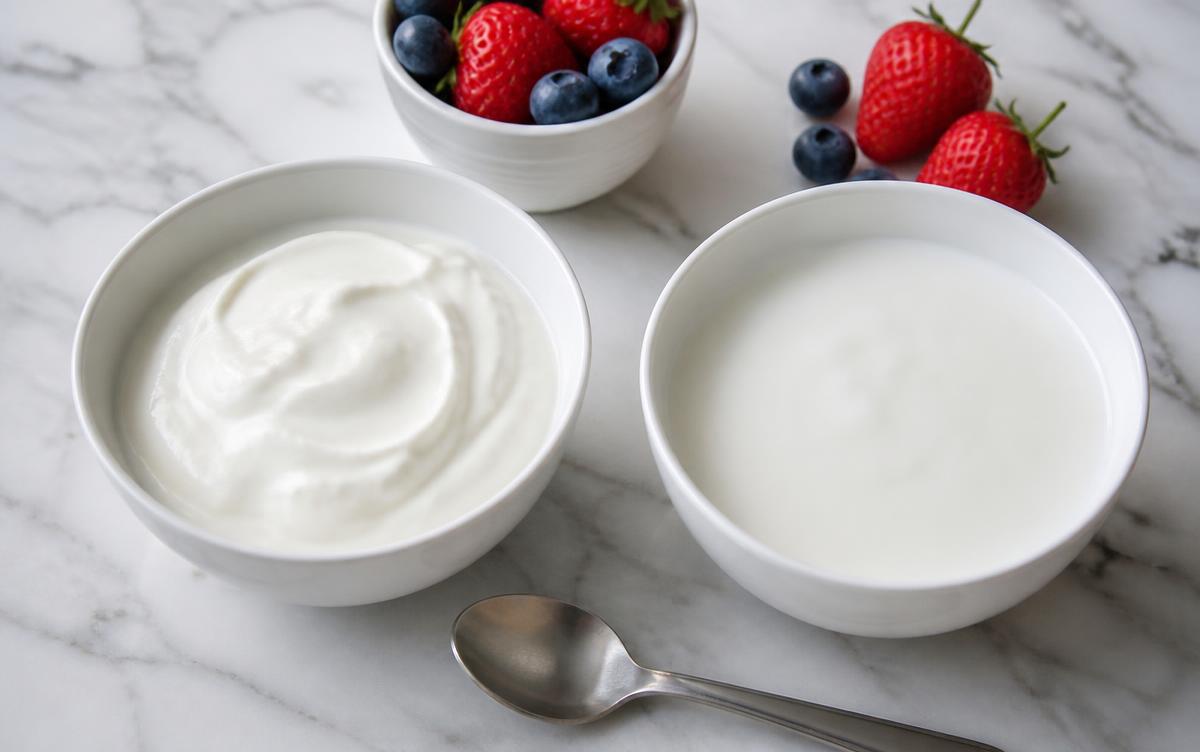
Sweet products are the weak spot. Low fat yogurt, low fat biscuits, low fat cereal bars and low fat ice cream frequently carry as many calories as the standard version once sugar has been added to restore flavour.
The satiety trade is also real. Fat slows gastric emptying and contributes to feeling full. Several studies of eating behaviour find that people compensate for a low fat product by eating more of it or by eating more later.
Portion inflation compounds this. A food carrying a virtuous claim on the front invites a larger serving, and the calorie saving disappears in the extra spoonfuls.
How to check a low fat product in ten seconds
Flip the pack and compare the panel with the standard version on the shelf beside it. Look at three lines: total calories, sugar and saturated fat, all per 100 grams rather than per serving so the comparison is fair.
If calories are within a few percent and sugar has risen, the reformulation traded one thing for another and there is no benefit. If calories have dropped meaningfully and sugar is flat, the claim is doing something real.
Also glance at the ingredient list length. A low fat product with a much longer list than its full fat counterpart has been engineered rather than simply skimmed.
The bottom line
Low fat is a precise legal claim about quantity per serving or per hundred grams, and reduced fat is a vague relative one. Neither is a claim about calories, sugar, salt or overall healthiness.
Use low fat where the swap is clean, mainly dairy and meat, and treat it with suspicion on sweet foods where sugar routinely fills the space the fat left behind.