
Quick Answer
An E number is a code for a food additive that has been assessed and approved for use across Europe. The E simply stands for Europe, and the number identifies the specific substance.
The codes are grouped by function. The 100s are colours, the 200s preservatives, the 300s antioxidants and acidity regulators, the 400s thickeners and emulsifiers, the 500s acidity regulators and anti caking agents, the 600s flavour enhancers and the 900s sweeteners and glazing agents.
An E number is not a warning label. E300 is vitamin C, E101 is riboflavin and E440 is pectin from fruit.
Where the system came from
Before harmonisation, every European country maintained its own additive list, which made cross border trade and enforcement messy. The E number system created one register of substances that had passed a common safety evaluation.
Approval is not permanent. The European Food Safety Authority re-evaluates additives, and substances have been removed or restricted when newer evidence emerged. Several colourings and preservatives that were common decades ago are no longer permitted.
The United States runs a parallel but differently organised system. American labels usually spell out the additive name rather than using a code, which is why an ingredient list reads sodium benzoate rather than E211.
What each number range covers
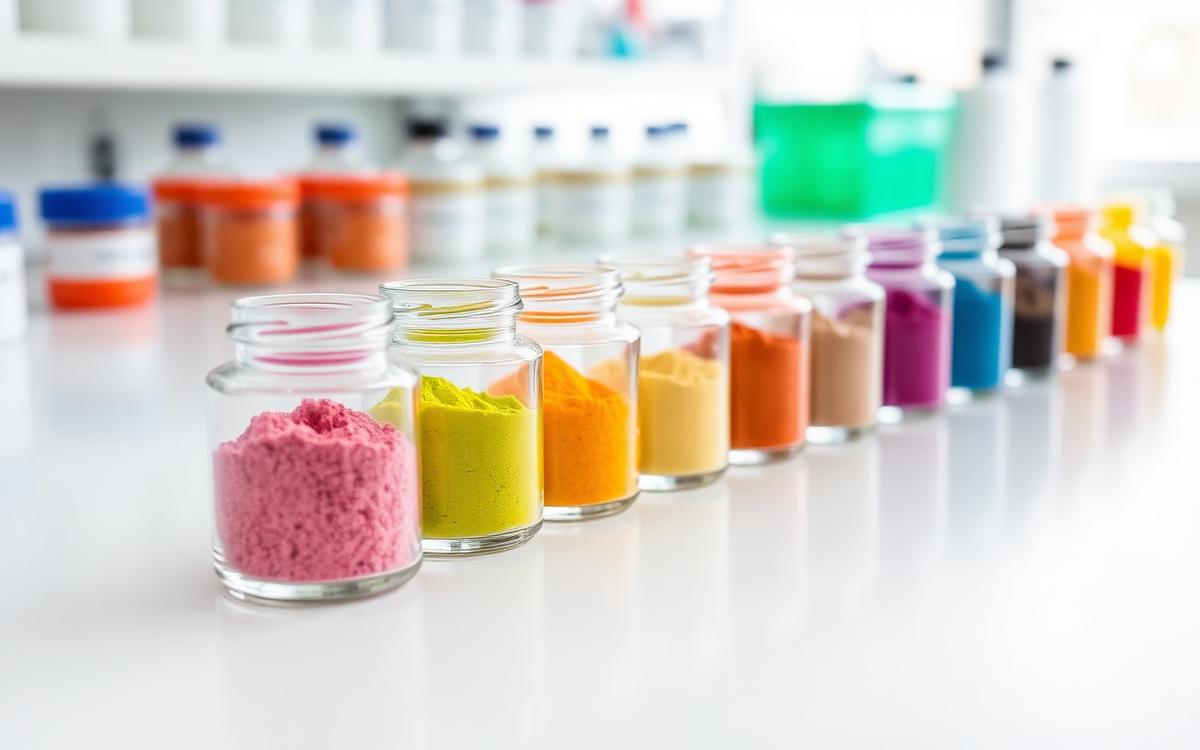
- E100 to E199, colours: E100 curcumin from turmeric, E101 riboflavin, E120 cochineal, E150 caramel colour, E160a carotenes.
- E200 to E299, preservatives: E202 potassium sorbate, E211 sodium benzoate, E220 sulphur dioxide, E250 sodium nitrite in cured meats.
- E300 to E399, antioxidants and acidity regulators: E300 ascorbic acid, E306 tocopherols, E322 lecithin, E330 citric acid.
- E400 to E499, thickeners, stabilisers and emulsifiers: E406 agar, E407 carrageenan, E410 locust bean gum, E412 guar gum, E415 xanthan gum, E440 pectin.
- E500 to E599, acidity regulators and anti caking agents: E500 sodium bicarbonate, E551 silicon dioxide.
- E600 to E699, flavour enhancers: E621 monosodium glutamate, E627 and E631 nucleotides.
- E900 to E999, sweeteners, glazing agents and gases: E951 aspartame, E955 sucralose, E960 steviol glycosides, E903 carnauba wax.
Numbers above E1000 cover a smaller set of additional substances including modified starches and enzymes.
How additives must appear on a label
European labelling rules require an additive to be listed by its function followed by either its name or its E number. So a label reads preservative: sodium benzoate, or preservative: E211, and both are equally compliant.
This is why the same product can look additive heavy in one market and clean in another. Spelling out mixed tocopherols rather than writing E306 changes nothing about the contents.
Additives sit in the ingredient list in descending order of weight like everything else, which is a helpful reminder that most are used in very small quantities near the end of the list.
The additives people ask about most
Monosodium glutamate, E621, is a salt of glutamic acid, an amino acid abundant in tomatoes, parmesan, mushrooms and soy sauce. Controlled studies have repeatedly failed to reproduce the cluster of symptoms once attributed to it, though a small number of people report sensitivity.
Nitrites, E249 to E252, are used in cured meat to prevent botulism and to fix the pink colour. The safety debate is real and centres on nitrosamine formation, which is why intake of processed meat rather than the additive alone is what health guidance targets.
Six specific colours, including sunset yellow E110, tartrazine E102 and allura red E129, must carry a statement in Europe that they may have an adverse effect on activity and attention in children. That requirement followed research at the University of Southampton, and many manufacturers reformulated rather than print the warning.
Sulphites, E220 to E228, must be declared as allergens above 10 milligrams per kilogram because they can trigger reactions in people with asthma.
Are E numbers natural or artificial?
Both, and the code tells you nothing either way. E300 is vitamin C. E160a is beta carotene, the pigment in carrots. E440 is pectin, extracted from apples and citrus peel and the same substance that sets homemade jam. E322 is lecithin, usually from soy or sunflower.
Meanwhile plenty of substances with no E number are synthetic. Having a code means the additive was formally evaluated, which is arguably more reassuring than not having one.
Some numbers do carry information worth knowing for dietary reasons. E120 cochineal is derived from insects and is not suitable for vegans, and E441 gelatine has animal origins.
A sensible way to think about them
Counting E numbers is a poor proxy for food quality. A tinned tomato passata with citric acid is a better everyday food than an additive free biscuit made of white flour, sugar and palm oil.
What a long additive list genuinely tells you is that the product is a formulated one, designed for shelf stability and consistent texture. That is a useful signal about the type of food you are holding, and a weak signal about its safety.
If you want fewer additives in your week, the effective move is not scrutinising codes but shifting the balance towards foods that need no formulation in the first place.
Frequently asked questions
Are E numbers banned in the United States?
No. The additives are mostly the same, though some differ, and American labels use ingredient names instead of codes.
Do E numbers cause hyperactivity?
Six specific colours carry a mandatory advisory statement in Europe based on the Southampton research. The evidence relates to those colours, not to additives as a class.
Are all E numbers vegan?
No. E120 comes from cochineal insects, E441 is gelatine and E904 shellac is an insect secretion. Most others are plant or mineral derived.
Why do some products list names instead of numbers?
Either format is legal. Manufacturers often prefer names because shoppers read codes as suspicious.
Can additives be removed from the approved list?
Yes. Re-evaluation has removed or restricted several additives over the years, including certain azo dyes and preservatives.
Why the codes look scarier than the names
Research on consumer perception consistently finds the same thing: shoppers rate an identical ingredient list as less healthy when it uses codes rather than names. E300 reads as chemistry, ascorbic acid reads as science, vitamin C reads as food, and all three are the same molecule.
Knowing a handful of the common codes defuses most of that reaction. Once you recognise E330 as citric acid, the same thing that makes a lemon sour, the list stops looking like a warning.