Quick Answer
The core of table manners is simple. Put your napkin on your lap when you sit, work your cutlery from the outside in, chew with your mouth closed, keep your phone off the table, and wait until everyone is served before you start.
Everything else is regional detail. If you get those five right, you will look comfortable at almost any table, from a family kitchen to a business dinner.
Below I break down each rule, explain why it exists, and flag where American and European habits differ.
Why Table Manners Still Matter
Table manners are not about looking posh. They are a shared shorthand that keeps a meal calm and lets people focus on each other instead of the mechanics of eating.
Most of the rules solve a practical problem. Chewing with your mouth closed spares the people opposite you. Passing food in one direction stops two dishes colliding in the middle. Waiting for the host stops one person eating alone while the rest watch.
In professional settings this still gets noticed. Recruiters have used meal interviews for decades precisely because a table shows how someone behaves when they are not thinking about being observed.
The Napkin: When It Goes Down and Where It Goes Later
Sit down, then place the napkin on your lap. Fold it in half with the crease toward your waist so crumbs stay trapped when you lift it.
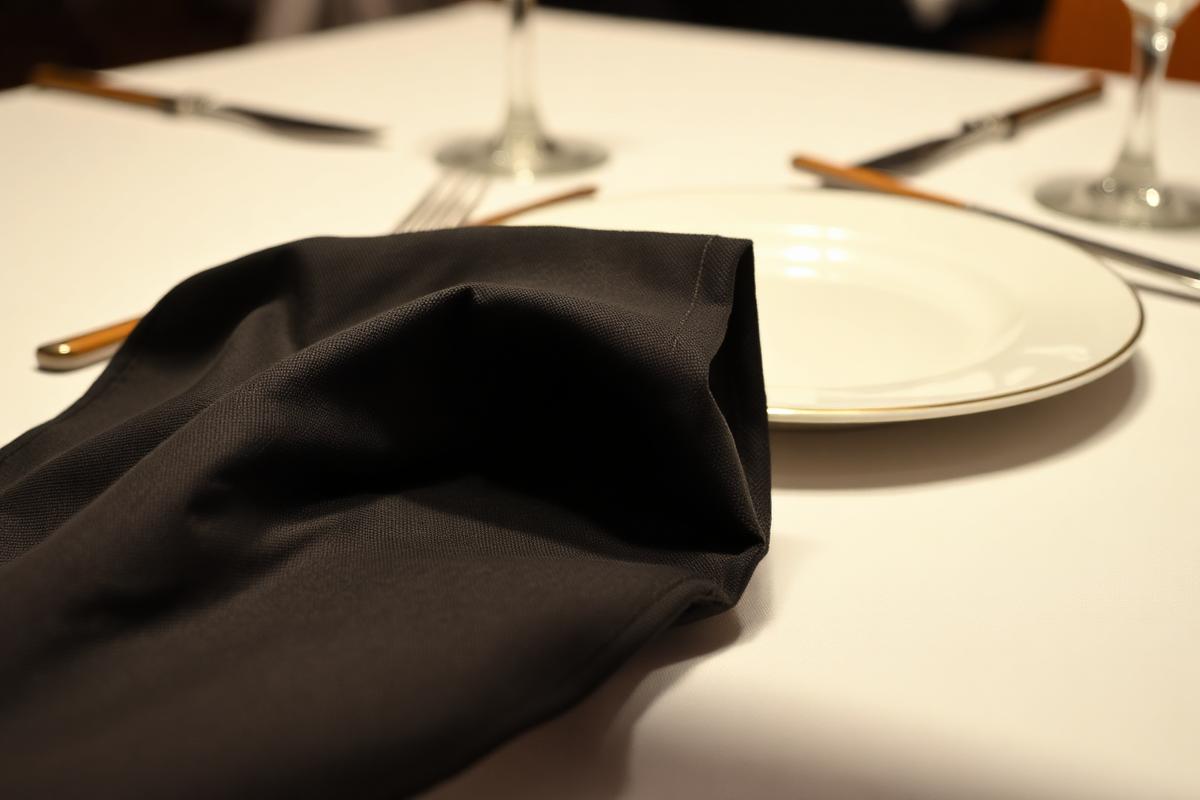
If you leave the table mid meal, put the napkin on your chair, not on the table. A napkin on the table reads as a signal that you have finished eating.
At the end of the meal, gather the napkin loosely and set it to the left of your plate. Do not refold it neatly, and do not crumple it into a ball on top of the plate.
Paper napkins follow the same logic in a more relaxed way. Lap during the meal, beside the plate at the end.
Cutlery: Outside In, and What Each Position Means
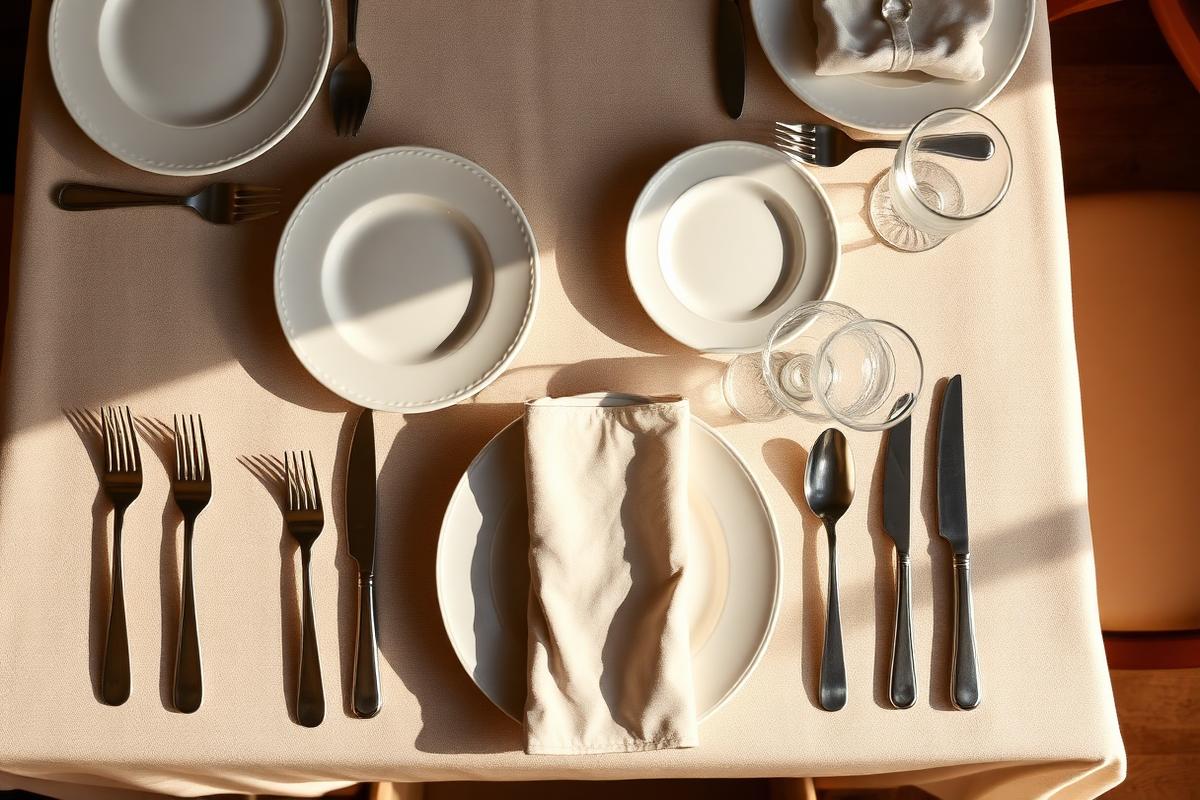
A formal setting can look intimidating, but it is arranged in the order you will use it. Start with the outermost fork and knife and move inward with each course.
- Forks sit to the left, knives and spoons to the right, with the knife blade facing the plate.
- Dessert cutlery usually lies horizontally above the plate, handles pointing toward the hand that will use it.
- Bread plate is the small plate on your left. Your drink is on your right.
The classic memory trick is that "left" and "fork" both have four letters, while "right", "knife" and "spoon" each have five.
There are two accepted eating styles. In the Continental style you keep the fork in the left hand tines down and the knife in the right throughout. In the American style you cut, set the knife down, then switch the fork to the right hand. Neither is wrong. Pick one and stay consistent within a meal.
Signalling That You Are Resting or Finished
Cutlery position is a quiet language that servers read constantly.
- Resting: cross the knife and fork loosely on the plate, or place them in an inverted V. The plate stays.
- Finished: lay the knife and fork together at roughly the four o'clock position with the tines facing up in the American style, or down in the Continental style.
Never push the plate away from you, and never stack plates for the server unless you are at a very casual table and have been asked to help.
Phones, Elbows and Other Modern Points
The strongest modern rule is the phone. A phone face down on the table still says the conversation is provisional. Put it in a pocket or a bag on silent. If you are genuinely waiting on something urgent, say so at the start of the meal and step away to take it.
Elbows on the table between courses are fine in most settings. Elbows on the table while you are actively eating look sloppy because they hunch you over the plate.
Do not photograph every dish at a private dinner without asking. One quick photo at a restaurant is normal now, a full shoot is not.
Keep your voice at a level the table can hear and the next table cannot.
Serving, Passing and Sharing
Food is passed to the right so it flows in one direction. Salt and pepper travel together even if someone asked for only one of them.
Serve to the left, clear from the right. That is a server rule, but it helps if you are hosting at home.
Never reach across someone. Ask for the dish to be passed. If you take the last portion of anything shared, offer it around first.
Bread is torn, not cut, and buttered one bite at a time on the bread plate rather than in mid air.
Handling Awkward Moments
Everyone drops something eventually. What matters is how little fuss you make.
- Dropped cutlery in a restaurant: leave it and quietly ask for a replacement.
- Food that is too hot: sip water. Do not spit it back onto the plate.
- Something you cannot chew: remove it discreetly with the same utensil that brought it to your mouth, and set it at the edge of the plate.
- A dish you dislike: take a small portion and move it around. Saying nothing is kinder than a critique of the cooking.
- Allergies: tell the host in advance, not at the table. That protects both of you.
Formal Versus Casual: What Actually Changes
At a casual meal most of these rules relax, but three survive everywhere: wait for others, keep your mouth closed while chewing, and keep the phone away.
At a formal dinner add a few extras. Wait for the host to sit and to lift the first fork. Do not start a course until most of the table has been served. Follow the pace of the host rather than racing ahead or lagging behind.
At a business meal, order in the middle of the price range, avoid anything you have to fight with, and keep alcohol matched to whatever the most senior person does.
Regional Differences Worth Knowing
In much of continental Europe both hands stay visible above the table, wrists resting on the edge. In the United States the free hand often rests in the lap.
In Japan it is normal to lift a rice or soup bowl toward you, and chopsticks should never be stood upright in rice. In much of the Middle East and South Asia, eating with the right hand is expected when cutlery is not used.
In France, bread sits directly on the tablecloth beside the plate rather than on a separate bread plate. In China, serving others before yourself is a mark of respect.
None of these are traps. Watch the host for a few seconds and copy what they do.
Teaching Table Manners to Children
Children learn manners by imitation and repetition, not by lectures during dinner. Pick one habit per month and model it yourself.
Start with napkin on lap, asking for things to be passed, and staying at the table until everyone is finished. Add cutlery order later, once the basics are automatic.
Praise the behaviour you want rather than correcting every slip. A meal that turns into a discipline session teaches children that the table is unpleasant.
Frequently Asked Questions
Is it rude to start eating before everyone is served?
At a small table, yes. Wait. At a table of eight or more, the host will often tell people to start so the food does not go cold, and following that instruction is polite.
Which hand should hold the fork?
Either, as long as you are consistent. Continental style keeps the fork in the left hand throughout, American style switches it to the right after cutting.
Can I put my phone on the table if it is face down?
It is still visible and still signals divided attention. Pocket or bag is better.
What do I do with the napkin if I leave the table?
Put it on your chair. On the table means you are done.
Is it acceptable to ask for a doggy bag?
In the United States it is normal. In much of Europe it is less common but increasingly accepted, especially since food waste rules changed in several countries.
Should I tip differently if the service was slow?
Judge the server, not the kitchen. Slow food is usually not the server's doing.
Bottom Line
Table manners are a short list of habits that make eating together easy. Napkin on the lap, cutlery outside in, phone away, wait for the table, and finish with your knife and fork together.
Learn those, watch your host for local variations, and you will never be the person the table is quietly noticing.