Quick Answer
Look for the words partially hydrogenated oil in the ingredient list. That phrase is the only reliable marker of industrially produced trans fat, and it outranks anything the nutrition panel says.
A label can legally declare zero grams of trans fat while the food still contains a small amount, because rounding rules allow anything under half a gram per serving to be printed as zero.
The US Food and Drug Administration determined in 2015 that partially hydrogenated oils are no longer generally recognised as safe, with the main compliance deadline falling in June 2018 and remaining uses phased out by 2021, and similar limits apply across the European Union and the United Kingdom, so the phrase is now rare rather than absent.
What trans fat actually is
Fats are chains of carbon atoms. In an unsaturated fat, some of those carbons are joined by a double bond, and the chain can bend around that bond in one of two geometries. The cis form kinks the chain and keeps the oil liquid. The trans form keeps the chain straight, so the fat behaves more like a solid.
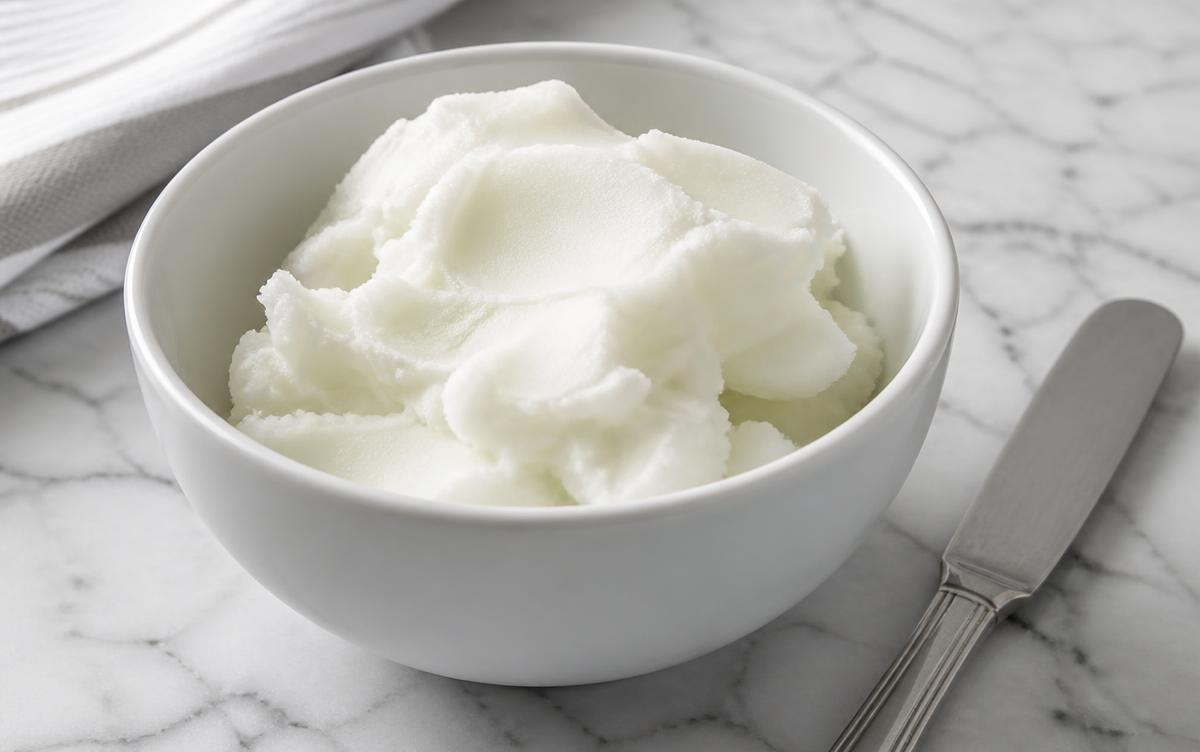
Industrial trans fat is made by bubbling hydrogen through liquid vegetable oil in the presence of a metal catalyst. Done completely, the process saturates the oil entirely. Done partially, it leaves a mixture that includes trans configured bonds, and that mixture is cheap, shelf stable and excellent for frying and pastry.
There is also a small amount of naturally occurring trans fat in dairy and beef, formed by bacteria in the stomachs of ruminant animals. Current evidence treats those in the small quantities normally eaten very differently from the industrial kind.
Why the health concern is unusually strong
Most nutrition debates are contested. Industrial trans fat is not. It raises low density lipoprotein cholesterol and lowers high density lipoprotein cholesterol at the same time, which is a worse combination than saturated fat produces.
The World Health Organization has run a global programme aimed at eliminating industrially produced trans fat from the food supply, and estimates that intake contributes to hundreds of thousands of cardiovascular deaths each year worldwide.
There is no established requirement for industrial trans fat in the diet, which is why the guidance is simply to keep intake as low as possible rather than to stay under a specific number.
The rounding rule that hides small amounts
In the United States, if a serving contains less than 0.5 grams of trans fat, the panel may declare it as 0 grams. In the United Kingdom and the European Union, trans fat is not required on the panel at all, and the ingredient list is the only route to the information.
The practical consequence is the same in both systems. Eat three servings of something declaring zero and you could still take in more than a gram without a single number changing on the pack.
This matters most for foods eaten in multiples: biscuits, crackers, coffee creamer portions, microwave popcorn and pastry. It matters least for foods you eat once.
The wording to search for
Scan the ingredient list rather than the front of pack. These phrases are the ones that matter.
- Partially hydrogenated oil, in any oil type: the direct marker
- Shortening, when no source is specified: worth a second look on older products
- Hydrogenated oil without the word partially: fully hydrogenated, which contains negligible trans fat but is highly saturated
- Mono and diglycerides of fatty acids: an emulsifier that can contain trace trans fat and is not counted in the panel
Fully hydrogenated oil deserves a note of its own. Because the hydrogenation goes to completion there are no double bonds left to sit in the trans configuration, so it is not a trans fat source. It is, however, a saturated fat, and it usually turns up in products where a firm texture is required.
Where it still turns up
Regulatory action has cleared industrial trans fat out of most mainstream packaged food in the United States, the United Kingdom and the European Union. It persists in three places worth knowing about.
The first is imported speciality products from countries with weaker rules. The second is bakery and food service items sold loose, where no packaged ingredient list reaches the customer. The third is older stock in long shelf life categories.
Fried food from a commercial kitchen is worth asking about if you eat it often. Repeatedly reheated frying oil develops its own problems even when it starts out free of trans fat.
How to read a panel and a list together
Start with the ingredient list, because it is qualitative and cannot round anything away. If partially hydrogenated oil appears anywhere, the product contains industrial trans fat regardless of what the panel says.
Then check the serving size on the panel. A declared zero is only a declared zero for that serving, and serving sizes on snack foods are frequently smaller than the amount people actually eat.
Finally, look at the saturated fat figure. Many products reformulated away from partially hydrogenated oils moved to palm oil or fully hydrogenated fat instead, which trades one issue for another.
Swaps that actually change the number
Replacing a fat is easier than removing it. In baking, butter or a firm coconut oil handles most jobs shortening was used for, and olive or rapeseed oil handles most frying at domestic temperatures.
For spreads, look for products made with liquid oils and water rather than hardened fat. Modern spreads are made by interesterification or blending rather than partial hydrogenation, so they avoid trans fat entirely.
For snacks, a nut, a piece of fruit or plain popcorn removes the question rather than answering it. That sounds glib, but the biggest single reduction most people can make is in packaged sweet baked goods.
Common misreadings
A front of pack claim of no trans fat is not a guarantee of zero, only of compliance with the rounding rule. A short ingredient list is not automatically better, since a single hardened fat can sit inside a list of four items.
Cholesterol free means nothing about trans fat, because plant oils never contained cholesterol in the first place. Vegetable oil is not a synonym for healthy oil, since palm and coconut oils are both highly saturated.
Finally, natural is unregulated in this context and carries no information about the fat used.
The bottom line
Trans fats hide behind a rounding rule, not behind complicated chemistry. Read the ingredient list for partially hydrogenated oil, treat any declared zero as an upper bound rather than an absolute, and pay attention to the foods you eat several servings of at a time.
Regulation has done most of the work in the last decade. What is left is a small number of products where the phrase still appears, and they are easy to spot once you know exactly which words to look for.