Quick Answer
To dose a peptide, you need three numbers: the vial size in milligrams, the volume of bacteriostatic water you add in millilitres, and your target dose in micrograms. Concentration equals total micrograms divided by total millilitres of BAC water. Volume per dose equals your target dose divided by that concentration. Multiply that volume by 100 for a U-100 syringe or by 40 for a U-40 syringe to get the exact unit mark to draw to.
A 5 mg vial of BPC-157 mixed with 2 mL of BAC water gives you 2,500 mcg per mL. A 250 mcg dose works out to 0.1 mL, which is exactly 10 units on a U-100 insulin syringe. The peptide calculator at the top of this page runs that math automatically and shows the draw mark, the concentration, the number of doses in the vial, and how many days of supply that gives at your chosen frequency.
Peptide Calculator
Enter your vial size, BAC water, and target dose. Get the exact syringe draw, concentration, doses per vial, and days of supply in seconds.
The Anatomy of a Peptide Vial
Before any calculation makes sense, you have to understand what is actually inside the equipment. A standard peptide protocol involves two distinct components, and confusing them is the number one source of expensive mistakes.
The Lyophilized Cake
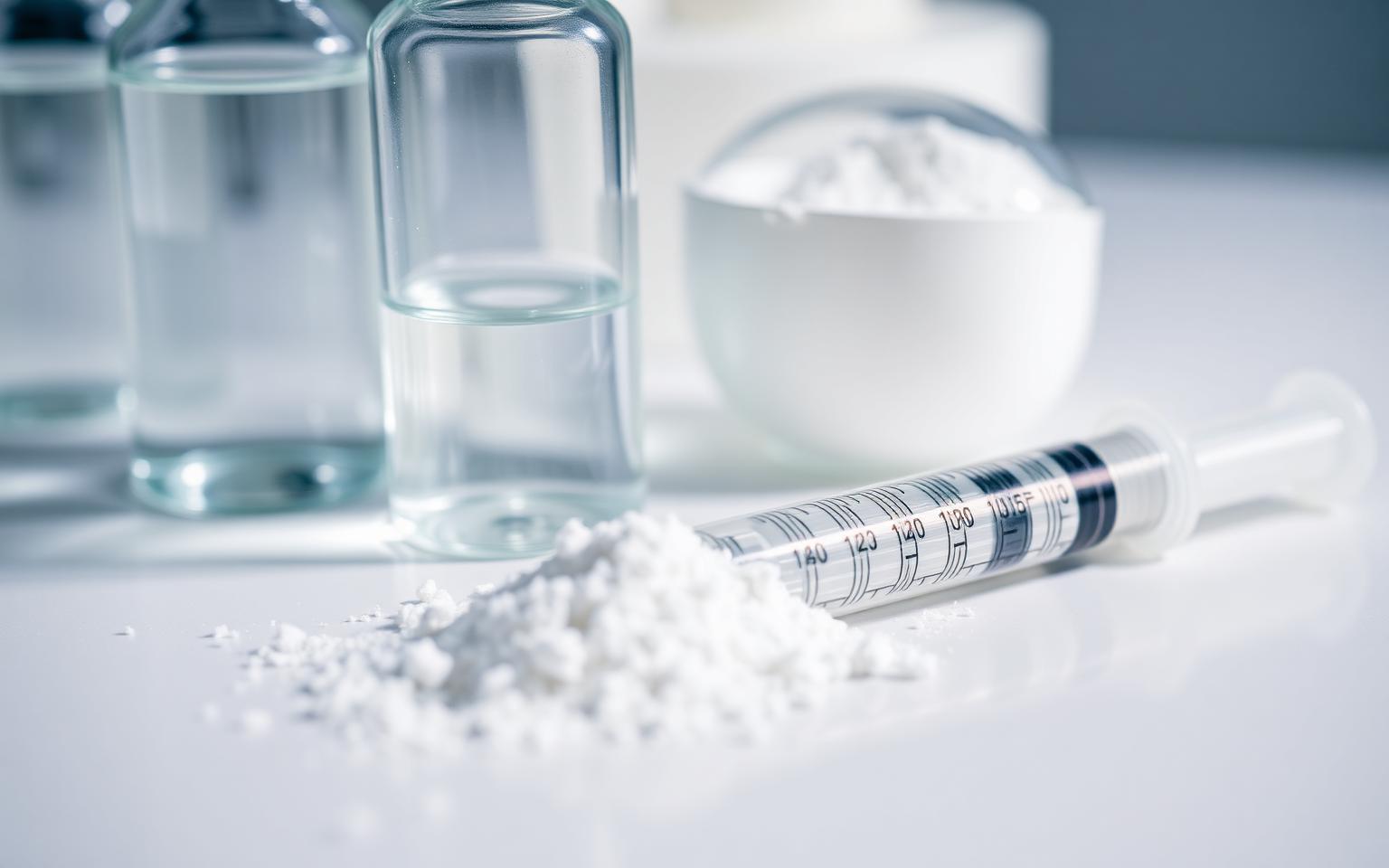
Inside a sealed peptide vial sits a compressed plug or powder called a lyophilized cake. Lyophilization is a freeze drying process that sublimates water directly from a frozen state into vapour under vacuum. The result is a dry, glass like solid that preserves the delicate amide bonds of the peptide chain for months or years.
One common trap is judging the dose by how much powder you can see. A vial containing 5 mg of peptide can look visually identical to one containing 2 mg or 10 mg. Manufacturers often add inert bulking agents like mannitol to stabilise the freeze drying process, so the volume of the cake is not a reliable signal. The only number that matters is the certified milligram rating printed on the label.
The Diluent
The liquid you add to dissolve the cake is the diluent. Choice of diluent determines sterility, shelf life, and safety.
- Bacteriostatic water (BAC water). Sterile water with 0.9 percent benzyl alcohol as a preservative. The benzyl alcohol suppresses bacterial growth introduced by repeated needle punctures through the rubber stopper. This is the standard diluent for any multi use vial.
- Sterile water for injection. Contains no preservative. Safe for a single use container, but the moment you puncture it and expose the inside to air, its usable life drops to roughly 24 hours.
For almost every peptide protocol, BAC water is the correct choice. Using plain sterile water for a multi day vial dramatically raises the risk of contamination.
Milligrams vs Micrograms: The Single Biggest Source of Errors
Vials are manufactured and labelled in milligrams. Doses are almost always prescribed in micrograms. The conversion is simple but the consequences of getting it wrong are not. A factor of 1,000 error in either direction can mean an inert dose or a dangerous one.
The rule is base 1,000 scaling:
- 1 mg equals 1,000 mcg.
- To go from mg to mcg, multiply by 1,000.
- To go from mcg to mg, divide by 1,000.
So a 2 mg vial of CJC-1295 contains 2,000 mcg of peptide. A 5 mg vial of Ipamorelin contains 5,000 mcg. A 10 mg vial of Epithalon contains 10,000 mcg. Every calculation downstream uses the micrograms figure, not the milligrams figure, because doses are sized in micrograms.
How Fluid Volume Sets the Concentration
When you inject BAC water into the vial, you create a solution. The amount of peptide in that solution does not change. What changes is how concentrated the peptide is per unit of liquid. Concentration is the entire engine of dosing math.
The formula is straightforward:
Concentration (mcg / mL) = Total peptide (mcg) ÷ Volume of BAC water (mL)
Watch how the same 5 mg (5,000 mcg) vial shifts when you change the BAC volume:
- 5,000 mcg in 1.0 mL of water gives 5,000 mcg per mL.
- 5,000 mcg in 2.0 mL gives 2,500 mcg per mL.
- 5,000 mcg in 3.0 mL gives roughly 1,667 mcg per mL.
- 5,000 mcg in 5.0 mL gives 1,000 mcg per mL.
Why More Water Is Not Always Better
Going too dilute is just as bad as going too concentrated.
If you put too little water in a high mg vial, the daily draw on the syringe might only be 1 or 2 units. At that scale, a single small bubble or a slightly long fingernail tap can double or halve your dose. Accurate measurement gets impossible.
If you put too much water in a small vial, you end up pushing 50 or 60 units of fluid under the skin for one dose. That stings, raises the chance of local irritation, and can produce a visible bleb that takes longer to absorb.
The sweet spot is a draw between 5 and 50 units on a U-100 syringe, where the gradations are large enough to measure cleanly without forcing an uncomfortable injection volume.
U-100 vs U-40 Syringe Scales
Insulin syringes measure in units rather than millilitres. A unit is just a fraction of a mL, and the fraction depends on the syringe type.
- U-100 syringe. 100 units equals 1.0 mL. Each unit is 0.01 mL. This is the standard for almost all peptide work.
- U-40 syringe. 40 units equals 1.0 mL. Each unit is 0.025 mL. Less common, but still used in some veterinary and legacy protocols.
To convert any volume in mL into units, multiply by the syringe type number. 0.1 mL on a U-100 is 10 units. The same 0.1 mL on a U-40 is only 4 units, because each unit holds more fluid. The peptide calculator above lets you toggle between U-100 and U-40 so this conversion is never something you do in your head at midnight.
Two Worked Examples
Example A: BPC-157 for Tissue Repair
Setup: a 5 mg vial of BPC-157, bacteriostatic water, and a U-100 syringe. Target dose 250 mcg once daily.
- Convert vial to micrograms: 5 mg x 1,000 = 5,000 mcg.
- Pick a fluid volume: use 2 mL of BAC water.
- Concentration: 5,000 ÷ 2 = 2,500 mcg per mL.
- Volume per dose: 250 ÷ 2,500 = 0.1 mL.
- Convert to units: 0.1 mL x 100 = 10 units.
Result: pull the syringe to the 10 unit mark for an exact 250 mcg dose. The 5 mg vial gives 20 daily doses, a 20 day supply.
Example B: TB-500 Loading Phase
Setup: a 10 mg vial of TB-500 and a U-100 syringe. Target dose 2,500 mcg twice per week.
- Convert vial: 10 mg x 1,000 = 10,000 mcg.
- Pick a fluid volume: 2 mL of BAC water to keep the injection comfortable.
- Concentration: 10,000 ÷ 2 = 5,000 mcg per mL.
- Volume per dose: 2,500 ÷ 5,000 = 0.5 mL.
- Convert to units: 0.5 mL x 100 = 50 units.
Result: pull the syringe to the 50 unit mark. The vial holds 4 doses, which at twice weekly lasts 14 days.
Aseptic Technique: The Five Phase Reconstitution Protocol
Math gets you the right number. Technique keeps the compound viable. Skipping steps here is how a 200 dollar vial turns into a contaminated paperweight.
Phase 1: Prepare the Work Surface
Clear a flat, well lit space and wipe it with an isopropyl alcohol wipe. Wash hands thoroughly. Remove the plastic flip off caps from both the peptide vial and the BAC water vial. Scrub the exposed rubber stoppers on both vials with a fresh alcohol swab for at least 15 seconds. Let them air dry. Do not blow on the stoppers to speed drying because exhaled air carries bacteria.
Phase 2: Draw the Diluent
Pull air into the mixing syringe equal to the BAC water volume you plan to draw. Insert the needle through the centre of the BAC water stopper and push the air in to equalise pressure. Invert the BAC water vial, submerge the needle tip in the liquid, and slowly draw your target volume. Tap the barrel to release any bubbles and push them back into the vial. Withdraw the needle.
Phase 3: Transfer Into the Peptide Vial
Peptide vials are sealed under partial vacuum. If you let go of the plunger after puncturing the stopper, the vacuum will yank the water in violently and spray it directly onto the freeze dried cake, breaking molecular bonds.
Insert the needle at a 45 degree angle through the sanitised stopper. Hold the plunger firmly and press it down slowly. Aim the stream of BAC water against the inside glass wall of the vial so the liquid trickles down gently and dissolves the cake from the side instead of blasting it from above. Before withdrawing the needle, pull a small amount of air back into the syringe to relieve internal pressure.
Phase 4: Dissolve
Discard the mixing needle into a sharps container. Hold the vial between your fingers and swirl it slowly in circular motions. Never shake the vial. Shearing forces from shaking can tear peptide chains apart, cloud the solution, and render the compound inert. Full dissolution can take 30 seconds to 5 minutes. If the solution stays cloudy after gentle swirling, refrigerate it for a few minutes and re check.
Phase 5: Draw and Inject
Use a fresh insulin syringe for the actual dose. Pull air equal to your target volume, push it into the reconstituted vial, invert, and draw to the unit mark the calculator gave you. Tap out any bubbles. Clean the injection site with an alcohol swab, allow it to dry, and inject at the angle and depth appropriate for the route prescribed by your clinician.
Reading the Calculator Warnings
The peptide calculator above runs two built in safety checks every time you change a value.
Dose Exceeds Syringe Capacity
If the calculated draw is more than the syringe holds (100 units on a U-100 or 40 units on a U-40), the calculator flags it. You have two fixes: use less BAC water to raise the concentration so the same dose fits into a smaller volume, or split the dose into two separate injections. Splitting is often cleaner because trying to chase a single large fluid volume usually means injecting an uncomfortable bleb.
Very Small Draw Amount
If the calculated draw is under 2 units, the calculator warns you. At that scale, a single hand tremor can move the plunger by a noticeable fraction of the dose. The fix is to add more BAC water, which dilutes the solution and pushes the draw into a larger, easier to measure range.
Doses Per Vial and Days of Supply
Beyond the single injection math, the calculator also tells you how many doses are inside the vial and how long that lasts.
- Doses per vial = Total mcg in the vial ÷ Dose mcg.
- Days of supply = Doses per vial ÷ Doses per day.
These numbers matter because reconstituted peptides have a 28 to 30 day potency window. If a vial gives you 50 days of supply at your chosen dose, 20 days of that solution will degrade past peak potency before you can use it. Smaller vials, more frequent dosing, or rotating between two compounds are all valid ways to align the supply curve with the potency window.
Common Questions
Can I change the BAC water volume after I have already mixed the vial?
No. Once the peptide is dissolved, the concentration is locked. You can only change the concentration on the next vial.
What happens if I draw the wrong unit mark by mistake?
If you under draw, the dose simply runs lower than planned. If you over draw, you waste peptide. Neither is dangerous for most common compounds in small overshoots, but it is wasteful and breaks the calendar math for doses per vial.
Do I need a different syringe for drawing and injecting?
Best practice is to use a larger mixing syringe (3 to 5 mL) to draw BAC water and transfer it, then a fresh insulin syringe for the actual injection. Reusing the same syringe risks bending the needle and dulling the tip, which makes subsequent injections more painful.
Why does the calculator default to BAC water and not sterile water?
Because BAC water is the only option that keeps a multi use vial safe for the full 28 to 30 day window. Sterile water is only valid for a vial you plan to finish in 24 hours.
What if my peptide is supposed to be measured in IU instead of mcg?
A small number of growth hormone style compounds are dosed in international units. For those, you need a conversion factor specific to the compound (mcg per IU), which should come from the certificate of analysis or your clinician. Do not assume 1 IU equals 1 mcg.
The Takeaway
Peptide dosing is not chemistry, it is arithmetic. Vials are sized in milligrams, doses in micrograms, and the conversion between them is a factor of 1,000. Concentration is total micrograms divided by total millilitres of BAC water. Volume per dose is target dose divided by concentration. Units on the syringe is volume times either 100 or 40 depending on syringe type. The peptide calculator above runs every step in sequence, flags impossible combinations, and gives you the exact unit mark to draw. Combine clean technique with the right math and your protocol stays both safe and reproducible.