Quick Answer
Calorie counts on packaged food are estimates with a legally tolerated margin of error, commonly cited as around 20 percent in the United States and similar in practice in the United Kingdom and European Union.
Most of the error is not fraud. It comes from natural variation in ingredients, from the calculation method used, and from the fact that a serving on the pack rarely matches the serving on your plate.
Restaurant and menu calorie figures are less reliable than packaged food, because portioning is done by hand. For most people the practical fix is consistency rather than precision.
How the number is produced
Very few manufacturers burn food in a calorimeter. The standard route is calculation. The amounts of protein, carbohydrate, fat, fibre and alcohol are determined by laboratory analysis or taken from ingredient databases, then multiplied by fixed energy factors.
Those factors, known as Atwater factors, are 4 calories per gram for protein and carbohydrate, 9 for fat, 7 for alcohol and 2 for some fibres. They are averages derived over a century ago and refined since.
The system works well at population level and gets progressively less exact for individual foods, particularly whole foods with tough cell walls, high fibre content or resistant starch.
Where the error actually comes from
Several sources stack up, and none of them individually is large.
- Ingredient variation: the fat content of a cut of meat or the sugar in a batch of fruit varies with season and supplier
- Manufacturing tolerance: a filling machine aims at a target weight with a permitted range around it
- Rounding rules: calories are rounded to the nearest 5 or 10 in many jurisdictions
- Database entries: recipe calculation uses average values for each ingredient, not the specific batch used
- Cooking losses: moisture loss and fat drainage change the finished figure
Add these together and a difference of ten to twenty percent between the label and a laboratory analysis is unremarkable.
Why the Atwater system understates some foods and overstates others
The most interesting inaccuracies are biological rather than industrial. Whole almonds deliver noticeably fewer calories than the Atwater calculation suggests, because a significant fraction of the fat stays locked inside intact cell walls and passes through undigested. Grinding them into butter closes most of that gap.
High fibre foods behave similarly. Fibre that reaches the colon is fermented into short chain fatty acids, which yield energy at a different rate than the standard factor assumes.
Cooking pushes the other way. Cooked starch and cooked protein are more digestible than raw, so a raw food label understates the energy you actually absorb from the cooked version. The same weight of raw and boiled potato does not deliver the same usable energy.
Serving size is the largest single error
The label is accurate for the serving it describes. The gap opens when the serving you eat is bigger.
Cereal is the standard illustration. A labelled portion is often 30 or 40 grams, while a typical poured bowl is closer to 70. Nobody misled anybody, yet the calories on the plate are nearly double the calories on the panel.
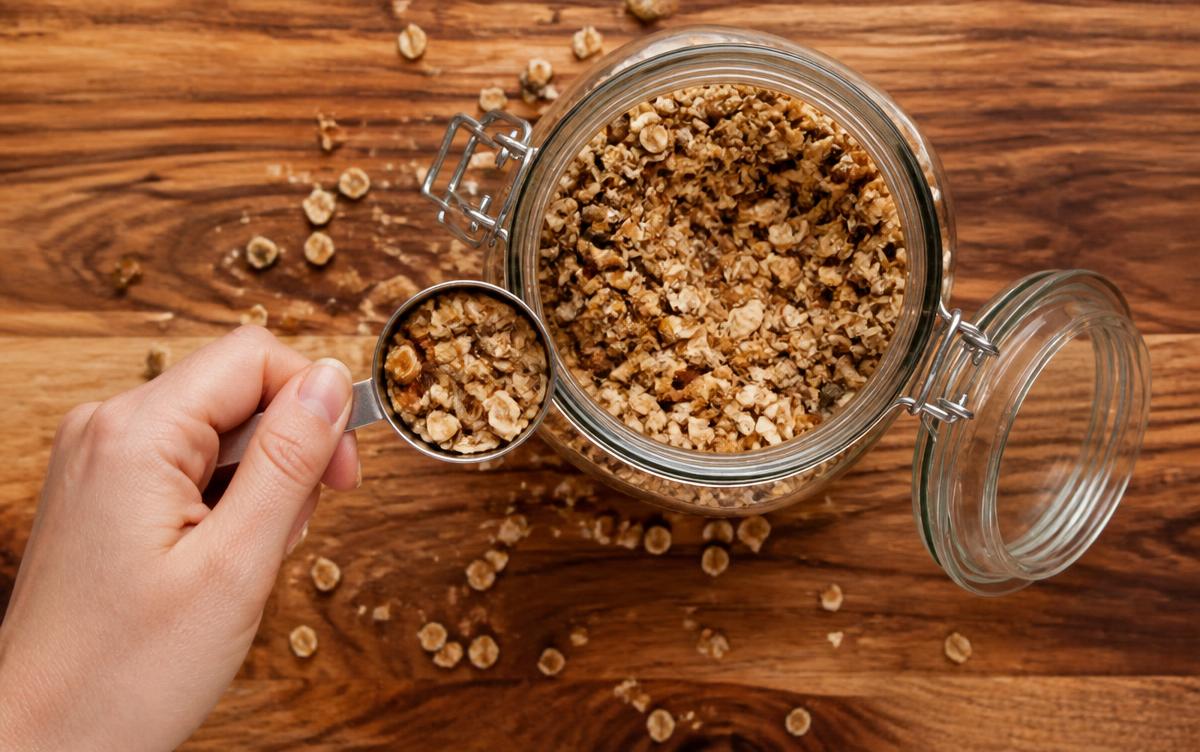
Spreads, oils, granola, nuts and cheese are the other frequent offenders, because they are dense and difficult to eyeball. A tablespoon of oil poured freehand is regularly two.
Restaurant and menu figures
Chain menu labelling is required in many countries, and the numbers are usually calculated from standard recipes. Kitchens are not laboratories. Studies comparing measured energy content with published figures have repeatedly found real dishes exceeding stated calories, sometimes substantially.
The mechanism is simple: an extra ladle of sauce, a heavier hand with oil, a slightly larger portion of chips. None of it is deliberate.
Treat menu figures as a way of ranking options rather than as an exact ledger. The relative difference between two dishes is more reliable than the absolute number attached to either.
Does the imprecision matter?
For most goals, less than people fear. If you are tracking intake to lose or gain weight, a consistent bias matters far less than an inconsistent one, because you adjust based on the trend in your own weight rather than on the arithmetic.
Suppose every label you use overstates by ten percent. Your logged intake is wrong, but your logged intake next week is wrong by the same amount, so the change you make in response is still the right direction and roughly the right size.
Problems arise when precision is assumed. Chasing a 50 calorie deficit inside a 20 percent measurement window is arithmetic theatre.
How to make your own numbers more useful
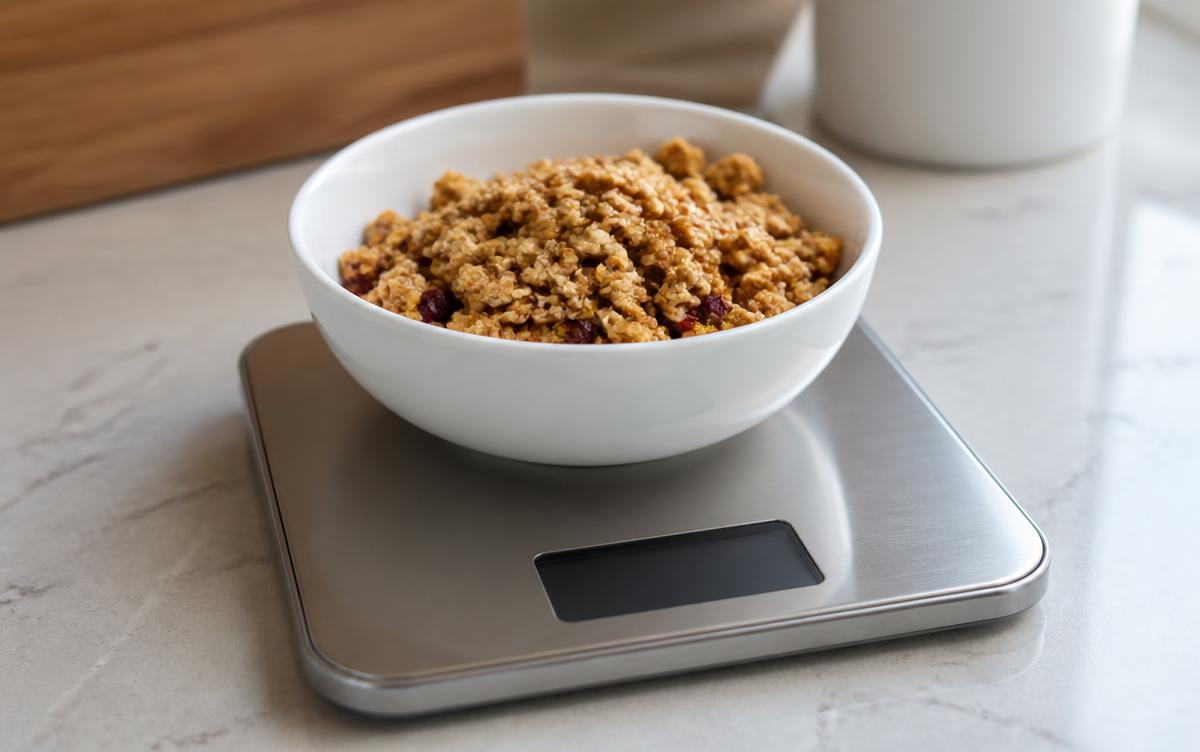
Weighing is the single highest value habit. A digital scale removes portion drift entirely, which is the largest error source you actually control.
Weigh dense foods in particular: oils, nut butters, cheese, granola, nuts and cooked grains. Eyeball the rest. Log foods raw or cooked consistently rather than mixing the two, and use the same database entries week to week.
Track a weekly average of body weight rather than daily readings, and adjust intake based on that trend over two or three weeks. That turns imprecise labels into a workable feedback loop.
The bottom line
Food labels are estimates built from average energy factors, permitted tolerances and rounding, and they can be off by roughly a fifth in either direction. Restaurant figures are looser still.
The label is rarely the problem. Portion size is. Weigh the dense stuff, stay consistent, and judge the result by what your own weight does over weeks rather than by the arithmetic on any single pack.
Frequently asked questions
Are labels deliberately wrong?
Rarely. Most of the gap comes from ingredient variation, averaged database values and rounding rules rather than from any attempt to mislead.
Should I log food raw or cooked?
Either, as long as you are consistent. Raw weights are more stable because cooking loss varies with method and time.
Why do almonds have fewer calories than the label says?
Some of the fat stays trapped inside intact cell walls and passes through undigested. Grinding or roasting reduces that effect.
Are restaurant calorie counts reliable?
Less so than packaged food, because portioning is done by hand. Use them to rank dishes rather than to log exact totals.