Quick Answer
Yes. Diamond melts, but not the way ice or metal does. At normal atmospheric pressure carbon never reaches a stable liquid state, because the solid converts and vaporises before liquid can form.
To get liquid carbon you need pressure in the hundreds of gigapascals and temperatures in the tens of thousands of kelvin, which in practice means driving a shock wave through a tiny diamond sample with a very large laser.
New shock compression work published in Nature Physics in August 2026, led by researchers at Lawrence Livermore National Laboratory, mapped that melting behaviour at roughly one terapascal, about three times the pressure at the centre of the Earth.
Why Diamond Will Not Simply Melt on a Hob
Diamond is carbon locked into a rigid three dimensional lattice, with every atom bonded to four neighbours. Those bonds are strong, which is why diamond is the hardest bulk material most people will ever hold.
Heat a diamond in open air and it burns, because carbon reacts with oxygen. Heat it without oxygen and the lattice reorganises into graphite, then leaves the solid phase entirely near 4,000 kelvin without ever passing through a puddle.
That is a pressure problem, not a temperature problem. A liquid needs enough external pressure to hold the atoms together while thermal motion breaks the bonds. At one atmosphere there is nothing holding the carbon in place once the bonds go.
How the Experiments Actually Work
Laser facilities such as the National Ignition Facility and the Omega laser take a synthetic diamond sample only microns thick and hit it with an extremely short, extremely intense pulse.
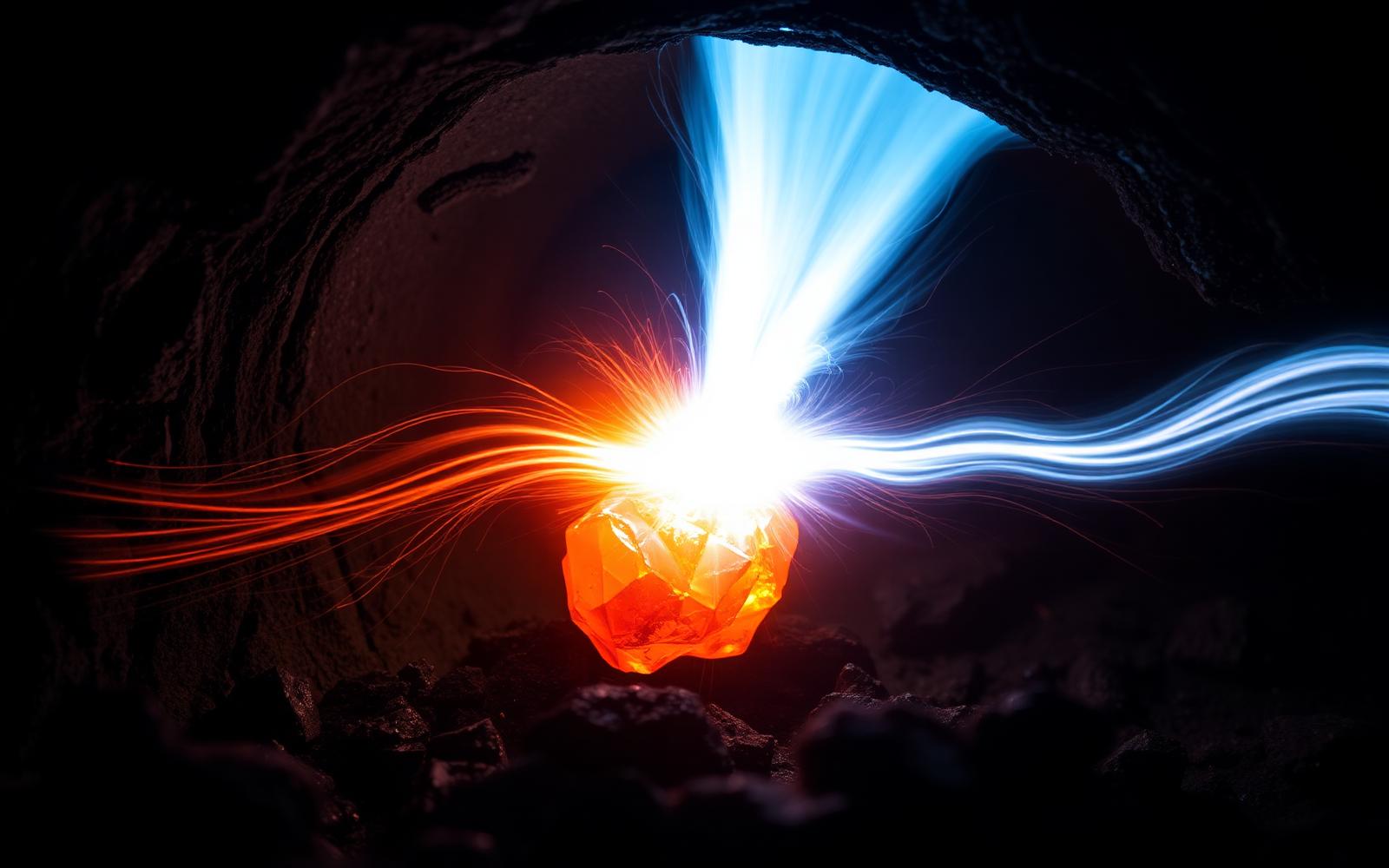
The surface of the sample vaporises instantly. That ablation acts like a rocket in reverse and drives a supersonic shock wave into the remaining material, compressing it in a few billionths of a second.
- Compression: the shock raises the sample far past the pressures inside the Earth's core.
- Heating: compression alone pushes the temperature past the surface temperature of the sun.
- Measurement: the whole event has to be diagnosed before the sample disassembles, which is why every instrument is triggered off the same laser pulse.
Researchers on the 2026 study reported measuring atomic structure, temperature, density and optical reflectivity in that window, which is what makes the result useful rather than merely spectacular.
What Happens to Carbon at a Terapascal
As the shock passes, the tetrahedral bonding collapses. The material stops behaving like a transparent insulator and starts behaving like a dense, reflective, electrically conducting fluid.
That change in reflectivity is one of the diagnostics. Solid diamond is optically transparent. Metallic liquid carbon is not, so the moment the sample starts reflecting light differently is evidence that the phase has changed.
The most counter intuitive finding is the density relationship. Under these conditions solid diamond floats in liquid carbon, in the same way that ice cubes float in a glass of water. Most substances do the opposite, so the solid sinks.
The Discrepancy This Work Resolved
For years experimental melting data and computer simulations of carbon did not agree. Theory and measurement gave meaningfully different answers about where the melt line sits and how the liquid behaves.
Simulation of this regime is genuinely hard. Standard density functional theory has to describe electrons that are partly bound and partly free, in a lattice being shaken apart by heat, at pressures nobody can reproduce in a static press.
By combining in situ x ray diffraction, pyrometry and reflectivity measurements from the same shots, the 2026 study brought experiment and simulation into agreement and tightened the equation of state that both fusion and planetary models depend on.
Why Fusion Researchers Care
| Property | Diamond at room conditions | Shock compressed liquid carbon |
|---|---|---|
| Structure | Rigid tetrahedral lattice | Disordered dense fluid |
| Pressure | About 0.0001 GPa | Hundreds of GPa up to about 1 TPa |
| Temperature | Ambient | Tens of thousands of kelvin |
| Electrical behaviour | Insulator | Conducting, metallic |
| Optical behaviour | Transparent | Reflective and opaque |
Inertial confinement fusion targets use a tiny spherical shell of high density carbon, which is diamond, to hold the hydrogen fuel. Lasers crush that shell and the fuel inside heats and fuses.
The shell has to collapse smoothly. If the diamond melts at a slightly different pressure than the design assumed, the shock timing drifts, the implosion goes lopsided and energy that should have gone into the fuel goes into turbulence instead.
Better melting data means better shock timing, which is why the Livermore team framed the result partly in terms of pushing fusion energy gain higher rather than purely as a curiosity about carbon.
Diamond Rain on Neptune and Uranus
The other application is planetary. Inside ice giants like Neptune and Uranus, methane sits under crushing pressure and high heat, and it does not stay methane.
The hydrocarbon breaks apart, the carbon separates out and can crystallise into diamond, which then sinks through the interior. Planetary scientists call this diamond rain, and it is one of the more literal names in the field.
Knowing exactly where diamond melts tells modellers whether that carbon stays solid on the way down or turns into a liquid layer deeper in. That changes how heat moves through the planet, which in turn feeds into models of their strange, off centre magnetic fields.
How to Read Claims About Melting Diamond
Headlines about melting diamond tend to lose the pressure half of the story, which is the half that matters. A furnace will never do this no matter how hot it gets.
The useful mental model is that pressure decides whether a liquid phase exists at all, and temperature decides whether you reach it. Carbon simply needs an unusual amount of the first before the second becomes relevant.
It is also worth noting the timescale. These liquids exist for nanoseconds inside a target that destroys itself in the process, so nobody is pouring liquid carbon into a mould any time soon.
Frequently Asked Questions
What temperature does diamond melt at?
There is no single figure, because the melting temperature depends on pressure. Under multi megabar shock compression the relevant temperatures run into the tens of thousands of kelvin, far above the roughly 4,000 kelvin at which carbon leaves the solid phase at ambient pressure.
Does diamond burn before it melts?
In air, yes. Carbon reacts with oxygen at a few hundred degrees Celsius, so a diamond exposed to a hot flame will burn away rather than melt.
Is liquid carbon denser than diamond?
Under the extreme pressures explored in these experiments, yes. Solid diamond floats on the liquid, which is the same anomaly that makes ice float on water.
Where is diamond melting research done?
At high energy density laser facilities, including the National Ignition Facility and the Omega laser, with analysis led in this case by Lawrence Livermore National Laboratory.
Why does fusion use diamond capsules?
High density carbon shells are strong, dense and can be machined very smoothly, which helps the fuel capsule compress evenly during a laser implosion.
Bottom Line
Diamond melts only when pressure holds the carbon together long enough for heat to break the bonds, which means hundreds of gigapascals and temperatures hotter than the sun's surface.
The 2026 shock compression work matched those measurements to theory for the first time, and the payoff shows up in two very different places: fusion capsule design on Earth, and the interiors of the ice giants.