Quick Answer
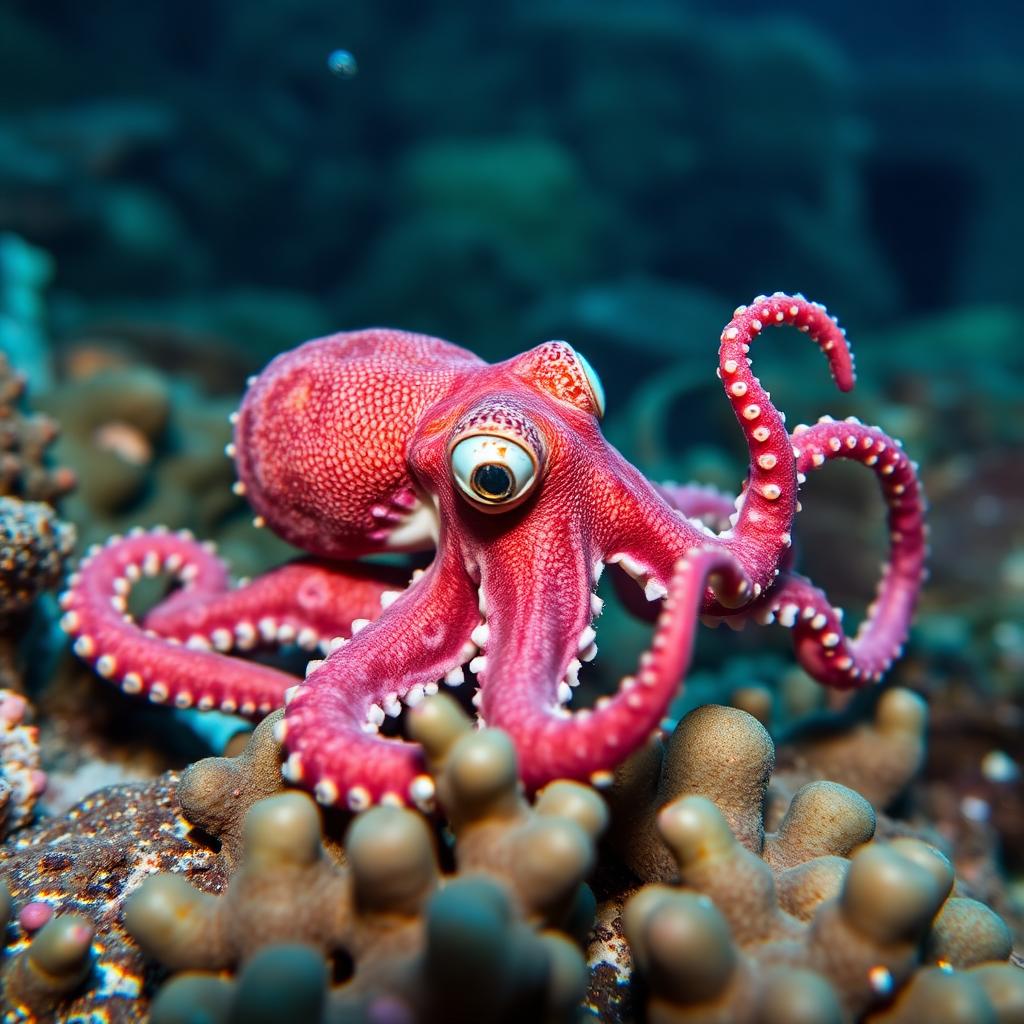
Yes. Octopuses are widely regarded as the most cognitively complex invertebrates on Earth. They have roughly 500 million neurons (about the same as a dog), solve mechanical puzzles, use tools, learn by observation, recognise individual human faces, and show clear evidence of curiosity and play.
What makes their intelligence so striking is that it evolved entirely independently from the vertebrate line more than 500 million years ago. Studying an octopus is the closest a human can get to meeting an alien mind on this planet.
The numbers that matter
A common octopus (Octopus vulgaris) has around 500 million neurons. For context, a honeybee has roughly one million, a rat about 200 million, a cat about 250 million, and a dog roughly 500 million. Humans sit far higher at around 86 billion, but raw count is only part of the story; architecture matters more than total.
The octopus architecture is the radical part. Only about a third of its neurons sit in the central brain wrapped around the oesophagus. The remaining two thirds live in the eight arms, organised into clusters called axial nerve cords. Each arm can independently taste, touch, explore and grip without instruction from headquarters.
Distributed thinking, eight ways at once
In a vertebrate, the central brain sends fairly detailed motor commands down the spinal cord and the limb executes them. In an octopus, the central brain sends a high-level goal (open this jar) and each arm figures out its own movement, coordinating with neighbours through local reflex arcs. Severed octopus arms studied in labs have continued to react to stimuli for minutes after separation, not because of consciousness but because they carry enough local nervous tissue to keep responding.
This design is closer to a federation than a monarchy. It is also why octopus motor control looks so alien on video: arms curl and uncurl with a smooth, non-jointed elegance that no vertebrate limb can match.
Documented tool use
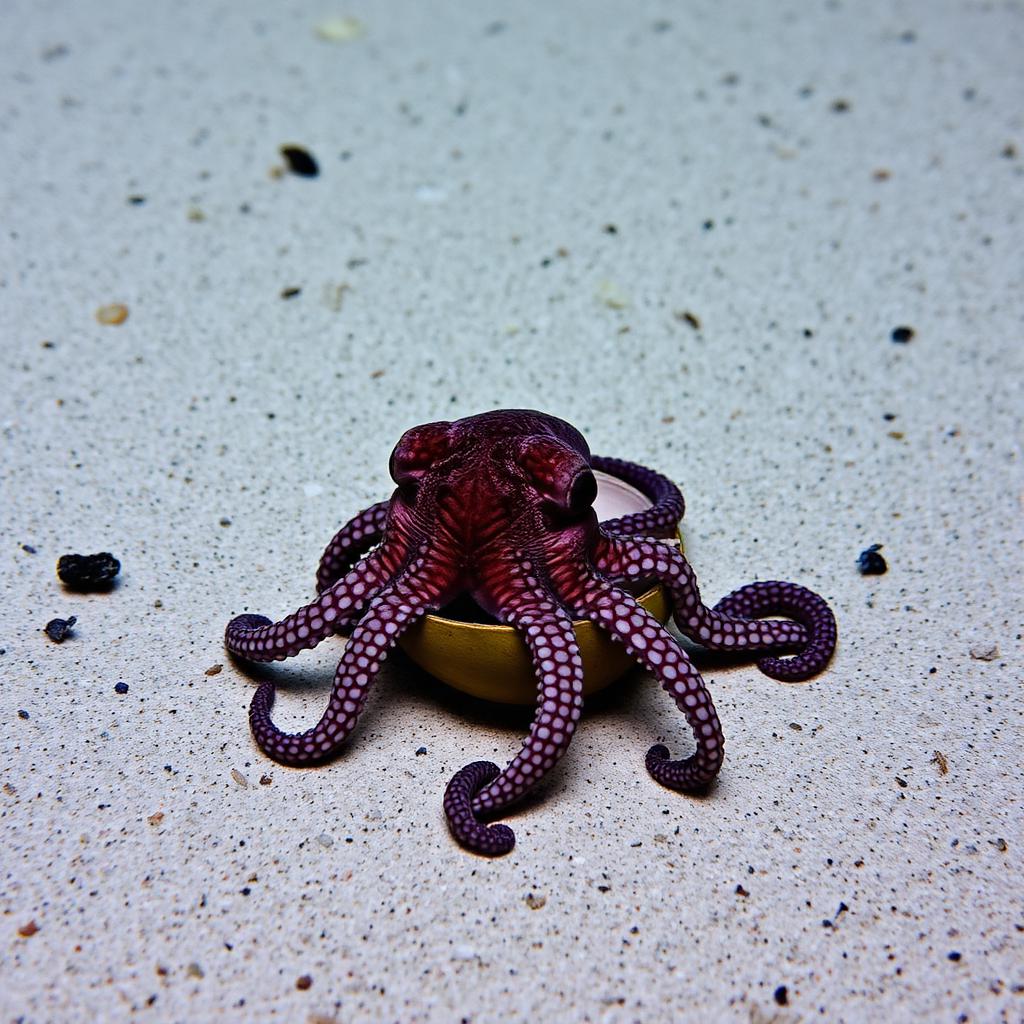
Tool use was once considered a hallmark of high vertebrate intelligence: chimpanzees, crows, sea otters, dolphins. The octopus joined the club in 2009 when marine biologists working off Indonesia and Bali documented veined octopuses (Amphioctopus marginatus) collecting discarded coconut shell halves, carrying them across the seabed by stilting awkwardly on the tips of their arms, then assembling them into a protective sphere when a predator approached.
Critically, the shells offered no immediate benefit during transport. The octopus had to invest energy now for a future payoff, which is the defining feature of tool use in the strict scientific sense.
Problem solving in captivity
In aquariums and labs, octopuses routinely solve puzzles that confound much larger-brained animals. They unscrew the lids of jars to reach prey, work out twist-and-pull mechanisms on Perspex puzzle boxes, learn to discriminate between visual patterns, and develop spatial memory maps of their tanks.
They also learn by observation. Naive octopuses watching trained octopuses solve a colour-discrimination task picked up the correct response much faster than control animals, an ability previously thought to require a complex social mammal brain.
Escapes, mischief and personality
Because an octopus body has no bones (only a small chitinous beak), it can squeeze through any opening larger than that beak. Aquariums have learned to weight, latch and silicone-seal their lids after losing animals to overnight expeditions. The most famous case in modern memory is Inky, a common New Zealand octopus who in 2016 lifted his tank lid at the National Aquarium in Napier, crawled across the floor, and posted himself down a 50 metre drainpipe straight back into Hawke's Bay.
Keepers consistently report that octopuses have individual personalities. Some are bold and outgoing, approaching the glass to investigate visitors. Others are shy and hide. Many will greet familiar keepers calmly and squirt water at staff they dislike, suggesting they recognise individual humans by sight even when the humans are wearing the same uniform.
Do they feel things?
The London School of Economics report commissioned by the UK government in 2021 reviewed more than 300 studies and concluded that cephalopods (octopus, squid, cuttlefish) show strong evidence of sentience: they avoid pain, learn from it, and exhibit behaviours consistent with suffering. The report led directly to octopuses being included in the UK Animal Welfare (Sentience) Act 2022. Several countries now restrict octopus farming on welfare grounds.
The catch: a brilliant, lonely, short life
For all this cognitive sophistication, most octopuses live only one to two years. The Giant Pacific Octopus, the longest-lived, makes it to about four. They are almost entirely solitary, do not raise their young, and the females die shortly after their eggs hatch. Whatever an octopus learns, it learns alone, uses for a few months, and takes with it.
The takeaway
Octopuses are intelligent on any reasonable definition: they plan, they remember, they tool-use, they recognise faces, they play, and they suffer. Their minds are not lesser versions of ours; they are a parallel solution to the same problem, evolved independently in salt water. That makes every octopus an opportunity to study cognition without the assumptions our own brains keep smuggling into the room.