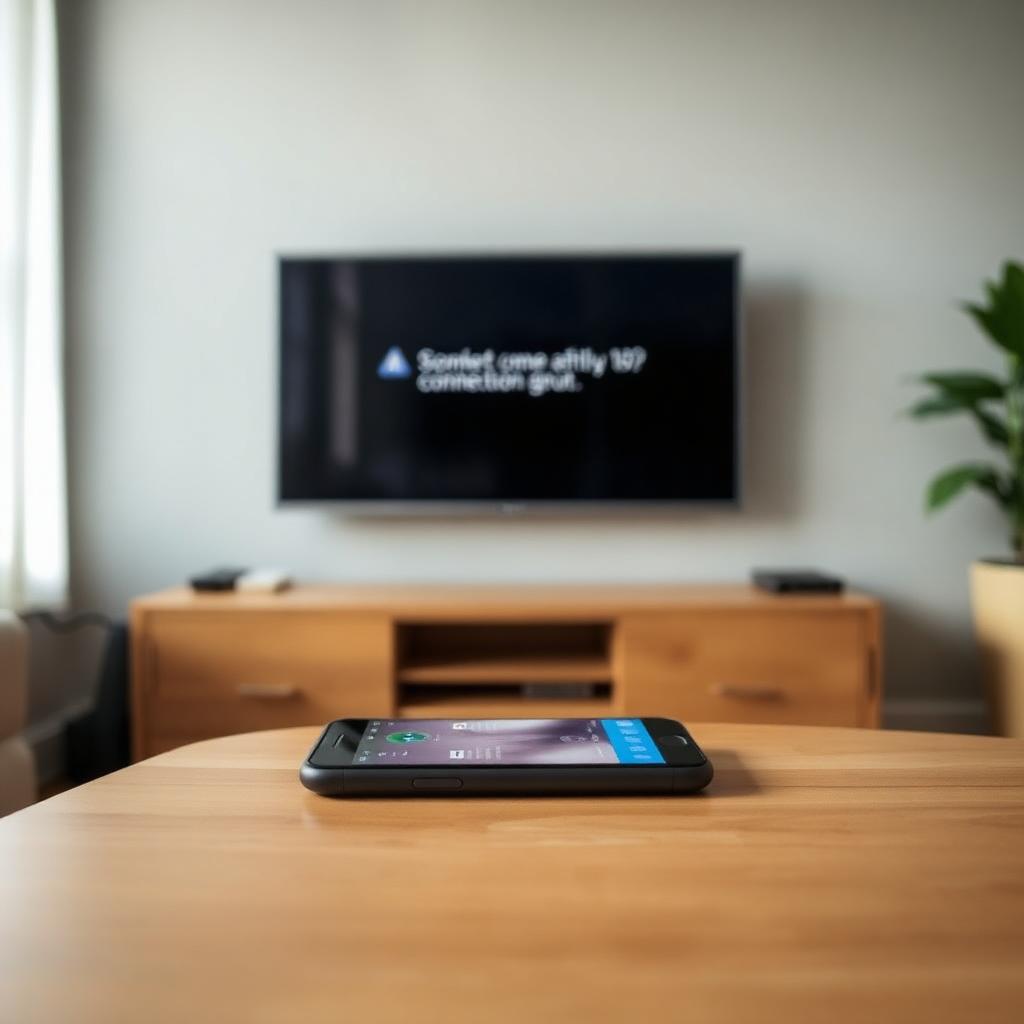
The official Roku Mobile App turns your phone into a digital remote, private listening hub, and keyboard, but it falls apart the moment it cannot find your television. The dreaded "No Roku devices found" screen is almost never a hardware fault. Nine times out of ten the phone and the TV are sitting on slightly different network segments, and the discovery handshake quietly times out.
Quick Answer
The Roku app fails to find your TV when the phone and the Roku device are not on the exact same local Wi-Fi subnet, or when the router is blocking peer to peer traffic with Access Point Isolation.
Quick fix in three steps: make sure your phone is on the same SSID as the TV (watch out for the 2.4 GHz vs 5 GHz split), open the app and tap Devices then Connect Manually, then type the TV's IP address from Settings, Network, About.
If manual connection still fails, disable AP Isolation (sometimes called Client Isolation or Guest Network Isolation) on your router and reboot both devices.
Step 1: the golden rule of device discovery
For the Roku mobile app to find your TV, both the smartphone and the Roku device must share the exact same Local Area Network subnet. Most modern routers broadcast two bands (2.4 GHz and 5 GHz) under similar SSIDs. If your phone hops onto HomeNet_5G while your Roku sits on HomeNet, the broadcast packets used for discovery never cross over.
- Open your phone Wi-Fi settings and write down the exact SSID.
- On the TV, press Home, then Settings, Network, About, and confirm the network name matches.
- If they differ, disconnect your phone and rejoin the matching base SSID.
Step 2: bypass discovery with a manual IP connection
If automatic discovery still fails, you can skip the broadcast scan entirely by typing the Roku's IP address directly into the app.
[ROKU HOME] -> [SETTINGS] -> [NETWORK] -> [ABOUT] -> [IP ADDRESS]- From the TV's Settings, Network, About screen, copy the IP (it looks like 192.168.1.x or 10.0.0.x).
- Open the Roku app and tap Devices at the bottom.
- Choose Connect Manually and enter the IP.
- Save. The app will lock onto the TV in seconds.
Step 3: disable AP Isolation on the router
If the IP override fails, your router has Access Point Isolation enabled. This security setting lets every device reach the internet but blocks them from talking to each other. It is common on dorm, hotel, and Guest networks.
- Log into the router admin page in a browser (typically 192.168.0.1 or 192.168.1.1).
- Look in Wireless or Advanced Security for AP Isolation, Client Isolation, or Guest Isolation.
- Disable it on the band your phone and Roku share, then save and reboot the router.
Step 4: rule out firewall and VPN interference
Mobile VPNs (NordVPN, ExpressVPN, Cloudflare WARP) route phone traffic through a tunnel that hides the local LAN entirely. Pause the VPN in the system settings before opening the Roku app. Antivirus apps with built in firewalls (Norton, McAfee) can also block UDP discovery on port 1900, the protocol the Roku app uses.
Frequently asked questions
Does the Roku app work over cellular data?
No. The app needs both phone and TV on the same local Wi-Fi network. Turn off mobile data while pairing if your phone keeps falling back to LTE.
Why does the app find my TV one day and not the next?
Most consumer routers reassign IP addresses every 24 hours. Either set a DHCP reservation for the Roku's MAC address, or always reconnect via the manual IP entry method.
Will a mesh router cause issues?
Yes, especially Eero, Google Wifi, and Deco systems with band steering enabled. Devices may quietly hop between nodes. Disable band steering or put both devices on a single SSID with a fixed band.
The takeaway
A missing Roku TV in the mobile app is a network problem, not a hardware one. Check that the phone and TV share the same SSID and band, override discovery by typing the TV's IP manually, then disable AP Isolation if the router is filtering local traffic. Pause any active VPN. With those four checks the app reconnects nearly every time.