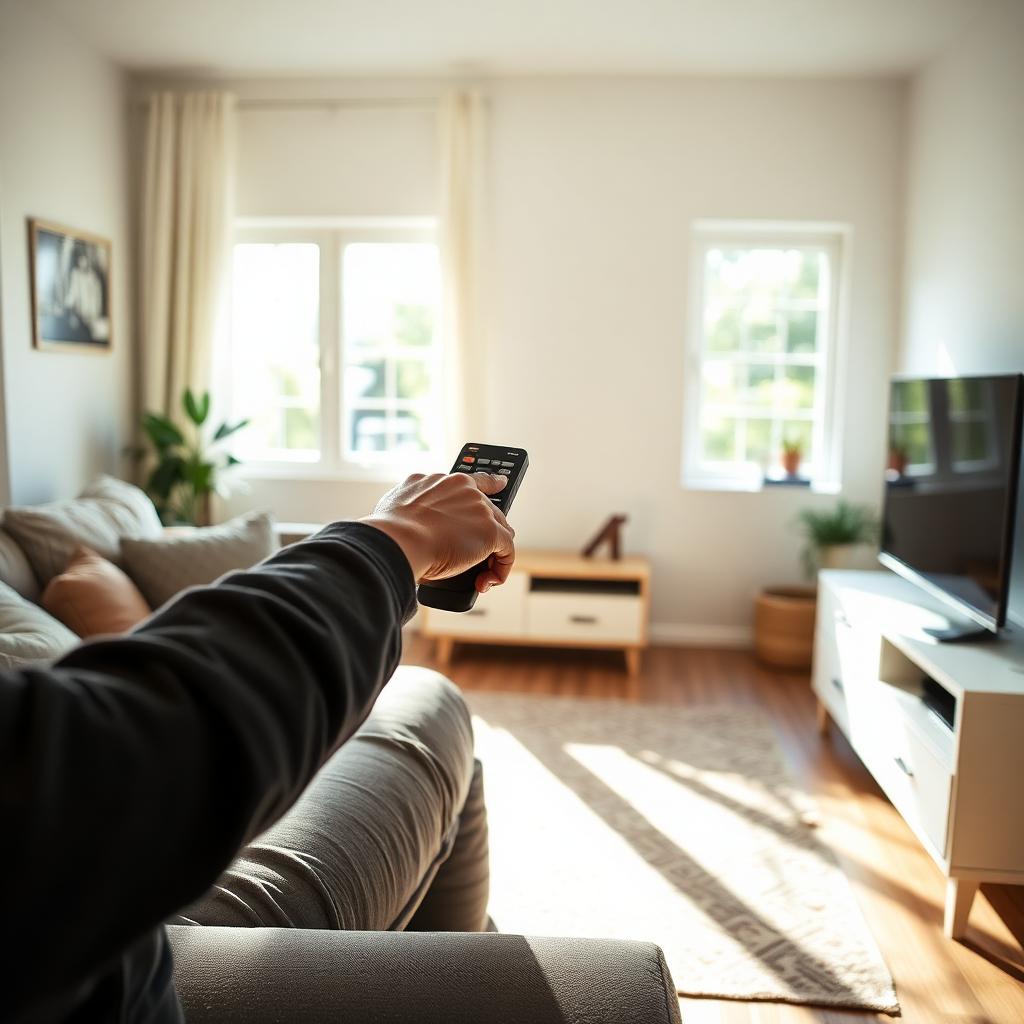
It starts as a minor annoyance: the remote ignores you unless you point it directly at the screen. Over a few weeks it gets worse. Eventually you have to walk within three feet of the TV just to register a single volume press. When an IR or Bluetooth remote suddenly loses range, the signal is being throttled by low power, ambient light, or radio noise.
Quick Answer
Most short range remote problems are caused by weak batteries. As the cells drop from 1.5 V to under 1.2 V, the IR LED still lights up but lacks the current to send a strong signal across the room.
The second most common cause is ambient infrared noise from sunlight, bright LED bulbs, or fluorescent tubes flooding the TV's sensor.
Quick fix: install fresh alkaline AAA batteries, close the curtains during the day, and wipe the IR sensor window on the lower right of the TV bezel with a microfiber cloth.
The number one cause: voltage sag
By far the most common reason for a short range remote is batteries near the end of their life. As batteries drain, their resting voltage drops from 1.5 V toward 1.1 V. That tiny drop is still enough to power the indicator LED on the remote face, but not enough current to drive the IR emitter LED at full output. The IR pulse weakens and only travels a few feet before fading into background light.
- Replace both batteries with fresh name brand Alkaline or Lithium AAA cells.
- Never mix an old battery with a new one. The old cell drags down the voltage of the fresh cell instantly.
- Avoid generic zinc carbon batteries. They cannot sustain the brief high current pulses an IR LED needs.
Ambient light blindness
+-------------------------------------------------------------+
|           HOW INFRARED INTERFERENCE OCCURS                  |
+-------------------------------------------------------------+
| Sunlight / LED bulbs -> flood room with IR noise            |
| TV Receiver Module    -> cannot separate remote from noise  |
+-------------------------------------------------------------+
Traditional IR remotes pulse at 38 kHz. Direct sunlight, high output fluorescent tubes, and cheap LED bulbs flood the room with overwhelming amounts of broad spectrum IR light. The TV's receiver sees a wash of IR noise and cannot pick out your remote's faint 38 kHz pulses unless you walk right up to the sensor window.
- Close blinds or curtains during sunny afternoons and retest.
- Swap any cheap unbranded LED bulbs near the TV for IR-clean LEDs from Cree, Philips, or GE.
- Wipe the IR sensor window on the lower bezel of the TV with a microfiber cloth to clear dust film.
Bluetooth remotes lose range too
Bluetooth voice remotes (Apple TV Siri, Roku Voice, Samsung Smart) use the 2.4 GHz band, which is shared with Wi-Fi, microwaves, baby monitors, and wireless headphones. If a 2.4 GHz Wi-Fi router sits on the same shelf as the TV, it can choke the BLE link.
- Move the router at least 4 to 5 feet from the TV.
- Switch to the 5 GHz band on devices that support it.
- Unplug any USB 3.0 hard drives from the TV. USB 3 ports are notorious for emitting 2.4 GHz noise.
When the LED itself is dying
If fresh batteries and a darkened room do not help, the IR LED on the remote may be failing. Use the smartphone camera test (open the front camera, point the remote at the lens, press a button). A bright purple flash means the LED is still good. A faint or no flash means the LED is dim or dead, and a replacement remote is the cheapest fix.
Frequently asked questions
Why does my remote work after I warm the batteries in my hand?
Cold reduces internal battery chemistry efficiency. Warming the cells temporarily restores voltage. It is a sign the batteries are very near end of life - replace them.
Will a remote extender help?
Yes. IR repeater kits ($20 to $40) place a receiver eye where you sit and rebroadcast the signal next to the TV. Useful if the TV is behind cabinet doors or in another room.
Why does the remote work better at night?
Almost certainly ambient IR blindness from daytime sunlight. The same room at night has far less infrared interference, so the TV's sensor can pick up the remote's weaker pulses.
The takeaway
A remote that only works when you stand close to the TV is suffering from weak batteries, ambient IR blindness, or 2.4 GHz radio noise. Replace both batteries with fresh alkaline cells, close the curtains, wipe the TV's sensor window, and move any 2.4 GHz Wi-Fi router off the same shelf as the TV. If a camera test still shows a faint or absent IR flash, the LED inside the remote is dying and a $15 replacement is the final fix.