Quick Answer
The best tonkotsu style ramen broth is made by blanching and scrubbing pork neck or femur bones, then boiling them with chicken carcasses at a hard rolling boil for 10 to 12 hours.
The continuous boil breaks collagen down into gelatin and emulsifies the rendered marrow fat into the water. That emulsion is what gives tonkotsu its signature opaque, creamy white appearance and velvety mouthfeel.
Add aromatics (onion, garlic, ginger, dried shiitake, kombu) in the final 2 hours, strain, and chill. Properly made, the cold broth sets into a firm jelly.
The science of creamy broth
The milky colour of tonkotsu has nothing to do with milk. It is pure physics and chemistry.
Collagen rich pork bones release gelatin into the water as they cook. Marrow renders fat at the same time. A gentle simmer keeps these two components separate, with fat floating in a clear layer on top. A hard rolling boil churns the liquid violently, breaking the fat into tiny droplets that the gelatin holds in suspension. The result is an opaque, creamy emulsion that coats the spoon.
If your broth turns out greasy on top and watery underneath, you simmered instead of boiled. Crank the heat.
Bone selection
You need two things: collagen and marrow. Use bones that deliver both.
- Pork neck bones are inexpensive and packed with collagen.
- Pork femur bones deliver deep marrow flavour. Ask the butcher to split them so the marrow is exposed.
- Pork trotters (feet) are pure gelatin and dramatically improve body.
- Chicken carcasses or chicken feet add even more gelatin and a savoury background note. About 1/3 chicken to 2/3 pork is the classic ratio.
Ingredients
| Ingredient | Amount |
|---|---|
| Pork neck or split femur bones | 3 lb (1.4 kg) |
| Chicken carcasses or chicken feet | 2 lb (900 g) |
| Cold water (for blanching) | enough to cover |
| Fresh water (for the boil) | about 6 qt (5.7 L) |
| Large white onion, halved, skin on | 1 |
| Garlic, head halved horizontally | 1 bulb |
| Fresh ginger, sliced | 2 inch piece |
| Dried shiitake mushrooms | 10 |
| Kombu (dried kelp) | 1 strip (about 6 inches) |
Method
1. Blanch and scrub
Place all the bones in a large stockpot, cover with cold water, and bring to a boil over high heat. Boil 15 minutes. A heavy grey foam will surface. This is coagulated blood, marrow gunk, and impurities that would turn the final broth grey and bitter.
Drain the bones into a clean sink. Scrub every bone under cold running water with a small brush or your fingers, paying attention to the marrow channels and any dark spots. This step takes 15 minutes and is the single most important quality control move for a clean white broth.
2. Start the long boil
Return the clean bones to a clean pot. Cover with fresh cold water (about 6 quarts). Bring to a rolling boil over high heat, then keep the heat high enough to maintain a steady, turbulent boil. Cover with a tight fitting lid.
3. Boil for 10 to 12 hours
Check the pot every 2 hours and top off the water level so the bones stay submerged. Skim any large fat clumps off the surface but leave most of the fat in the pot. That fat is what emulsifies into the creamy texture.
The broth will gradually shift from clear to cloudy to opaque white. By hour 10, it should look like watered down milk.
4. Add aromatics
During the final 2 hours, add the halved onion, garlic, sliced ginger, dried shiitake mushrooms, and the kombu. Pull the kombu out after 1 hour so it does not turn the broth slimy.
5. Strain and chill
Pour the finished broth through a fine mesh sieve lined with cheesecloth into a clean container. Discard the spent bones and vegetables. Cool quickly in an ice bath, then refrigerate.
The test of a successful tonkotsu: when fully chilled, the broth should set into a firm, wobbly jelly. That jelly is your collagen extraction proof.
Building a bowl
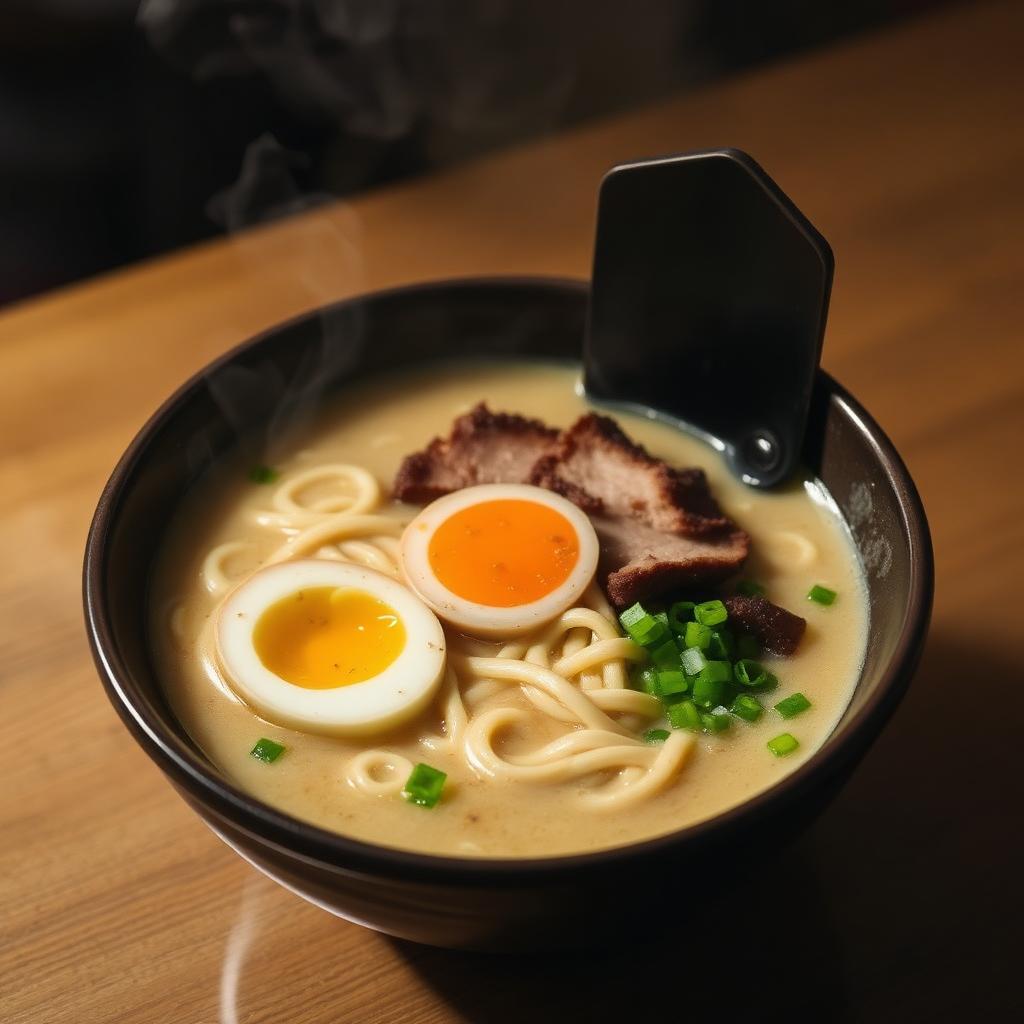
The broth is the base, not the finished bowl. To assemble a single serving of ramen:
- 1 tablespoon of tare (seasoning) in the bottom of a hot bowl. Shio (salt), shoyu (soy), or miso are the classics.
- 1 cup of hot tonkotsu broth.
- Fresh ramen noodles, cooked separately.
- Toppings: chashu pork belly, soft boiled marinated egg (ajitama), sliced scallion, menma (fermented bamboo), nori, and a drizzle of garlic or chilli oil.
Common mistakes
- Skipping the blanch. Broth turns grey and tastes off.
- Simmering instead of boiling. The fat will not emulsify. You get a clear pork stock, not tonkotsu.
- Not topping off the water. The bones get exposed and the broth scorches.
- Boiling kombu too long. It turns the broth slimy and bitter. Remove after 1 hour.
Storage
Refrigerate for up to 4 days. Freeze in 2 cup portions for up to 3 months. The jelly melts back to liquid the moment it hits a hot pot.
Frequently asked questions
Can I use a pressure cooker?
Yes, with a tweak. Pressure cook the bones at high pressure for 2 hours, then open and boil hard for another 90 minutes to force the emulsion. You still need the violent rolling boil step.
How is paitan different?
Paitan is the chicken version of the same technique. Same hard boil, same opaque white result, lighter flavour. Use all chicken bones and feet.
Can I make a quick version?
Real tonkotsu cannot be rushed past about 6 hours, but a shortcut is to enrich a standard pork stock with a tablespoon of unflavoured gelatin and a pat of butter. It is not the same, but it gets you in the neighbourhood.
Sourcing pork and chicken bones
Most American butchers will sell pork neck bones, femurs, and trotters at a low price because they are byproducts of larger primal cuts. Call ahead and ask the meat counter to split femur bones for you, which exposes more marrow and speeds up the gelatin extraction. Asian grocers almost always carry them in the freezer aisle as well.
Chicken feet are the secret weapon. They are roughly 70% collagen by weight and turn even a short stock into a wobbly jelly when chilled. If your local store does not carry them, swap in 1 lb of chicken wings, which are also high in connective tissue.
Timing and equipment
This is a weekend project. Start the blanch in the morning, get the pot to a rolling boil by lunch, and let it run all day with checks every two hours. A 12 quart heavy stockpot with a tight fitting lid is ideal. A pressure cooker shortcut works but the texture is slightly different.
The takeaway
A real tonkotsu broth is a weekend project, but the technique is simple: blanch, scrub, hard boil, top off, strain. Respect the rolling boil, do not be afraid of the long timer, and you end up with a creamy white broth that puts most ramen shops to shame.