Quick Answer
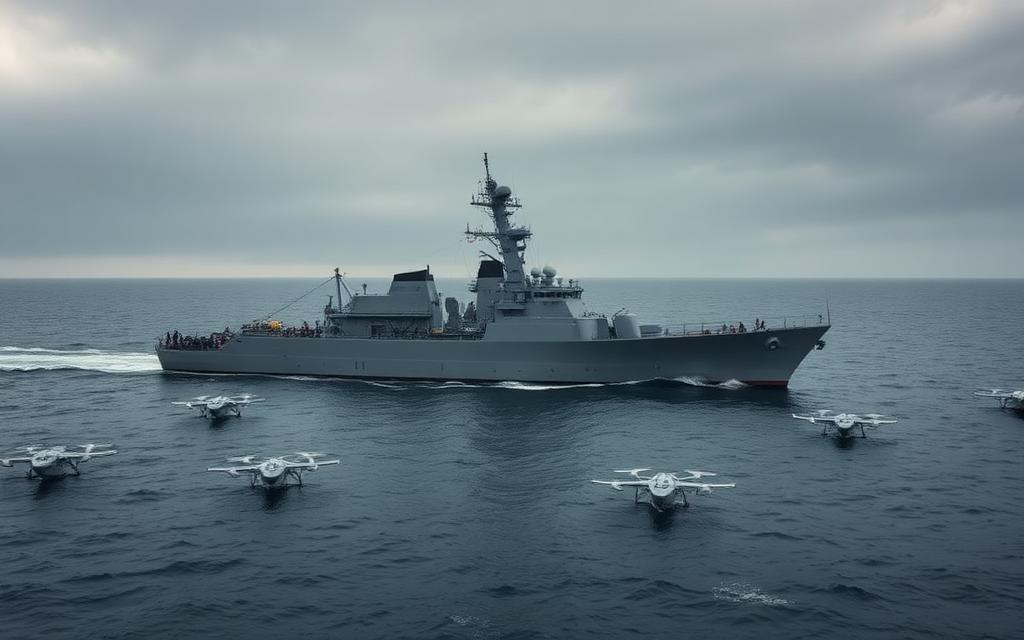
At the 2026 Combined Naval Event in Farnborough, First Sea Lord General Sir Gwyn Jenkins said the Royal Navy must rapidly pivot to a hybrid fleet that combines manned warships with swarms of autonomous, uncrewed vessels.
His mantra: "Crewed where necessary, uncrewed wherever possible, integrated always."
The Navy has ring fenced £115 million for a hybrid navy programme and is testing the concept now in the Gulf, working alongside Type 45 destroyer HMS Dragon and Project BEEHIVE as an operational base.
Why This Speech Matters
The naval analyst site Navy Lookout reported that Jenkins' May 2026 address was the clearest public case yet for a Royal Navy built around uncrewed assets. He directly challenged "traditionalists" and "hybrid sceptics" within the service.
Pointing to attrition rates in the Black Sea during the Ukraine war and the asymmetric threats in the Middle East, Jenkins argued that autonomy is not a future concept. It is already changing modern warfare today, and the Royal Navy has no time to wait.
Who Is General Sir Gwyn Jenkins?
General Sir Gwyn Jenkins KCB OBE ADC RM is a Royal Marines officer with a distinctive career. Commissioned in 1990, he served operationally in Northern Ireland and Afghanistan, where he earned an OBE.
His later roles included Military Assistant to the Prime Minister in 10 Downing Street, Deputy National Security Adviser in the Cabinet Office, Vice Chief of the Defence Staff, and Commandant General of the Royal Marines.
In May 2025 he became the first Royal Marine ever appointed as First Sea Lord and Chief of the Naval Staff. His commando background, favouring agility, speed, and lethal efficiency, runs through the 2026 vision.
The Hybrid Fleet Concept
The core argument is that pouring shrinking defence budgets into a small number of very expensive hulls creates strategic fragility. Lose one Type 45 destroyer or aircraft carrier and a huge chunk of capability disappears overnight.
A hybrid fleet networks a single manned command ship with dozens of autonomous surface vessels and underwater drones. The result is mass plus dispersion, two qualities a small number of large warships can never deliver on their own.
Key Benefits
- Distributed sensors and weapons that are hard for an adversary to track
- Higher overall lethality from cheaper, replaceable platforms
- Sailors kept out of the most dangerous threat zones
- Faster procurement cycles than traditional shipbuilding
The £115 Million Hybrid Navy Programme
Jenkins is not just talking concepts. The Navy has committed £115 million to a hybrid navy programme that is being tested in the Gulf right now.
| Element | Detail |
|---|---|
| Funding | £115 million ring fenced |
| Active deployment | Gulf region |
| Lead manned platform | HMS Dragon (Type 45 destroyer) |
| Base of operations | Project BEEHIVE |
| Primary use case | Autonomous mine hunting |
The live deployment gives the Navy real world data on how human operators and AI driven drones communicate, share targeting information, and execute missions under stress.
The End of Ever Bigger Warships?
Aircraft carriers and nuclear submarines will remain the strategic bedrock of the Navy. The Queen Elizabeth class carriers and the future Dreadnought submarines are not going anywhere.
But Jenkins' warning against "ever bigger, ever more expensive platforms" is a clear signal that future procurement will prioritise numbers, modularity, and drone integration over sheer tonnage. Expect fewer flagship orders and more orders for modular, optionally crewed vessels.
Frequently Asked Questions
Who is General Sir Gwyn Jenkins?
A senior Royal Marines officer who became the first Royal Marine appointed as First Sea Lord and Chief of the Naval Staff in May 2025.
What was the focus of his 2026 Combined Naval Event speech?
The need to pivot the Royal Navy to a hybrid fleet that integrates uncrewed and autonomous vessels with manned warships.
What is the £115 million hybrid navy programme?
A funded initiative integrating autonomous drones and mine hunting tech with manned warships, currently being tested in the Gulf alongside HMS Dragon.
Does this mean fewer aircraft carriers?
No. Carriers and submarines stay. The shift is away from building lots of mid sized expensive platforms toward many smaller uncrewed assets.
The Bottom Line
Gwyn Jenkins has put the Royal Navy on a clear new path. The hybrid fleet vision is not just a slide deck. It is funded, deployed, and being tested in one of the most volatile regions in the world. Whether the institution can move at the speed the First Sea Lord wants is the open question, but the direction is set.