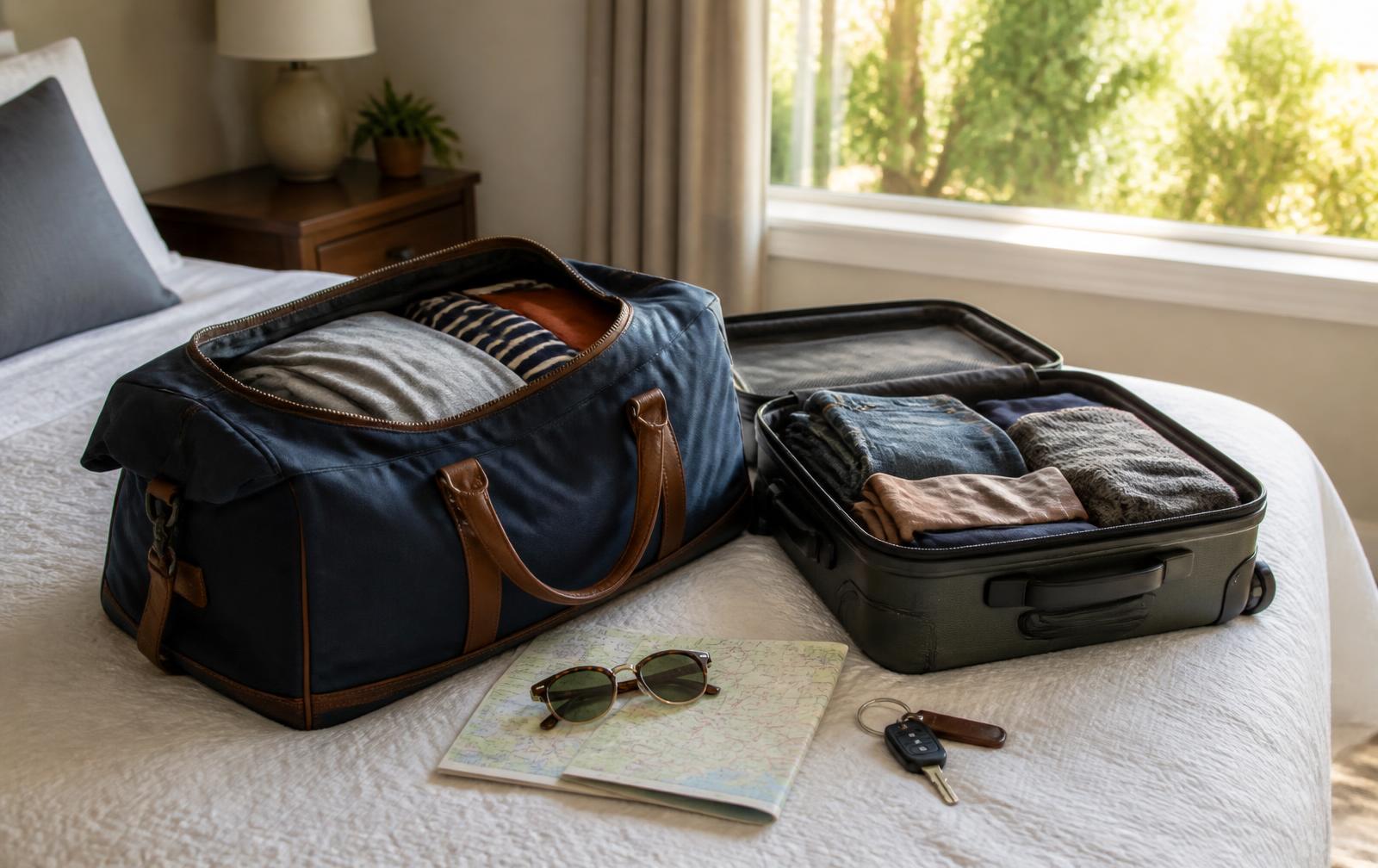
Quick Answer
The best business travel packing tips come down to one system: a carry-on roller, a separate laptop tote that fits under the seat, a 3-day capsule wardrobe in one colour family, and a small in-flight kit. Built right, you can run a 3 to 5 day trip without ever checking a bag.
Pack for the meetings, not the maybe. Almost every "just in case" item that adds weight to a business trip never leaves the suitcase.

The Two-Bag System
Most airlines and almost every business traveller's life works around two pieces of cabin baggage: one carry-on (overhead) and one personal item (under the seat). Use them like this:
- Carry-on: clothing, toiletries, shoes. A 35 to 40 litre soft-sided spinner is plenty for 3 to 5 nights.
- Personal item: laptop, charger, headphones, passport, wallet, in-flight kit. A leather tote, slim backpack or briefcase works.
Keep anything you cannot afford to lose (laptop, meds, passport, presentation materials) in the personal item, never the overhead bin.
Capsule Wardrobe for 3 to 5 Days
One colour anchor (navy or charcoal), one accent (white or light blue). Every shirt works with every trouser, every trouser works with the jacket.
- 1 suit or blazer + matching trousers (wear the jacket on the plane)
- 1 extra pair of dress trousers
- 3 dress shirts (one extra over the number of full days)
- 1 polo or smart-casual layer for dinners
- 2 ties or 1 belt swap if needed for variety
- 4 pairs of dress socks + 4 pairs of underwear
- 1 pair of dress shoes (worn on the plane) + 1 pair of trainers for the hotel gym
- Gym kit if you actually use the gym (be honest)
Wear the suit, dress shoes and overcoat on the plane. They are the heaviest and most wrinkle-prone items; on your body they go free.
The Blazer and Shirts Survive the Flight
Use the shoulder-fold for any jacket you do not wear, lay it on top of everything else in the carry-on, and hang it the moment you reach the hotel. For shirts, fold along the existing creases (most shirts have set fold lines in the back yoke) and stack flat. A small plastic bag inside the collar of each shirt keeps the points crisp.
Steam in the hotel bathroom for 10 minutes the night before the meeting. That single habit replaces 95 percent of iron use on the road.
Tech That Earns Its Place
- Laptop + charger (the actual one, not a knock-off cable)
- USB-C and USB-A spare cables. Plural.
- A 65W or 100W GaN charger that handles laptop, phone and tablet from one port
- Power bank (under 100 Wh for cabin baggage)
- Noise-cancelling headphones
- Universal travel adapter
- Phone charging cable long enough to reach from hotel desk to bed
- A small dongle bag if your laptop is USB-C only and the meeting room is HDMI
One backup of your presentation lives on a USB stick in the laptop tote. The other lives in your email and one cloud folder. Three copies, three places, zero panic.
The In-Flight Kit
Small zipper pouch in the personal item:
- Travel toothbrush and toothpaste tablets
- Lip balm and eye drops (cabin air is desert-dry)
- Painkillers and an antihistamine
- Spare contact lenses or glasses
- Phone charger and earbuds
- Pen and small notebook for the meeting where the laptop battery dies
Refill a 500 ml reusable bottle past security. Long-haul flights dehydrate you more than most people realise.
The Small Things That Save the Trip
- One spare collar stay set in a coin pocket. Hotels never have them.
- A lint roller sheet folded inside the suit pocket.
- A safety pin and a 3-metre roll of clear tape. Both fix more wardrobe failures than a sewing kit.
- A handful of business cards even in 2026. Not everyone wants to swap LinkedIn QR codes.
- One extra dress shirt beyond your day count. The coffee spill is a question of when, not if.
Bottom Line
Business travel packing is solved by a two-bag system, a tight one-colour capsule, the shoulder-fold for jackets, a small but reliable tech kit and a few hotel-room tricks. Pack for the meetings you actually have on the calendar, leave the just-in-case items at home, and a 3 to 5 day trip fits comfortably into one carry-on.
Frequently Asked Questions
Can I get away with one suit for a 5-day trip?
Yes, with a backup pair of trousers and a swap of shirts and ties. Most clients and conferences do not notice the same jacket twice if the shirt and tie change. Brush the jacket each evening and hang it overnight.
What is the best carry-on for business travel?
A 35 to 40 litre soft-sided four-wheel spinner from Briggs & Riley, Away, Tumi or Travelpro covers the airline cabin spec on every major carrier and gives you enough room for a 5-day capsule plus shoes. Hard cases pack neater but flex less when the overhead bin is full.
Do I need a separate laptop bag if I have a carry-on?
Yes. The laptop bag is your personal item under the seat and stays with you when the overhead bin is full and the carry-on gets gate-checked. Anything you cannot afford to lose lives there.
How do I handle expense receipts on the road?
Photograph every receipt the moment you get it into an app like Expensify, Concur or even a dedicated Google Drive folder. Paper receipts fade or get lost; the photo is what your finance team will accept anyway.
What is the single most-overlooked item?
A spare collar stay set. Hotels never have them, dry cleaners eat them, and a curling collar undoes the whole sharp-suit effort. They cost almost nothing and live forever in a coin pocket.