Quick Answer
Whether you need to recheck your luggage usually depends on if you are flying an international route or a domestic one. For most domestic flights within the United States on a single ticket, your bags are checked through to your final destination without you needing to touch them.
If you are arriving in the United States from an international location, you must almost always claim your bags at your first point of entry to clear customs, even if your final destination is elsewhere. You then take them to a nearby recheck counter before heading to your next gate.
If you booked two separate tickets on different airlines that do not have an interline agreement, you will always have to collect your bags at the carousel, exit the secure area, and check them in again at the main departure hall.
When Your Bags Fly Through Automatically
If you purchased your entire journey as one single booking, life is generally easier. I have found that most major carriers like Delta, United, and American will automatically transfer your bags from plane to plane if you are staying within the United States or traveling from the U.S. to an international destination.
When you drop your bag at the first airport, look at the white luggage tag the agent attaches to the handle. If it shows your final destination airport code in large letters at the top, it is likely checked all the way through. I always make it a habit to double check with the agent by asking if I need to pick it up at my connection city.
In these cases, you simply get off your first flight, follow the signs for your next gate, and grab a coffee. Your luggage is handled behind the scenes by ground crews who move it from the belly of one aircraft to the next.
The International to Domestic Exception
This is the most common scenario where travelers get confused. If you are flying into the U.S. from London, Tokyo, or any other foreign city, you must clear U.S. Customs and Border Protection at your first port of entry. This is a federal requirement that applies even if the bag is tagged to a further city.
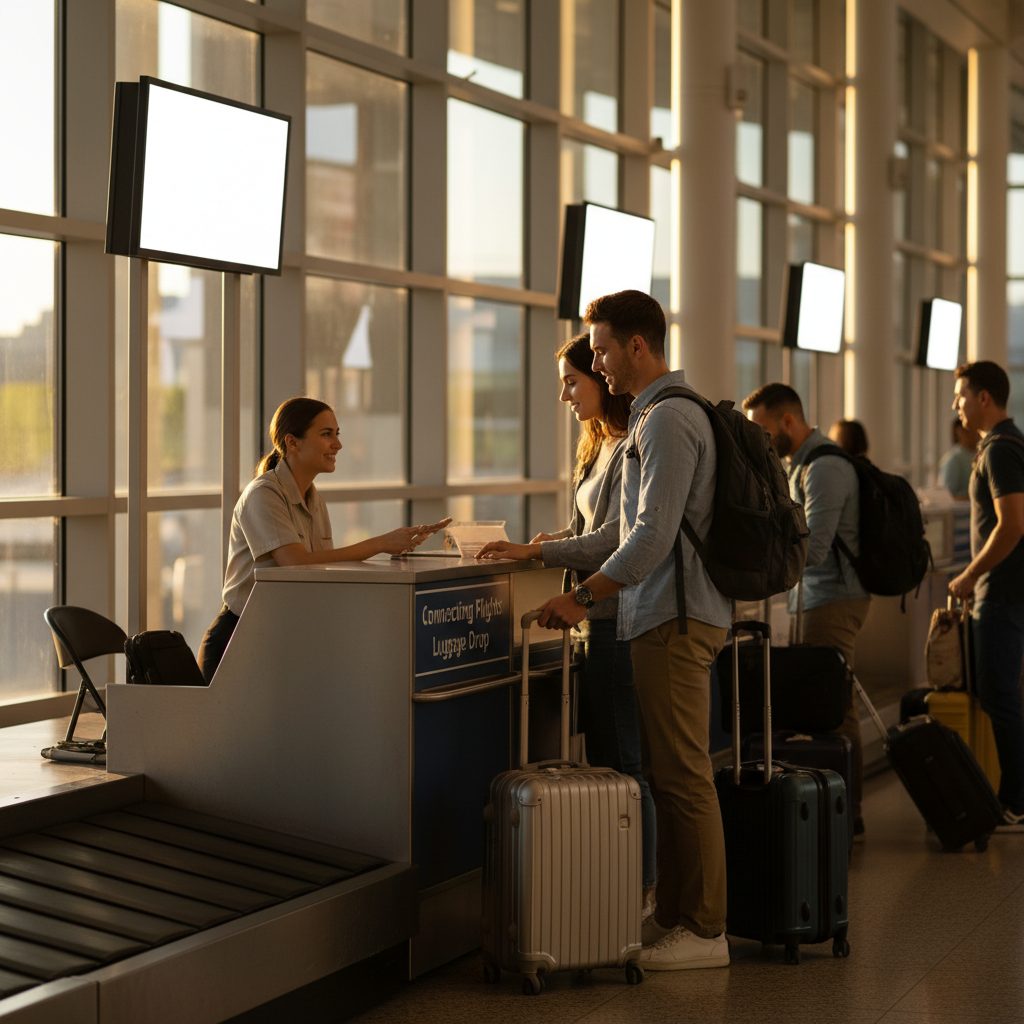
After you pass through passport control, you will follow the signs to baggage claim. You must pick up your suitcase from the carousel and walk it through the customs declaration area. Once you are past the customs officers, look for a desk or a conveyor belt labeled baggage recheck or connecting flights.
Since your bag is already tagged to your final destination, you do not need to go to the main lobby. You simply hand the bag to the staff at the recheck station. They will scan it and put it back into the system. From there, you will proceed to the security checkpoint to reenter the terminal gates.
Understanding Interline Agreements
Interline agreements are essentially handshakes between different airlines that allow them to handle each other’s passengers and luggage. If you book a trip that uses two different airlines, such as an Alaska Airlines flight connecting to an American Airlines flight, these agreements ensure your bag moves between them seamlessly.
Most full service carriers have these agreements in place. However, low cost carriers like Southwest, Spirit, or Allegiant often do not have interline agreements with other airlines. If you try to book a flight on Spirit that connects to a Delta flight, those bags will not transfer automatically.
I always suggest checking the airline websites if you are mixing carriers. If the airlines do not have a partnership, you will be treated as if you are ending your journey at the connection city. You will have to go to baggage claim, haul your bags to the next airline’s ticket counter, and pay any applicable baggage fees again.
Checking In for Separate Tickets
Buying two separate tickets is a popular way to save money, but it adds a lot of logistics to your travel day. I call this a self transfer. Because the two airlines have no record of each other’s bookings, they will only check your bag to the destination listed on the specific ticket you are using.
When you land at your connection city, you are a terminating passenger. You must go to the public baggage claim area and wait for your luggage. After you have your bags, you have to find the check in counters for your second airline, which might even be in a different terminal.
This process requires you to go through the full check in and security screening process again. I recommend leaving at least four hours between flights if you are doing a self transfer with checked bags. Any delay in your first flight could cause you to miss the check in cutoff for your second flight.
What to Do at the Recheck Counter
The recheck counter is usually located just outside the customs hall in international terminals. It is designed to be a quick drop off point so you do not have to carry heavy suitcases through the entire airport. When you arrive at this counter, here is what you should do:
- Confirm that your original luggage tag is still attached and is not torn.
- Make sure the agent scans your bag so it is tracked in the new flight system.
- Ask the agent if your seat assignment for the next leg is still valid.
- Ensure you receive a new claim stub if the old one was replaced.
If there is nobody at the recheck counter, do not just leave your bag on the floor. Look for a nearby airline representative or follow signs to the main departure level. Leaving a bag unattended in an airport is a major security risk and could result in the bag being confiscated or destroyed.
Managing Short Layovers
Short layovers are stressful when you know you have to recheck a bag. If your layover is less than ninety minutes and you are arriving from an international flight, you are in a race against the clock. The time it takes for bags to hit the carousel can vary from ten minutes to nearly an hour.
If I find myself in this situation, I try to get off the plane as quickly as possible to get to the front of the customs line. Once I have my bag and drop it at the recheck desk, I head straight for the TSA PreCheck or Clear lanes if available. This saves precious minutes during the security screening process.
If you realize your first flight is delayed and you will not have time to recheck your bag, speak to a flight attendant or a gate agent immediately. They can sometimes prioritize your bag or help you get rebooked on a later flight so you do not have to worry about the luggage missing the connection.
Tips for a Smooth Bag Transfer
I have learned a few tricks over the years to make sure my bags don't get lost during a recheck. First, I always remove old stickers and tags from previous trips. These can confuse the automated scanners and send your bag to the wrong city. Only the current tag should be visible.
Second, I use colorful luggage straps or unique tags to make my bag easy to spot on the carousel. When dozens of black suitcases are spinning around, you want to grab yours and get to the recheck desk instantly. This is especially helpful during the hectic customs process.
Third, I keep a photo of my luggage and my bag tag receipt on my phone. If the bag does not show up at the final destination, this information is vital for the airline to track it down. Having the digital record means I do not have to worry about losing the small paper slip the agent gave me at check in.
Frequently Asked Questions
Do I have to pay baggage fees again when I recheck?
If your flights are on a single ticket, you usually only pay once at the start of your trip. However, if you are traveling on two separate tickets from different airlines, you will likely have to pay a second baggage fee when you check in for your second flight.
What happens if I forget to pick up my bag at customs?
If you walk past the baggage claim and exit into the terminal without your luggage, it will stay on the carousel or be moved to a secure holding area. You will not be allowed to enter the customs area again easily. You must contact the airline baggage office immediately to retrieve it, which may cause you to miss your next flight.
Can I check my bag to the final destination on a self transfer?
Generally, no. Most airlines will only check a bag to the destination on the ticket you presented. Even if they are partner airlines, agents are often restricted by their software from checking bags across two separate, unconnected reservations.
Is it faster to carry on my luggage for connections?
Yes, carrying on your luggage is the best way to avoid the recheck process entirely. If your bag fits in the overhead bin, you can skip the customs baggage claim and the recheck desk, going straight from the plane to the next security checkpoint or gate.
Will the airline tell me if I need to recheck?
Airlines usually make announcements on the plane before landing or include this information in their mobile apps. However, it is always your responsibility to know the rules. If you are unsure, the safest bet is to check the luggage tag or ask a ground agent when you land.
Final Thoughts on Bag Rechecking
Rechecking luggage is a minor inconvenience that is part of the rhythm of international travel. As long as you understand the difference between a through-checked bag and a customs clearance requirement, you will be fine. I always build in extra time for these steps so I never feel rushed.
Remember to stay observant of the signs in the airport. Most modern airports are designed to funnel connecting passengers through the correct paths. If you follow the signs for baggage claim and then look for the transfers or recheck area, you can navigate the process like a pro.
Ultimately, the most important thing is to keep your luggage receipts and stay informed about your airline's specific policies. With a little preparation, you can ensure your belongings make it to your final destination just as safely as you do.