Quick Answer
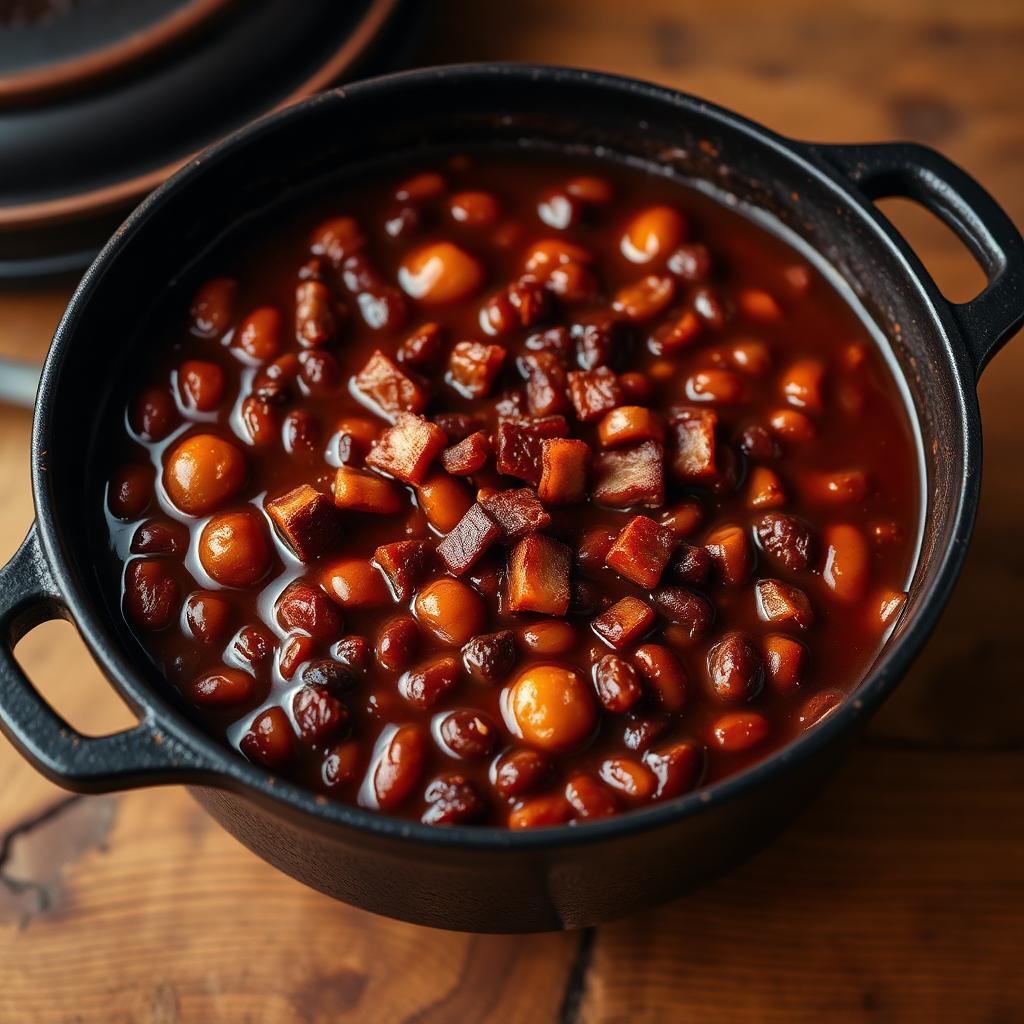
Real brown sugar baked beans start with dry navy beans soaked overnight in salted water, simmered until tender, then baked low and slow in a Dutch oven with smoked bacon, dark molasses, brown sugar, tomato sauce, apple cider vinegar, and Dijon mustard.
The two non negotiable rules: salt the soak water so the bean skins soften evenly, and never add tomato or molasses until the beans are already tender. Acid added too early stalls the beans and leaves them tough no matter how long you bake them.
Bake at 160 C for 3 to 4 hours, lid off for the last 45 minutes to reduce the sauce into a sticky glaze.
Why canned baked beans cannot compete
Most grocery store canned baked beans live in a thin, oversweet sauce built on high fructose corn syrup and a hit of artificial smoke flavour. The beans themselves are usually mushy because they have been pressure cooked twice, once in the can and once when you reheat them.
A scratch version delivers three things a can cannot. The beans hold their shape with a creamy interior. The sauce is glossy and clings to each spoonful. The flavour layers go from smoky bacon to dark molasses to a tangy mustard finish, instead of one flat sweet note.
The salt soak rule
Old cookbooks tell you to never salt your soaking water. Modern food science says the opposite, and it is correct.
Salt your soak water at a rate of about 1 tablespoon per quart and let the beans rest for 8 to 12 hours. The sodium ions in the brine displace the calcium and magnesium ions in the bean skins. That magnesium and calcium swap is what makes salted soaked beans cook with intact, tender skins instead of bursting and shedding.
If you forget to soak overnight, do a quick soak instead. Boil the beans for 2 minutes in salted water, take the pot off the heat, cover, and rest for one hour. Drain and proceed.
The pH trap that ruins most baked beans
Tomato, vinegar, molasses, and brown sugar all lower the pH of the cooking liquid. In an acidic environment, the pectin in the bean skins refuses to break down. The beans stay chalky and firm no matter how long you cook them.
The fix is simple. Boil the beans plain until they are already tender, then add the acidic ingredients during the bake. The beans are now soft enough that the acid only sets the texture, not stops it.
Ingredients you need
| Ingredient | Amount |
|---|---|
| Dry navy or Great Northern beans | 1 lb (450 g) |
| Thick cut applewood smoked bacon | 6 slices, diced |
| Yellow onion | 1 medium, finely chopped |
| Garlic | 3 cloves, minced |
| Dark molasses | 0.5 cup |
| Dark brown sugar | 0.5 cup, packed |
| Tomato sauce | 1 cup |
| Apple cider vinegar | 2 tbsp |
| Dijon mustard | 1 tbsp |
| Smoked paprika | 1 tsp |
Step by step method
- Soak the beans in salted water for 8 to 12 hours. Drain and rinse.
- Place the beans in a heavy pot, cover with fresh water by 5 cm, and simmer for 45 to 60 minutes until tender but not falling apart. Drain, reserving 2 cups of the cooking water.
- In a large Dutch oven, render the diced bacon over medium heat until crisp. Lift out the bacon and reserve, leaving the fat in the pot.
- Sweat the onion in the bacon fat for 6 to 8 minutes until soft, then add the garlic for the last minute.
- Stir in the cooked beans, molasses, brown sugar, tomato sauce, apple cider vinegar, Dijon mustard, smoked paprika, and the reserved cooking water. Top with the crisp bacon bits.
- Cover, transfer to a 160 C oven, and bake for 3 to 4 hours. Remove the lid for the final 45 minutes to reduce the sauce into a thick, sticky glaze.
How to tell when they are done
- The beans should be creamy on the inside with intact skins.
- The sauce should coat the back of a spoon and pool slowly rather than run like water.
- The top of the pot should have a slightly caramelised crust where the sugars hit the dry air.
If the sauce is too thin, return the pot to the oven uncovered for another 15 minutes. If it is already too thick, stir in a splash of the reserved bean cooking water to loosen.
Tweaks worth trying
- Add half a teaspoon of liquid smoke if you cannot find good quality smoked bacon.
- Swap a third of the brown sugar for sorghum syrup for a deeper, more old fashioned profile.
- Stir in a tablespoon of bourbon at the end for a Southern barbecue lean.
- For a vegetarian version, skip the bacon and start with two tablespoons of olive oil plus a teaspoon of smoked paprika in the sweat step.
Storage and reheating
The beans keep in an airtight container in the fridge for up to 5 days and freeze well for 3 months. Reheat in a saucepan over low heat with a splash of water to bring the sauce back to a pourable consistency. They actually taste better the next day, after the sauce has settled and the flavours have had time to merge.
Frequently asked questions
Can I use canned beans to save time?
You can. Skip the soak and simmer steps, drain and rinse 3 cans of navy beans, and start at the bacon rendering step. Reduce the oven time to 90 minutes total because the beans are already cooked.
What goes with baked beans?
Pulled pork, smoked brisket, grilled sausages, fried chicken, and cornbread are the classic American pairings.
Why are my beans still hard after hours of baking?
Almost always because you added tomato or molasses before the beans were tender. Save acid for after the simmer step.
The takeaway
Brown sugar baked beans done right are a low effort, high reward dish. Salt the soak, simmer the beans plain, bake low and slow with bacon and molasses, and finish uncovered to set the glaze. The result blows away anything you can pour out of a can.