Quick Answer
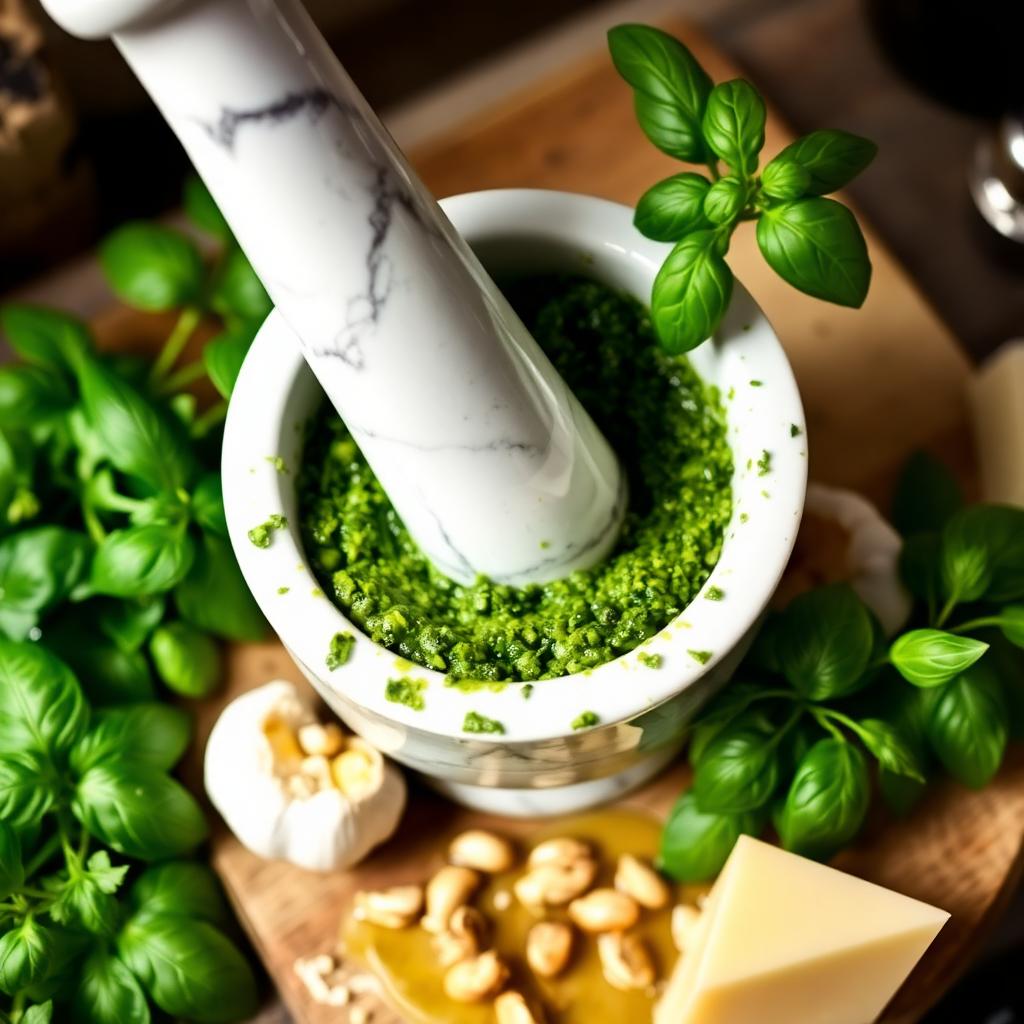
Authentic Pesto alla Genovese uses just seven ingredients: young Genovese basil leaves, Ligurian extra virgin olive oil, Italian pine nuts, garlic, aged Parmigiano Reggiano, Pecorino Sardo and coarse sea salt. Grind the garlic and salt into a paste in a marble mortar with a wooden pestle, add the pine nuts, then add the basil leaves a handful at a time using a circular crushing motion. Finish by stirring in the two cheeses and a thin stream of olive oil. The whole process takes 10 minutes and yields a sauce that no blender can match.
Why mortar and pestle matters
The Italian Consortium of Pesto Genovese protects the traditional recipe and explicitly recommends a marble mortar with a wooden pestle. The reason is mechanical. A blender or food processor uses fast spinning blades that cut the basil leaves. Cut leaves release oxidative enzymes that turn the sauce brown and dull within minutes, and the friction heats the oil, which mutes its flavour.
A pestle crushes rather than cuts. The cell walls break gently, the volatile oils stay in the leaf, the sauce stays a vivid green, and the texture is the slightly rustic emulsion the dish was designed for. If you only ever make pesto in a food processor, a small marble mortar (15 to 30 dollars) is the single best upgrade you can buy.
The seven ingredients in detail
Basil
Use young Genovese basil with small to medium leaves. The variety matters; Thai basil, lemon basil and large leaf Italian basil all have different essential oil profiles. Avoid wilted or flowering plants because the leaves develop a menthol bitterness as they age.
Olive oil
A delicate, fruity Ligurian extra virgin (Taggiasca varietal if you can find it). Strong peppery Tuscan oils overpower the basil. Use enough oil to bind the sauce, not flood it: roughly 100 ml for 50 grams of basil leaves.
Pine nuts
Italian or Mediterranean pine nuts (Pinus pinea). Chinese pine nuts are cheaper but can cause a metallic aftertaste called "pine mouth". Toast them lightly in a dry pan for 30 to 60 seconds only if you want a deeper note; classical Genovese pesto uses them raw.
Garlic
One or two small cloves of mild fresh garlic. The Vessalico variety from western Liguria is traditional, but a fresh young clove from anywhere works.
Cheese
Two cheeses, both grated finely: Parmigiano Reggiano (aged 24 months minimum) for sweet umami, and Pecorino Sardo or Pecorino Fiore Sardo for sharpness. A 2:1 ratio of Parmigiano to Pecorino is standard.
Salt
Coarse sea salt, not table salt. The crystals also act as a mild abrasive when grinding the garlic, which speeds the work.
The classic recipe
For four generous portions of trofie, trenette or linguine:
- 50 g young Genovese basil leaves (about two large handfuls)
- 1 to 2 small cloves of garlic
- 15 g Italian pine nuts
- 40 g Parmigiano Reggiano, finely grated
- 20 g Pecorino Sardo, finely grated
- 100 to 120 ml extra virgin olive oil
- A large pinch of coarse sea salt
Step by step in the mortar
Step 1: prep the basil
Pick the leaves from the stems and wash gently in cold water. Pat completely dry with a tea towel. Wet basil dilutes the sauce.
Step 2: garlic and salt
Drop the peeled garlic cloves and a large pinch of coarse sea salt into the mortar. Crush with a rotating, downward motion of the pestle until you have a smooth pale paste. The salt is your abrasive.
Step 3: pine nuts
Add the pine nuts and continue grinding until they break down into a smooth, slightly chunky paste. About 30 seconds of work.
Step 4: basil, a handful at a time
Add the basil leaves a small handful at a time. Use a gentle circular crushing motion rather than smashing straight down. The leaves should bruise and release their oil rather than being chopped. Add another handful only when the first is fully incorporated. Keep going until all the basil is in and you have a vivid green paste.
Step 5: cheese
Transfer the contents to a bowl (you can keep working in the mortar if it is large enough). Stir in the grated Parmigiano and Pecorino with a wooden spoon.
Step 6: olive oil
Drizzle in the olive oil gradually while stirring, only as much as you need to reach a thick spoonable consistency. The pesto should fall in a slow ribbon from the spoon, not pour like a salad dressing.
Taste and adjust salt if needed.
If you must use a food processor
You can get close to the right texture and colour with a food processor by following three rules:
- Chill everything. Cool basil, cool blade, cool bowl. Friction heat is the enemy.
- Pulse, do not run continuously. Short pulses bruise rather than chop.
- Blanch the basil for 5 seconds in boiling water, then plunge into ice water, dry and proceed. Blanching deactivates the oxidising enzymes and locks in colour.
The result is brighter green and fresher tasting than a continuously processed version, even if it never quite matches the mortar.
How to serve pesto with pasta
Traditional Ligurian practice cooks small chunks of potato and green beans alongside the pasta and tosses everything together with the pesto. For a simpler weeknight version:
- Cook trofie, trenette or linguine in heavily salted water.
- Reserve a small ladleful of pasta cooking water before draining.
- Toss the hot pasta in a warmed (not hot) bowl with the pesto and a splash of the pasta water to loosen the sauce.
- Serve immediately. Pesto should never be heated in a pan, which kills the basil flavour.
Storage
Fresh pesto keeps three to four days in the fridge with a thin layer of olive oil poured on top to seal out air. For longer storage, freeze in ice cube trays (without the cheese, which becomes grainy) and stir freshly grated cheese in after thawing. Frozen cubes keep three months.
FAQs
Can I substitute walnuts for pine nuts?
Walnut pesto is its own dish (pesto alla salsa di noci, common in Liguria) and is delicious, but it is not classic basil pesto. For traditional Genovese, use pine nuts.
Why is my pesto bitter?
Three usual causes: overworked or old basil, too much raw garlic, or olive oil that is too peppery and intense. Use young basil, less garlic and a milder oil.
Why did my pesto turn brown?
Oxidation. Either you used a blender that bruised and cut the leaves at high speed, or the sauce sat exposed to air. Top with a layer of oil immediately after making.
The takeaway
Authentic pesto is a five minute job once you have the ingredients on the counter. The mortar matters more than the recipe, the basil should be young and fragrant, and the sauce should never see direct heat. Make a small batch in the traditional way once and you will understand why nothing in a jar comes close.