Quick Answer
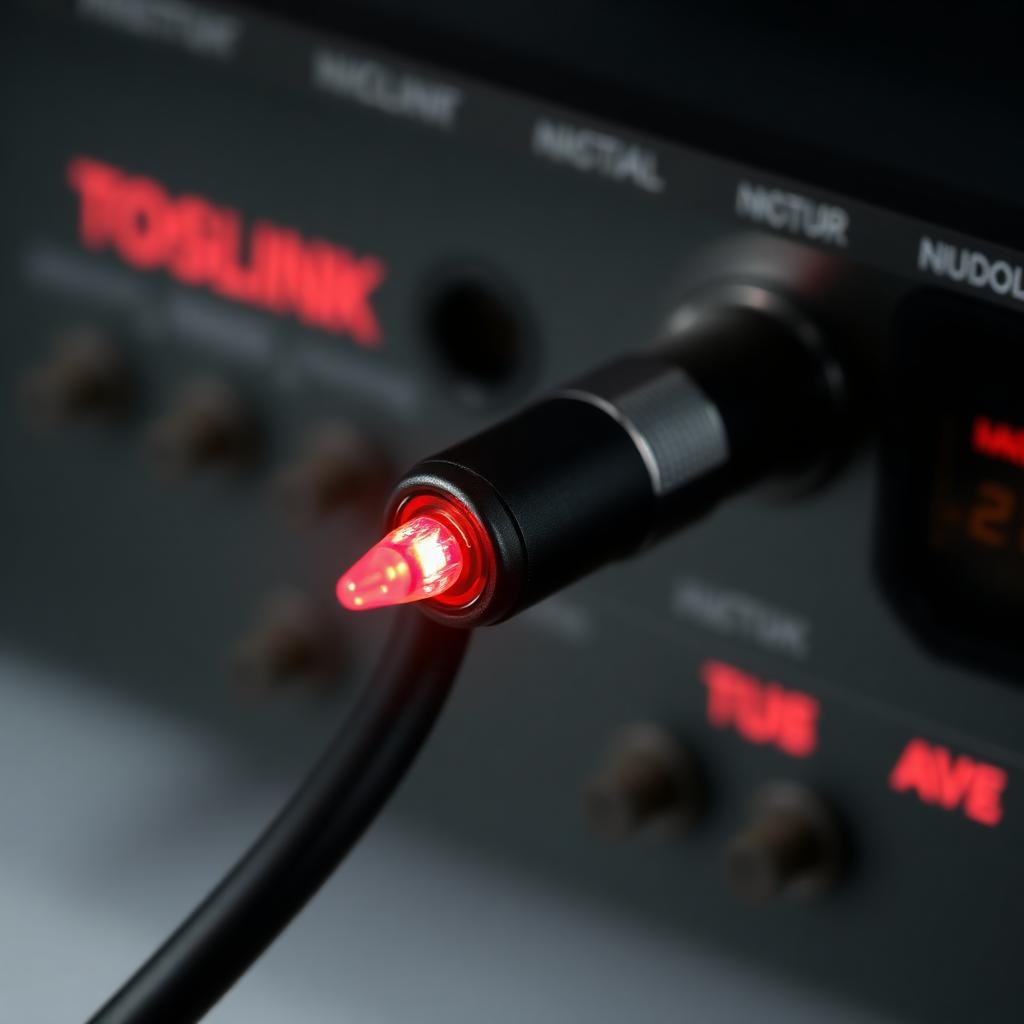
Toslink optical ports carry pulsed red light through polished plastic or glass. Any film left by chemical contact cleaner will scatter that light and break the link, so the usual electronic cleaner sprays are off limits.
The safe routine is short: power down the gear, blow out loose dust with compressed air held upright, then twist a 2.5 mm fiber optic cleaning swab lightly damp with 99 percent isopropyl alcohol inside the port. Wipe the cable tip with a dry microfiber cloth and reconnect.
What a Toslink port actually is
Toslink (officially EIAJ optical) is a one way digital audio link using a red 650 nm LED on the transmit side and a photodiode on the receive side. The cable is either pure glass fibre or, more often in consumer gear, a clear PMMA acrylic core wrapped in black jacketing.
Both ends of the cable are polished to a mirror finish. The port has a small spring loaded plastic door that closes when no cable is plugged in. When the cable goes in, the door swings open and the light path is complete.
+-------------------------------------------------------------+
|              TOSLINK SIGNAL CHAIN                           |
+-------------------------------------------------------------+
|  Source LED --> Cable core --> Receiver photodiode          |
|  Any dust or film in the path scatters the light            |
|  and the digital decoder loses the bitstream                |
+-------------------------------------------------------------+
Why standard contact cleaner is wrong
Electronic contact cleaner is formulated for metal pins. It dissolves oxide and evaporates, but most formulations leave a faint residue or plasticiser film. On a metal pin that residue is harmless. On a polished optical face it acts like a frosted window and scatters the beam in every direction. Even a 5 percent loss of signal can drop the bitstream below the receiver's lock threshold.
The right toolkit
| Tool | Purpose |
|---|---|
| Compressed air canister | Removes loose dust without contact |
| 2.5 mm fiber optic cleaning swab (e.g. Sticklers, Chemtronics) | Sized to fit Toslink ports |
| 99 percent isopropyl alcohol | Evaporates with zero residue |
| Lint free microfiber cloth | Polishes the cable end face |
Step by step
- Power down. Disconnect the source device from the wall. You do not want a live red beam aimed at your eye during cleaning.
- Unplug the cable. Pull straight out. Do not wiggle side to side; the optical face can chip.
- Air blast the port. Hold the compressed air can fully upright. Tilting it lets propellant out as liquid, which can frost the optic. Two or three short bursts from 2 cm away clears loose dust.
- Swab the inside. Lightly dampen a 2.5 mm fiber swab in 99 percent isopropyl alcohol. Insert it straight in, twist clockwise three times against the rear wall, withdraw. Use a fresh swab for each port.
- Clean the cable end. Wipe the polished tip with a clean microfiber cloth. If it looks hazy, dampen the cloth with a drop of isopropyl alcohol.
- Reconnect and power up. The receiver should lock within a few seconds.
When cleaning will not fix it
- Chipped cable tip. Replace the cable. A new Toslink cable is $7 to $15.
- Broken port door. The internal spring door snapped off and the port is letting dust in continuously. Replace the device or live with a permanent loose cover of clean tape over the unused port.
- Bitstream type mismatch. If you swapped the source from PCM to Dolby Digital and the receiver does not support that codec, the link is fine but the receiver mutes. Check the source audio output settings.
Preventing the next clog
- Always leave the dust plug in place on unused cables.
- Do not store Toslink cables in a drawer with loose carpet fibres or pet hair.
- If the device sits in a cabinet, vacuum the cabinet floor twice a year so dust does not migrate into the port.
Frequently asked questions
Can I use a Q-tip instead of a fiber swab?
Only in an emergency. A cotton swab leaves lint inside the port that becomes harder to clear than the original dust. Real fiber swabs are $5 for a pack of 10 and worth it.
Is it safe to look into a Toslink port?
The output is class 1, visible red, and very low power. It will not damage your eye in a brief look but a long stare is uncomfortable. Power down before cleaning anyway.
Will denatured alcohol work?
It will, but it contains methanol and other additives that may leave traces. Pure 99 percent isopropyl alcohol is cleaner and easy to find.
The takeaway
Toslink is optical, not electrical, so the rules are different. Compressed air to remove dust, a 2.5 mm fiber swab with 99 percent isopropyl alcohol to remove film, a microfiber wipe on the cable tip, and you are done. Skip the contact cleaner sprays designed for metal pins; they will only make the problem worse.