Quick Answer
Use your true inseam, not your jeans inseam, and compare it to the bike's standover height. A road bike should clear your crotch by about one inch when you straddle the top tube flat footed. A mountain bike should clear by about three inches. Where you sit between two sizes, your reach decides: longer arms relative to height push you up a size, shorter arms push you down.
As a rough starting point, a rider 5 feet 2 to 5 feet 6 fits a 50 to 52 cm road frame or a Small mountain frame. 5 feet 6 to 5 feet 10 fits 54 to 56 cm or Medium. 5 feet 10 to 6 feet 2 fits 56 to 58 cm or Large.
Why your jeans inseam is the wrong number
A clothing inseam is measured to the ankle. A bike fit inseam is measured to the pubic bone, because that is where the saddle actually contacts your body. The two numbers can differ by several centimeters, and using the clothing number is the single most common reason riders end up on a frame that is one size too tall.
Measuring your pubic bone inseam
- Stand barefoot with your back flat against a wall and feet about six inches apart.
- Place a hardcover book between your legs, spine up, and press firmly into your crotch as if you were settling onto a saddle.
- Have a partner measure straight down from the top of the spine to the floor in centimeters.
- Repeat twice and use the average.
This single number drives almost every other fit calculation, so it is worth getting right.
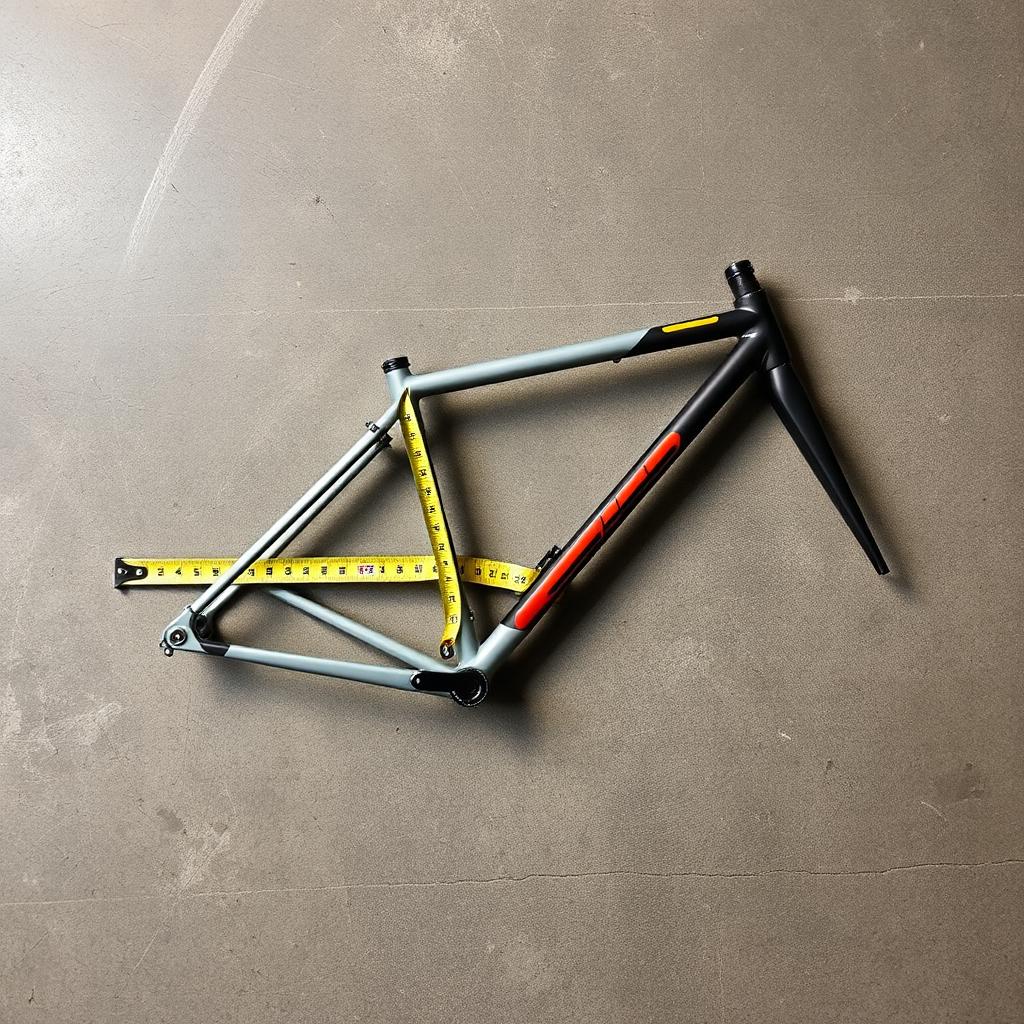
Standover height and clearance
Standover height is the vertical distance from the ground to the top of the top tube at the point where you would straddle it. When you stand over the bike flat footed:
- Road bike. Aim for about 2 to 3 cm (roughly one inch) of clearance.
- Hybrid or commuter. About 3 to 5 cm of clearance is comfortable.
- Mountain bike. 5 to 8 cm, about three inches. Trail terrain throws you off the saddle constantly, and you need room to land.
Modern sloping top tubes muddle this metric, which is why reach and stack have become the more reliable numbers for serious fit work.
Reach and stack: the modern way to compare frames
Reach is the horizontal distance from the bottom bracket to the top of the head tube. Stack is the vertical distance between the same two points. Together they describe the exact cockpit you would sit in, independent of seat tube angle or top tube slope. Two bikes labeled 56 cm can have wildly different reach numbers; one might feel cramped and one stretched out.
When you cross shop two frames, ignore the seat tube length and compare reach and stack instead. A reach difference of more than 10 mm is noticeable. A reach difference of more than 20 mm will change how the bike handles.
The ape index and the between sizes decision
If your height puts you on the seam between a 54 and a 56, calculate your ape index: arm span minus height, both in centimeters.
- Positive ape index (arms longer than height). Pick the larger frame. Your longer torso and arms need the extra reach to avoid bunching up over the bars.
- Negative ape index (arms shorter than height). Pick the smaller frame. A short torso on a long top tube forces you to round your lower back to reach the hoods.
- Near zero. Lean to the smaller size if you ride relaxed, the larger size if you ride aggressively or do long endurance days.
Mountain bike sizing gets simpler
Modern trail and enduro bikes have moved toward shorter seat tubes and longer reach, which is why brands often publish a single reach chart by rider height instead of S, M, L. If a manufacturer offers two sizes that both put you in the recommended reach range, choose the longer one for descending confidence or the shorter one for slow technical climbing and tight switchback country.
Kids and growth allowance
For a child, sizing is by wheel diameter, not frame number. A 6 to 8 year old usually fits a 20 inch wheel; 8 to 11 fits 24 inch; 11 and up moves to a 26 inch or adult Small. Resist the urge to buy two sizes up so they "grow into it." A bike that is too big to control safely is the fastest way to make a child quit cycling for good.
What test rides actually tell you
Once you have narrowed to one or two sizes, a 20 minute test ride is the final filter. Things to feel for: knees should track straight, not splay out or in, over the pedals. Your hands should rest on the hoods without your shoulders hunching. After 20 minutes, you should feel mild fatigue in your legs, not in your neck, wrists, or lower back. Pain in those three places is the bike telling you it is the wrong size or that the saddle and stem need adjustment.
When to spend on a professional fit
A self served fit gets you 90 percent of the way there for a casual rider. If you ride more than 100 km a week, race, or have a chronic knee or back issue, a one to two hour session with a fitter is worth the cost. They use motion capture or static angles to land your saddle height, fore aft, stem length, and cleat position in a single visit, and the changes usually feel obvious within the first ride.
The takeaway
Bike fit is geometry, not vibes. Measure your true inseam, confirm standover clearance, compare reach and stack across the two frames you are considering, and let the ape index break the tie. Get those four things right and you have a bike that disappears under you instead of fighting you, which is the whole point.